





Aintree
AINTREE FLYING SITES
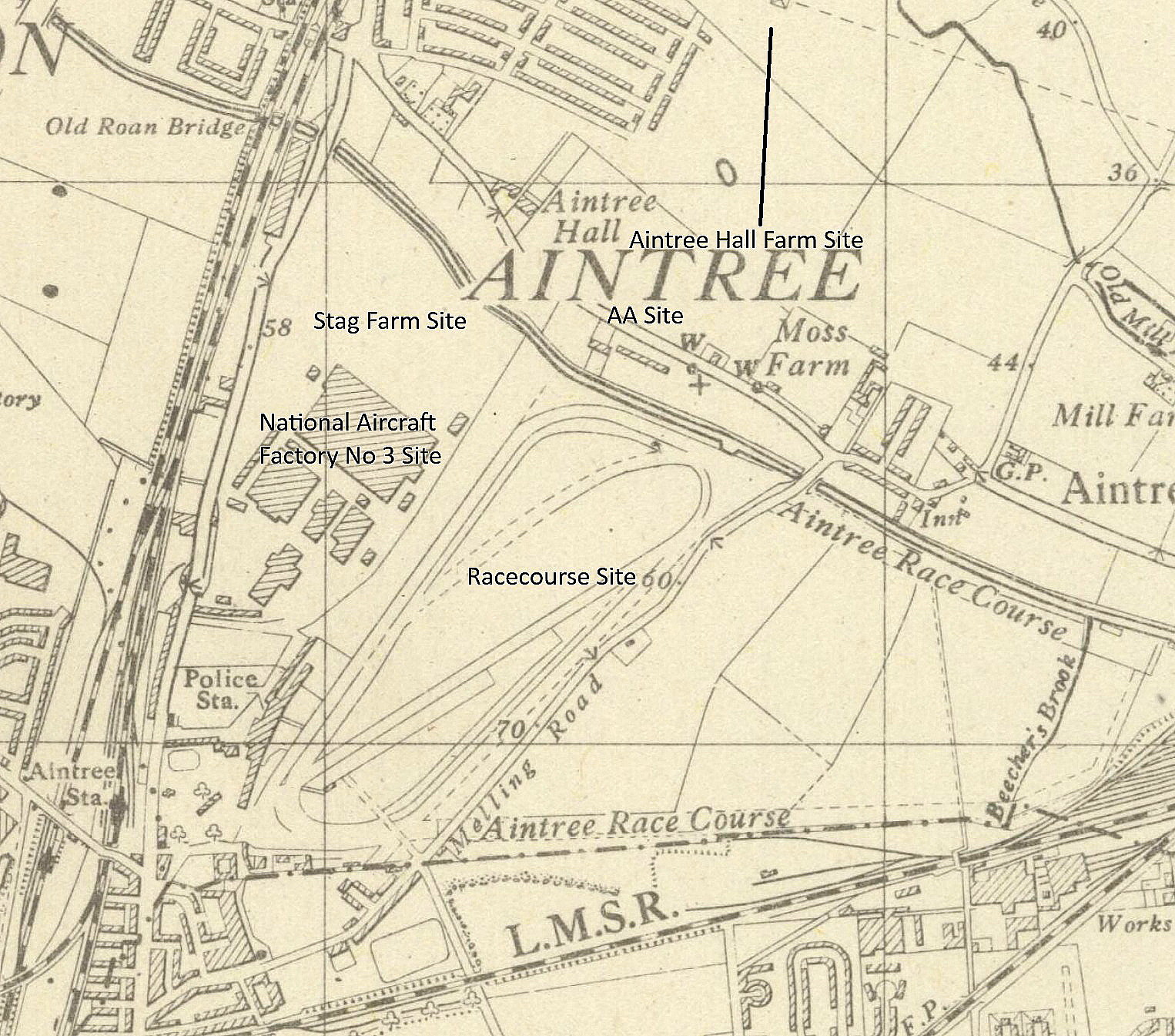
This 'Guide', even after a quarter of a century in the making by 2026, is still very much a work in progress - and being an impossible task - will always remain so. In March 2026 Mike Holder, a great long-term friend of this 'Guide', decided to take it upon himself to investigate what is available about AINTREE and has come to the conclusion that there are actually four closely related sites. Any advice kindly offered will be much appreciated.
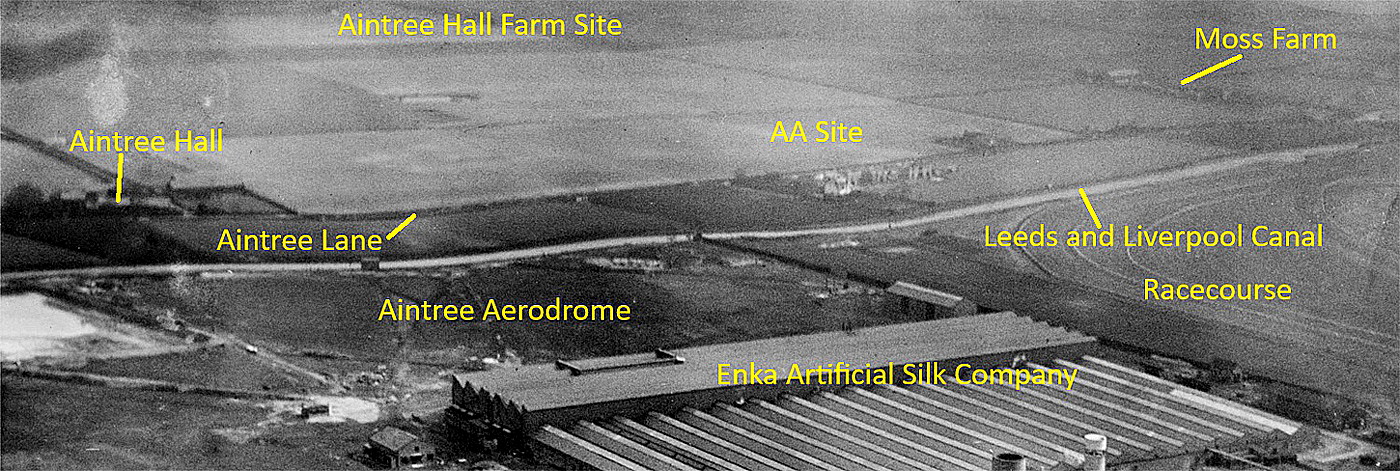
Number ONE: This being the actual racecourse central area. Probably only being used for fixed-wing operations prior to WW1 and during WW1 until the STAG FARM aerodrome became available.
Number TWO: STAG FARM which later became known as AINTREE AERODROME is just north of the No.3 National Aircraft Factory. This aerodrome/airport being closed in 1926. (See the Notice published in Flight magazine below)
Number THREE: A small private airfield E of Aintree Hall Farm and south of the River Alt.
Number FOUR: An airfield approved for use by the Automobile Association from 1933 and south of Aintree Hall Farm.
SOME ASSORTED ITEMS
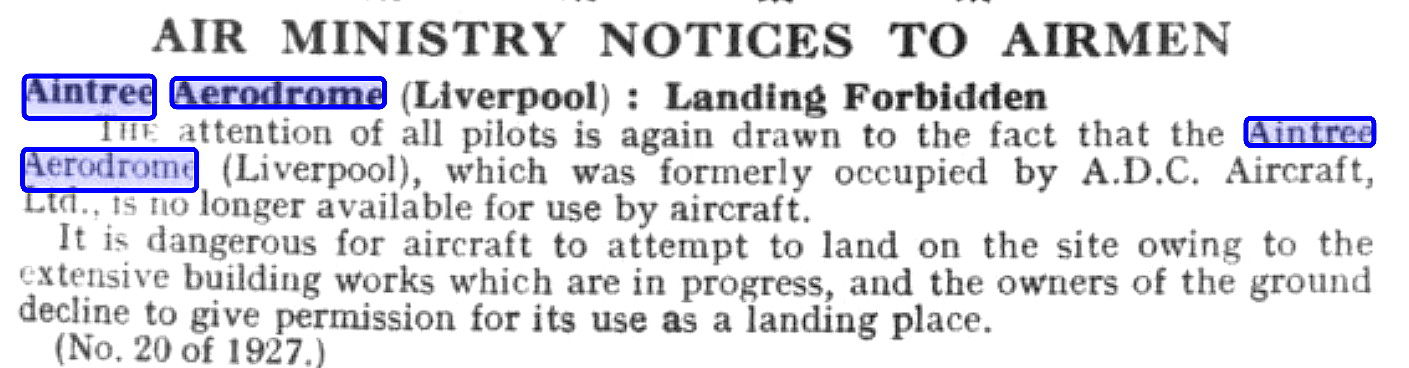
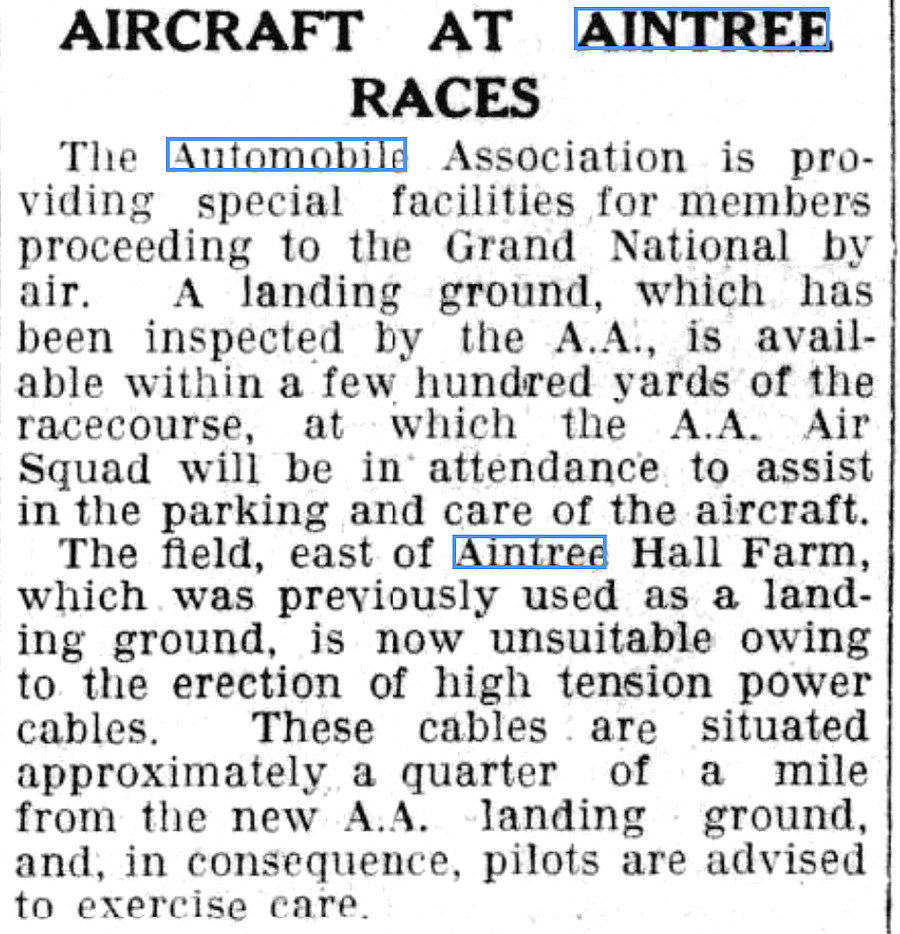

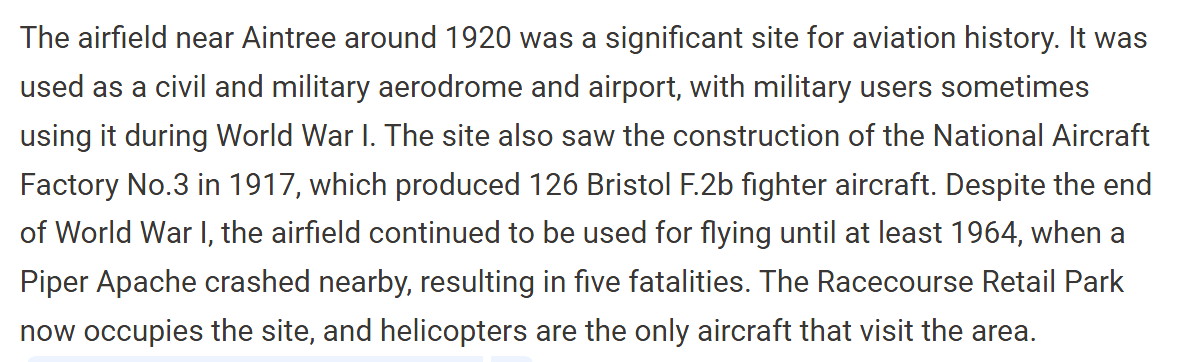
The Notice was published in Flight magazine on the 31st March 1927. The second item, the Article, was published in the Evening Despatch on the 20th March 1933, as was the 'Short article' in the Hull Daily Mail. Please note how misleading the 'History from Bing' is, making no reference to there being four distinct and seperate flying sites.
AN EXTRA NOTE
I will happily admit that this listing is jumbled up chronologically, reflecting in large part how I have added information over many years, without caring much about getting it all in order from the start. Then again, little did I know how complicated the eventual history of AINTREE would become! And of course, as you can see, some aspects are still open to question.
AINTREE AERODROME: Civil aerodrome/airport (Situated on the STAG FARM site)
British airline user: Northern Air Lines
Flying Club: Late 1920s to ? Liverpool and District Aero Club
Note: I now strongly suspect this Aero Club also used the STAG FARM location, later known as AINTREE AERODROME.
Period of operation: 1924 to 1926?
NOTES: From April to June in 1924 it is reported that Northern Air Lines operated a regular service to MALONE near Belfast, calling in at SOUTHPORT SANDS and BARROW which were both in LANCASHIRE in those days. They then flew to MARYPORT in CUMBERLAND and on to PORTPATRICK (DUMFRIESSHIRE) before crossing the Irish Sea to MALONE.
As per usual conflicting reports are made. One report stated that Northern Air Lines used this location in 1923 using DH.50s and another stating that operations ceased in early 1925. As far as I can ascertain, it would appear that the service to MALONE only operated from April to June 1924?
THREE ITEMS FROM THE LIVERPOOL EVENING EXPRESS IN 1924
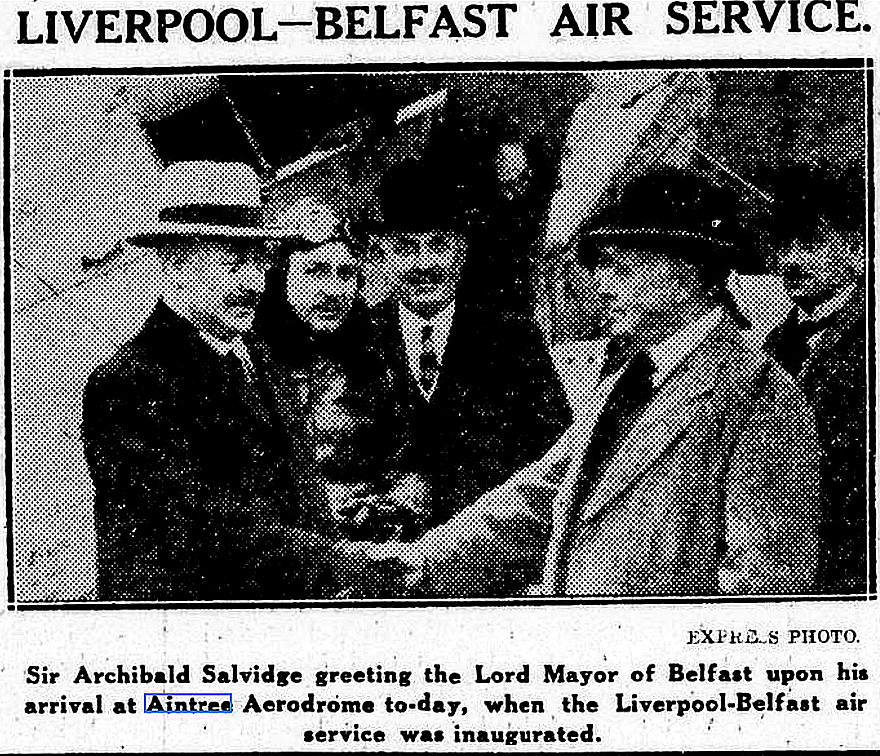
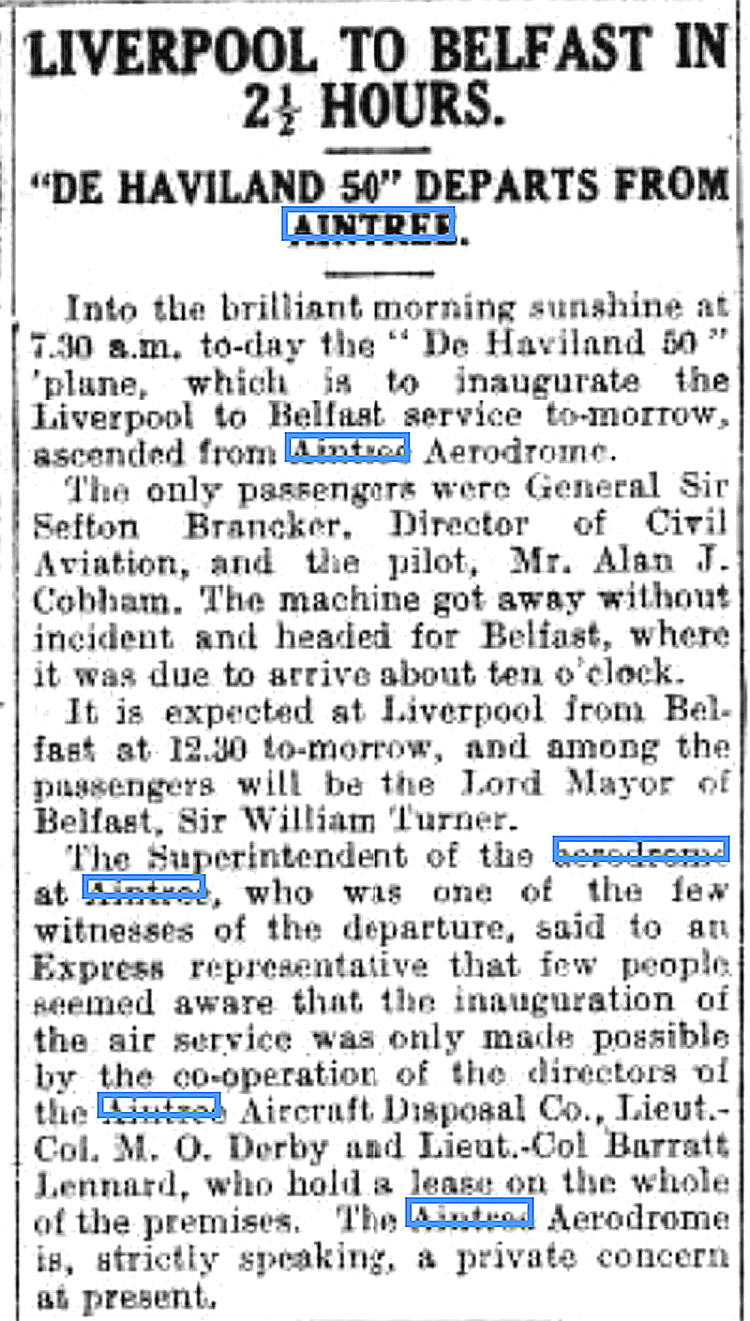
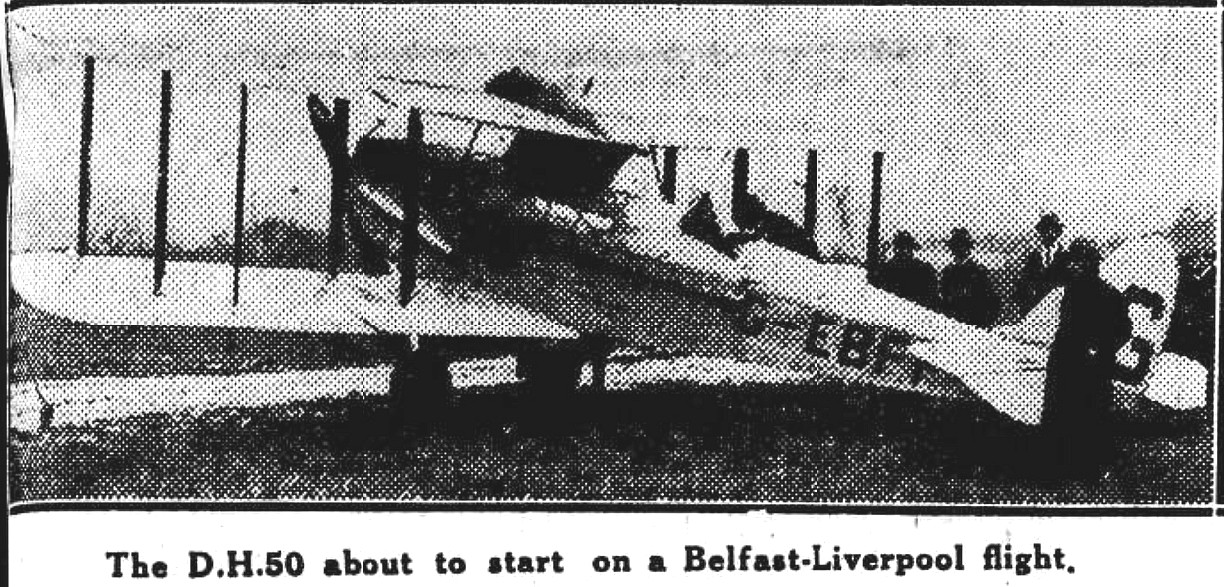
The article was published on the 29th April and Photo One was published a day later on the 30th April. Note the name of the pilot!
I think it is G-EBFP in Photo Two, simply because the DH.50 G-EBFN was registered to Northern Airlines from 24.04.25 until 23.02.26. (Not that official records can be relied upon of course). This photo being published, for some odd reason, much later on the 12th June.
AINTREE: Private airstrip/airfield
Operated by: Mr H B Elwell?
Location: ? Almost certainly located east of Aintree Hall Farm
Period of operation: 1925 to between 1930 and 1932
NOTES: Somewhere along the line, in the early days of the research for this 'Guide', I made this note. Can anybody throw any light on this? Well, perhaps we can? It appears that this airfield was used by private aircraft visiting the races until high tension cables on pylons were installed nearby. But when?
PRE-WW1 ACTIVITY
Apparently used by Samuel F Cody on the 15th November 1909. (See NOTES below)
Henry G Melly and A Dukinfield-Jones 1911
Note: On the 7th July 1911 Mr Melly and Mr Dukinfield-Jones took off in a Bleriot XI and successfully flew to Trafford Park golf course. Mr A V Roe made sure the landing area was well marked! This was it appears the very first flight between Liverpool and Manchester.
See below for an account of Mr Melly making another rather hasty visit in 1912.
A MICHAEL T HOLDER GALLERY
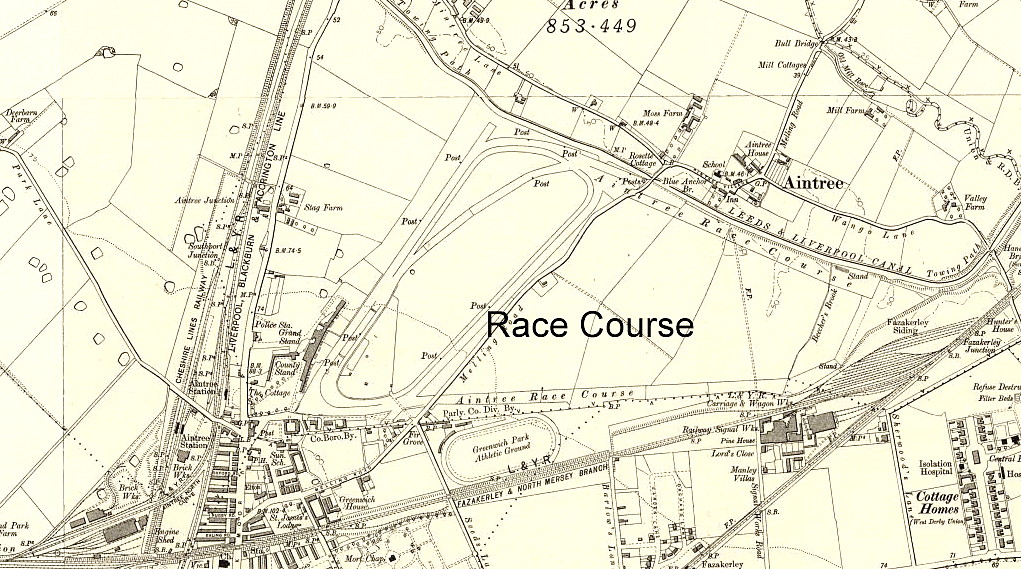
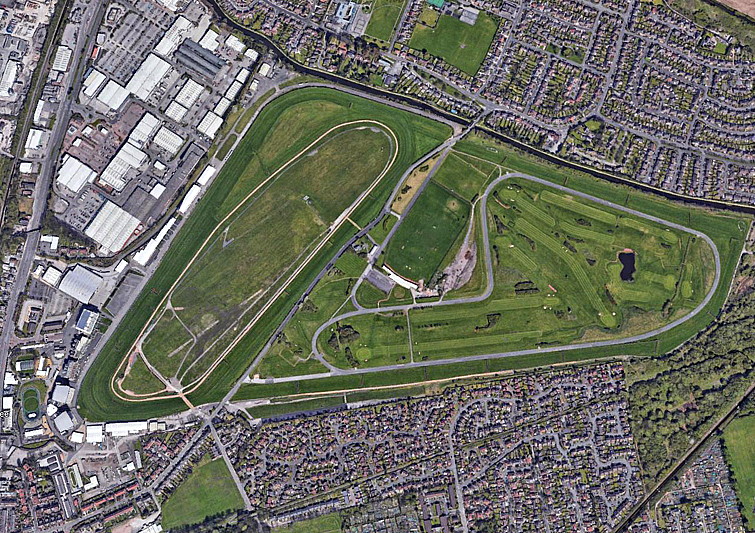
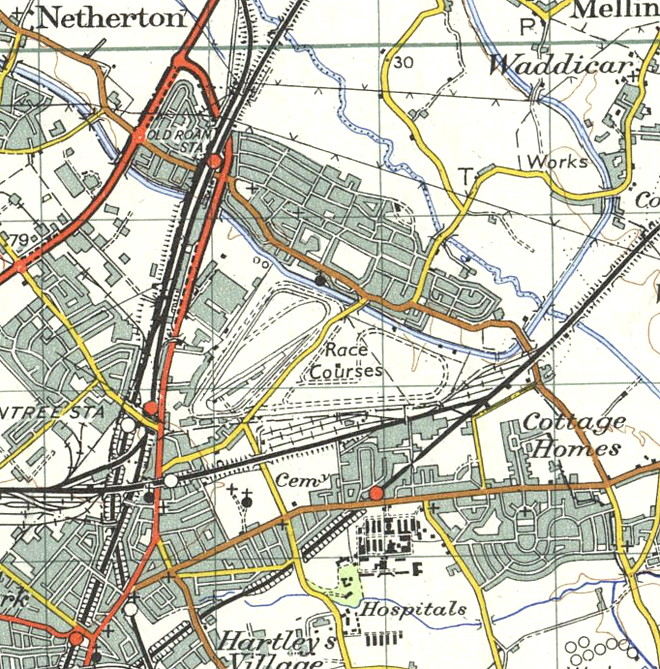
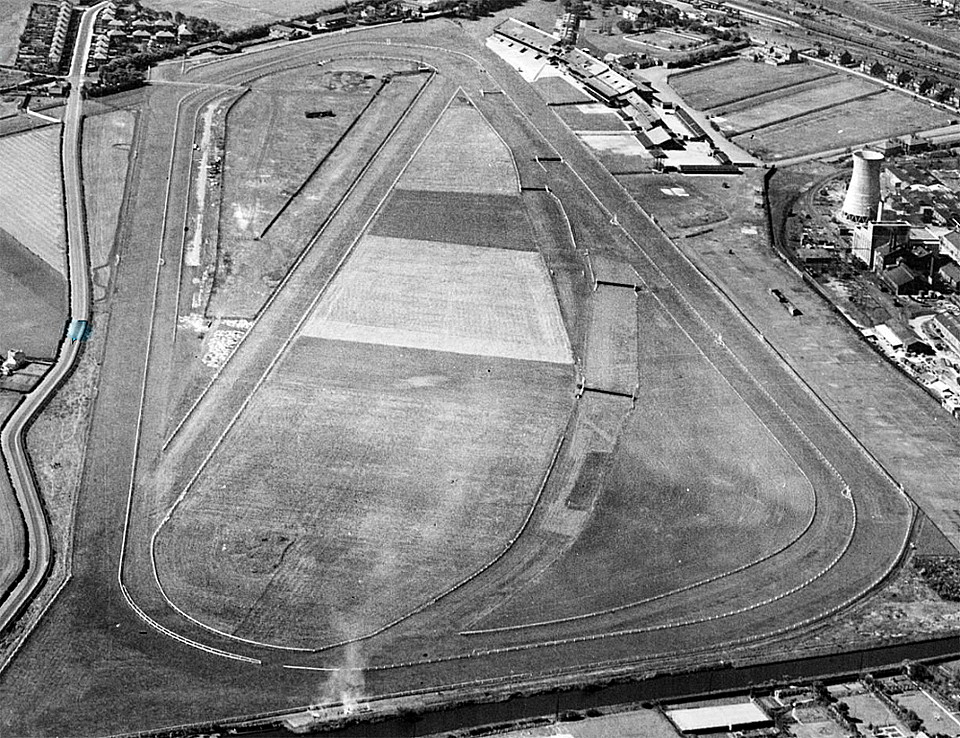
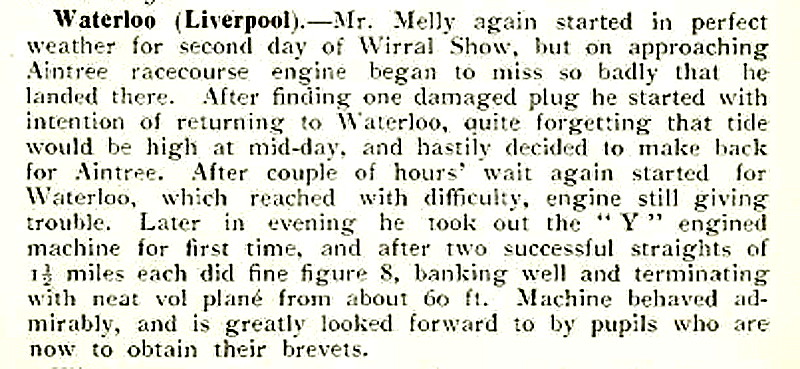
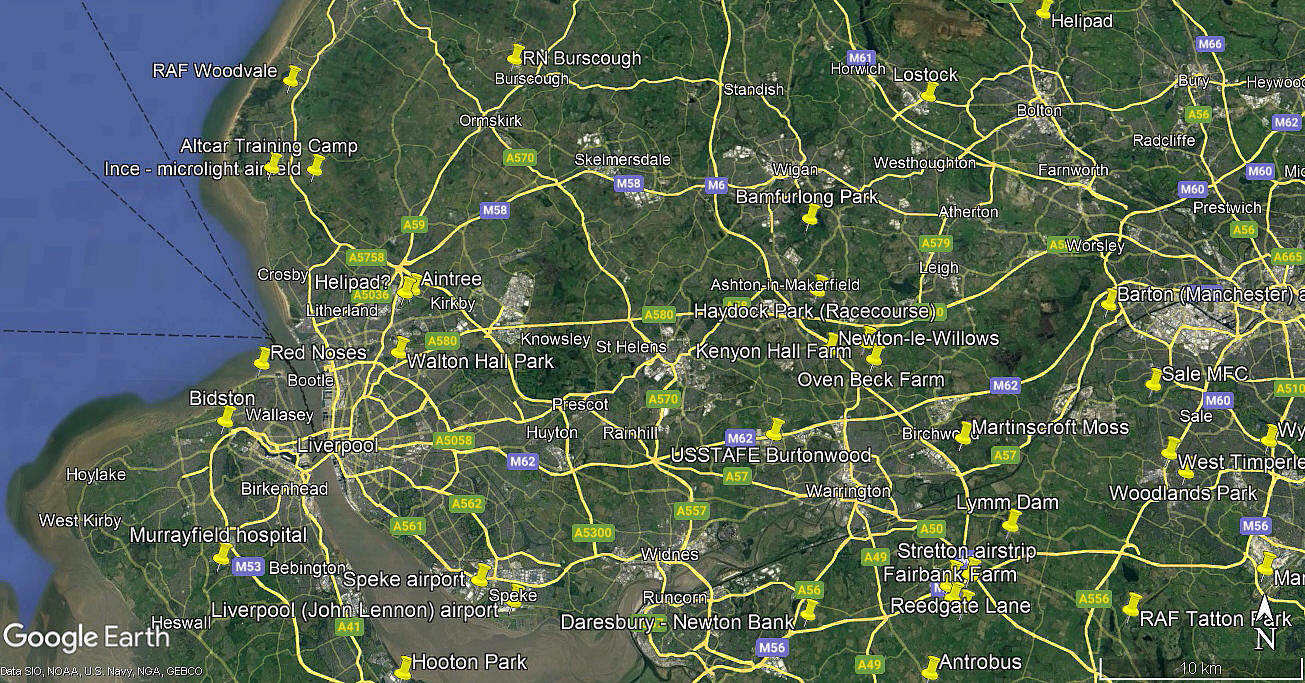
Note: The short article was published in The Aeroplane on the 19th September 1912. The area view is from my Google Earth © derived database.
WORLD WAR 1
Military users: It seems the military sometimes used AINTREE during WW1 especially during the earlier years on a casual basis presumably as a visiting point for various training exercises. It does seem it was also an “Examination Ground” for the RFC in 1916 for example. In 1917 the National Aircraft Factory No.3 was built ‘next door’ on Stag Farm and a properly prepared aerodrome was laid out on the racecourse. Or was it? Subsequent information reveals that this was not the case, and that an aerodrome was laid out just north of the factory, later to be known as AINTREE AERODROME.
The factory produced the Bristol F2B Fighter type and perhaps rather bizarrely was operated by the Cunard Steamship Company according to one source..
I have found records that in 1919 the site became the No.4 Aircraft Salvage Depot operated by the Aircraft Disposal Company. Here again the history gets complicated. Perhaps the No.4 Aircraft Salvage Depot was not operated by the Aircraft Disposal Company? That company was formed by Frederick Handley Page, (later to become Sir Frederick of course), in March 1920 with its main facility being at what later became part of CROYDON airport south of London.
But, I have also noticed that this company is often described, (see the CROYDON listing), as the ADC (Aircraft) company. So, possibly Handley Page used this alternative name having acquired the existing Aircraft Disposal Company? Here once again, advice much welcomed.
EXTRAGAVENT WASTE
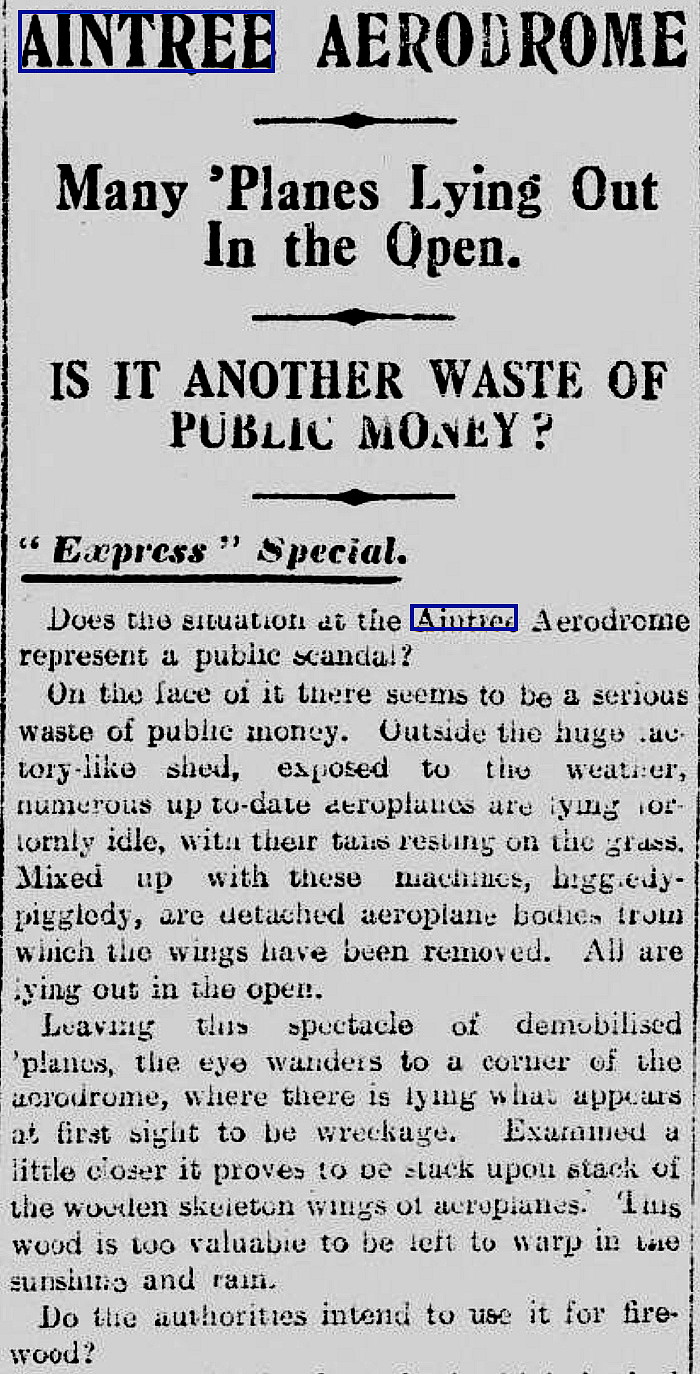
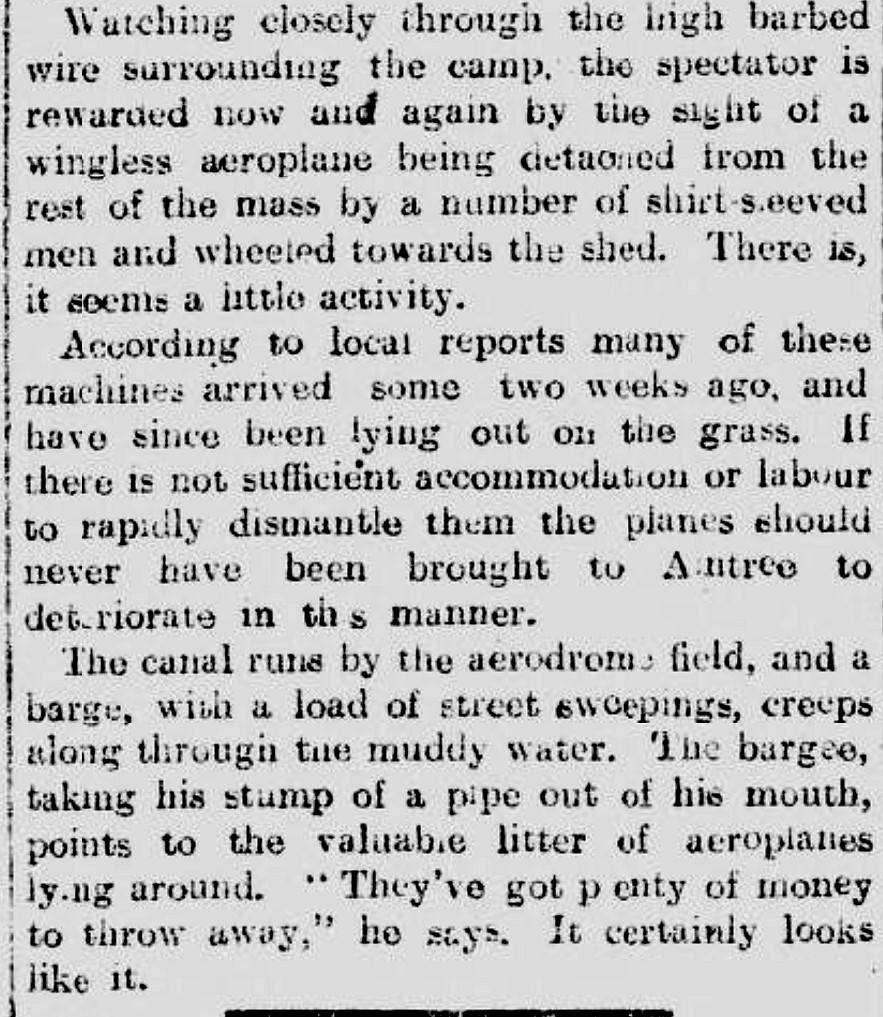
This article in two parts, was published in the Liverpool Evening Express on the 21st May 1919 and serves to illustrate one of my favourite historical themes - namely the sheer amount of waste wars created - and still do of course.
I like to think that I am a well balanced person, having a chip on both shoulders, and have learnt over the years that major wars starting are great
news for major industrialists and financial institutions. Especally so following an economic depression. They have no concern at all about the wholesale loss of life involved - that's up to the miltary to arrange. And, I do not think I'm being too cynical in thinking that the fabulous profit margins resulting are what is really of interest?
POST WW1
NOTE: I shall leave this in place simply to illustate how, now over a quarter of a century in the making in 2026, this 'Guide' has progressed. In part asking as many questions as trying to provide answers. For example. where exactly did the Cobham 1933, 1934 and 1935 Tours actually take place at AINTREE?
FLYING CIRCUS VENUES - A CORRECTION
Sir Alan Cobham’s 1933 No.1 Tour of the UK, Cobham’s 1934 No.2 Tour and Cobham’s 1935 No.1 Tour
A most respected source of information regarding the Sir Alan Cobham National Aviation Day Tours says the venue on the 23rd July 1933 was simply Aintree Racecourse and for the 1934 Tour on the 22nd July it was the same. And indeed, for the 1935 No.1 Tour the venue on the 11th September was also the Racecourse. This is entirely incorrect in all three cases, the venue being WOOD END FARM, Maghull. (See seperate listing).
NOW BACK, SORRY ABOUT THIS, TO 1909
NOTES: It appears that while Cody was making his preparations for the first ‘prize winning’ flight from Liverpool to Manchester in November 1909 a Reverend Sidney Swann arrived with a un-flown monoplane design. This only achieved a few short hops before ground looping and in fact Cody didn’t do so much better either when his first attempt on the 15th December reaching Maghull about three miles away, (but flying in the wrong direction surely?). His second attempt on the 29th landed at Valencia Farm, near Portico church in the vicinity of Prescot covering roughly six miles this time!
It must be remembered that these early aviators generally didn't have any idea as to how to navigate in even the most basic of terms. Plus, trying to use a map in a totally open aeroplane, (without a cockpit), wasn't an option - and having items like knee-pads had yet to be invented. You might think they'd have devised some means of making notes, but apparently not. Plus it appears they mostly didn't bother to study a map before taking-off. When the first London to Manchester race took place, sponsored by the Daily Mail, the railway companies very kindly painted the rail sleepers white along the route to be followed.
IN MORE RECENT YEARS
Generally speaking it appears that a helicopter landing area, especially for the Grand National, is situated in the SE corner of the course. This was/is operated by Rotorywing Ltd.
A VERY NICE ADDITION
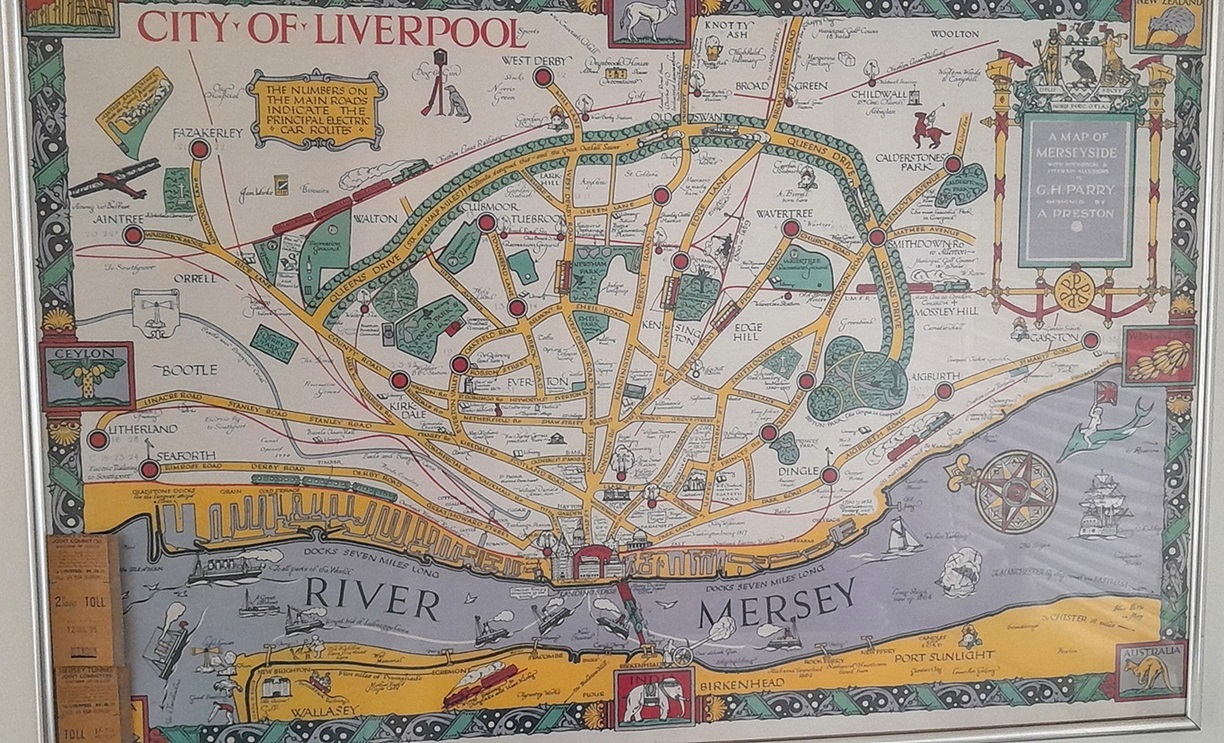
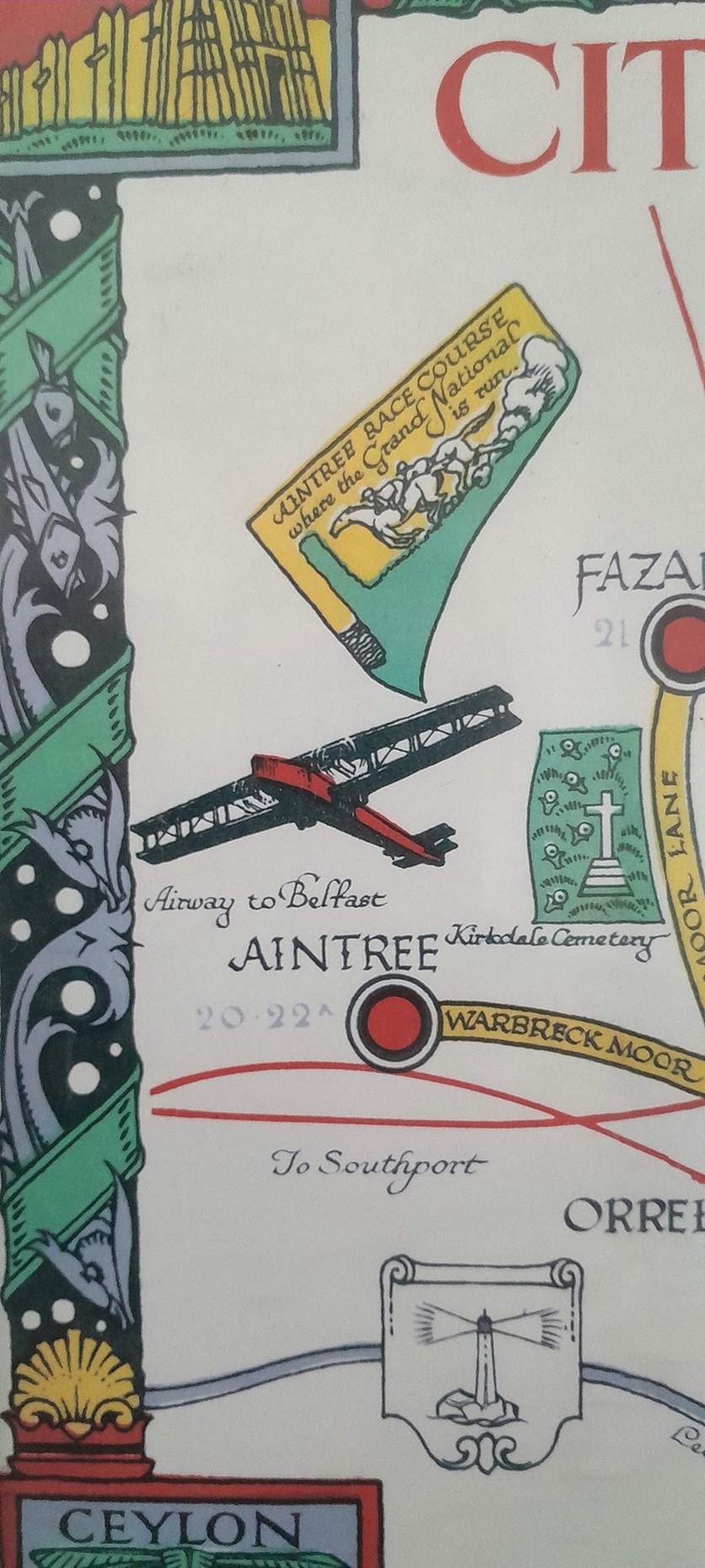
In April 2024 Mr Keith Jones very kindly sent me these two pictures of a pictorial map he has dated 1924.
Graham Allen
This comment was written on: 2020-12-09 12:28:46I have found some B/W negatives which show aircraft at Aintree in 1927/8 are you interested?
Dick Flute
This comment was written on: 2020-12-09 18:40:16Hi Graham, Yes indeed. As jpg's please, up to 500kb. Have never done so, but there must be a way to convert them into positive images. Best regards, Dick
We'd love to hear from you, so please scroll down to leave a comment!
Leave a comment ...
Copyright (c) UK Airfield Guide