





Blackacre Farm
Note: This map shows the location of Blackacre Road in Theydon Bois, which I assume gives a clue regarding the position of BLACKACRE FARM? If anybody can kindly offer advice, this will be much appreciated.
BLACKACRE FARM: Gliding site
Operated by: Essex Aero Club
Location: In/near Theydon Bois
Period of operation: 1933 to ?
NOTES: Here, once again, I have Alan Simpson to thank for adding most of the detail. During the early 1930s there were at least two gliding clubs operating in S W Essex - the South Essex Aero Club and the Essex Gliding Club - and they moved around the southern part of the County quite a bit, looking for more favourable sites to operate from.
In July 1931 the two clubs merged to become the Essex Aero Club, then operating from HAVERING PARK FARM, near Havering-Atte-Bower. According to Alan Simpson, by 1933 the Club, " ...had moved once more, this time to Blackacre Farm, Theydon Bois, on land rented from farmer Harry Smith. The club had about 20 active members at this time, although total membership was somewhat larger.'
Please see my listing for HAVERING PARK FARM regarding more information on this era of gliding in this region.
SOME MORE INFORMATION
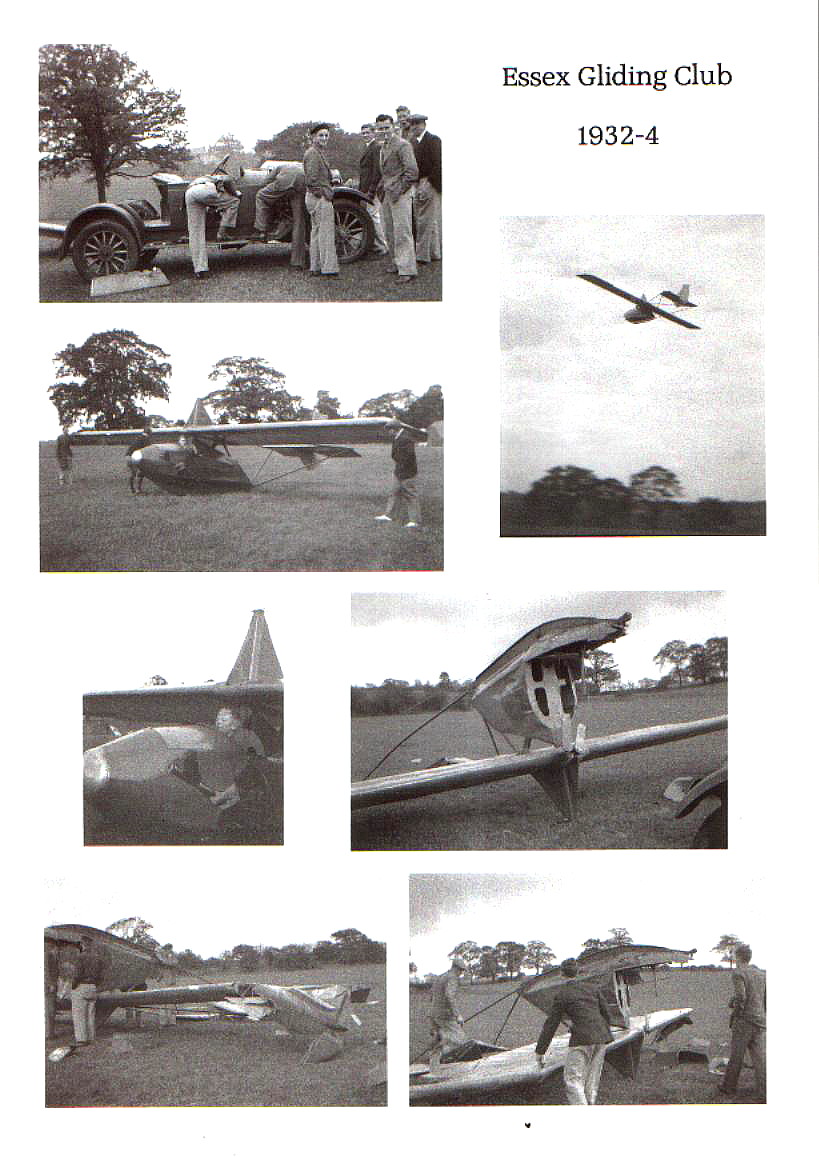
Alan Simpson also tells us: "At Theydon Bois, the club's gliders were kept on site in a shed. One of the gliders was fitted with a nacelle; this was a streamilined plywood fairing fitted around the front half of the fuselage and according to Charles Ellis, a member from 1932 to 1934, it increased performance considerably." I'm sure it did, and one wonders why such fairings weren't commonplace? The answer though may well be in what follows.
"Accidental damage to the gliders was frequent and it was not unusual for members to arrive on site only to find that neither glider was flyable. One former member, Eric Starling, recalled 'The gliders were very primitive affairs which we all used to break - and repair- periodically'."
These gliders would have been very draggy and I suspect that they often stalled, and although flying at low level, a stall could easily result in a heavy landing, with damage almost inevitable. The fitting of a nacelle would have helped considerably in maintaining airspeed and therefore control; but I suppose this might have enticed members to fly a bit higher, and therefore, if a stall occurred the resulting damage would have been even more serious. As far as I am aware, none of the early glider designs were fitted with any form of airspeed indicator - probably because they flew too slowly for one to start working effectively.
"Instruction was very rudimentary as the instructors were self-taught and they used the solo method of teaching, starting with ground slides and then low and high hops before a pupil was considered competent enough to try a full-power bungee launch down the slope. Eric Starling recalled: 'Flight was achieved by catapult take-offs using two enormous lengths of rubber material with four people at either end with a ninth member of the team holding the tail of the flimsy craft'."
"Charles Ellis remembered being taught by this method too; Charles earned his 'A' certificate No 339 at Theydon Bois on 7 August 1933. He moved to the London Gliding Club at Dunstable in 1935 and there gained his 'B' and 'C' certificates. An alternative method of training was by car-towing using a 1925 Studebaker. Here the ends of the bungee normally pulled by the launch team were tied to the back of the car and a length of rope was attached between the other end of the bungee and the nose of the glider. The instructor sat in the car facing the glider as it was pulled across the field, shouting instructions to the trainee pilot."
"As far as is known, no soaring was done at these early sites - all flights were straight downhill glides. A few photographs of these early days at Theydon Bois have survived and provide a fascinating glimpse of those early days of what became the Essex Aero Club."
To the best of my knowledge, ".....the solo method of teaching" was, in the type of gliders normally used for very basic training at low level in those days, simply used because two-seater examples were not available, and indeed, these rudimentary designs were quite incapable of lifting two people. As far as I am aware, in the UK at least, the first two-seat glider was the Slingsby T.21, and that first flew in 1944.
We'd love to hear from you, so please scroll down to leave a comment!
Leave a comment ...
Copyright (c) UK Airfield Guide