





Gaydon
GAYDON: Military aerodrome


Notes: Pictures by the author. Picture One is the entrance to the Heritage Motor Centre conference centre and Picture Two is of the entire building, both taken in August 2015. Viewed on Google Earth a great deal of evidence remains regarding the airfield but I couldn't find, on a brief visit, any view points to take photographs from.
Military users: WW2: RAF Bomber Command 91 Group
Activities: First a satellite base for Chipping Warden for operational training.
In 1945 became a Glider Training School.
Upgraded in 1953 and in 1954 Gaydon became the first and only ‘V’ Bomber OCU (No 232) training base. Vickers Valiant and Handley Page Victor crews were certainly trained here. Presumably Avro Vulcan crews too?
An OCU is an Operational Conversion Unit.
Later became a navigation training base
Location: W of A41, NW of Gaydon village, 7nm SE of Warwick, 7nm SSE of Leamington Spa
Period of operation: 1942 to 1974
Runways: WW2: 17/35 1280x46 hard 06/24 1463x46 hard
13/31 1280x46 hard
1954: 05/23 2650x60 hard


Note: These four items were kindly provided by Mr Michael T Holder
NOTES: This aerodrome started from humble beginnings as a training satellite station for CHIPPING WARDEN and later WELLESBOURNE MOUNTFORD with Vickers Wellingtons.
THE 'V' BOMBERS ARRIVE
From 1945 to 1946 No.3 Glider Training School used Miles Master tugs and General Aircraft Hotspur gliders. In 1946 the aerodrome was placed on a care and maintenance basis until 1953 when it was upgraded to become the first V-bomber OCU (No.232) in March 1954 flying the Vickers Valiant B.Mk.1. Depending on which source you care to believe there is some disagreement about the sequence of events in those days. One source maintains that the first Valiants were from 138 Squadron who undertook operational training here from the 1st January until the 18th November 1955. No 232 OCU was then formed for the first Handley Page Victors and some English Electric Canberra T.4s which arrived late in 1957. GAYDON remained a ‘V-Force’ OCU until June 1965.
Today it would appear that without doubt 232 OCU started with the Valiant and then moved on to the Victor - both the B1 and B2 versions. The Victor B2 being, in many respects a very different aeroplane compared to the B1.
During most of this time it appears that No.637 Gliding School, mostly providing gliding experience to Air Cadets, was also based here. Presumably operating at the weekends when the RAF National Defence machine knocks off at around 16.00hrs on Fridays. It is well worth looking at web-sites with photographs of lines of ‘V-bombers’ based here.
A STORY FROM A 'V' BOMBER PILOT
In 2018 I was very kindly contacted by Ian Strachan, who had this to tell.
"Flt Lt Taffy Foreman was flying a training sortie out of the OCU at Gaydon when there was a loud bang, but no other evidence as to what it was. They returned to Gaydon and on lowering flap, found that it would not come down on one side, so carried out a flapless landing. The reason was that on one wing, the rear spar had suffered a fatigue failure which caused the bang, and the flap roller on that side had leapt out of its guide and the flap was stuck. After investigation, the damage was attributed to metal fatigue. The rest of the Valiant fleet were inspected and other instances of fatigue damage were found that urgently needed repair. The aircraft were divided into three categories, Cat A aircraft continuing to fly, Cat B to fly to a repair base, Cat C requiring repair before flying again. The tanker squadrons had the highest proportion of Cat A aircraft because their role had been mainly at high level. Tanker flying on 214 squadron was hardly affected, my crew flying again 5 days after the Gaydon incident and in September we went to Gan again to refuel some Javelins. Because many other Valiants were grounded, pilots from other Squadrons came to fly with us, and Taffy Foreman flew with my crew on 28 October on a sortie in which we refuelled Lightnings. As there were bomber squadrons at Marham with some Cat C aircraft, our hangars were full of engineers from
Vickers who had been sent to carry out the repair, aided by our own ground crew."
"Then on 9 December when I was on a routine sortie refuelling Lightnings over the north sea, we had a radio message to return to base. I replied that we would, but only after we had finished refuelling the Lightnings. However, they insisted that we return straight away, as if it was some sort of emergency. Reluctantly, I had to apologise to the Lightning pilots and we went back to Marham, to be told after landing that the whole Valiant fleet had just been grounded. This was not because there had been another fatigue incident, but was a decision of the new Labour government to stop the repair work and take all Valiants out of service. The object was to save money, but it also significantly reduced our nuclear deterrant. It also stopped all RAF air-to-air refuelling, because the Valiant was our only large tanker aircraft. I believe that my flight in XD812 on 9 December 1964 was the last in a Valiant."
"Very sad, it was a great aircraft in its time, our first V-bomber which with a "clean" wing without underwing tanks, could climb straight to 50,000 feet after takeoff."
"Later I became a QFI and then a Test Pilot, commanding a test squadron at Boscombe Down and the Test Wing at Farnborough."
It is such a privilege, when compiling a simple 'Guide', to find people kind enough to provide stories such as this. Which, historically, are of considerable importance. And indeed, providing proof that the Labour government under Harold Wilson were certainly giving quite a big advantage to the Soviet Union at this stage in the 'Cold War'.
A PICTURE
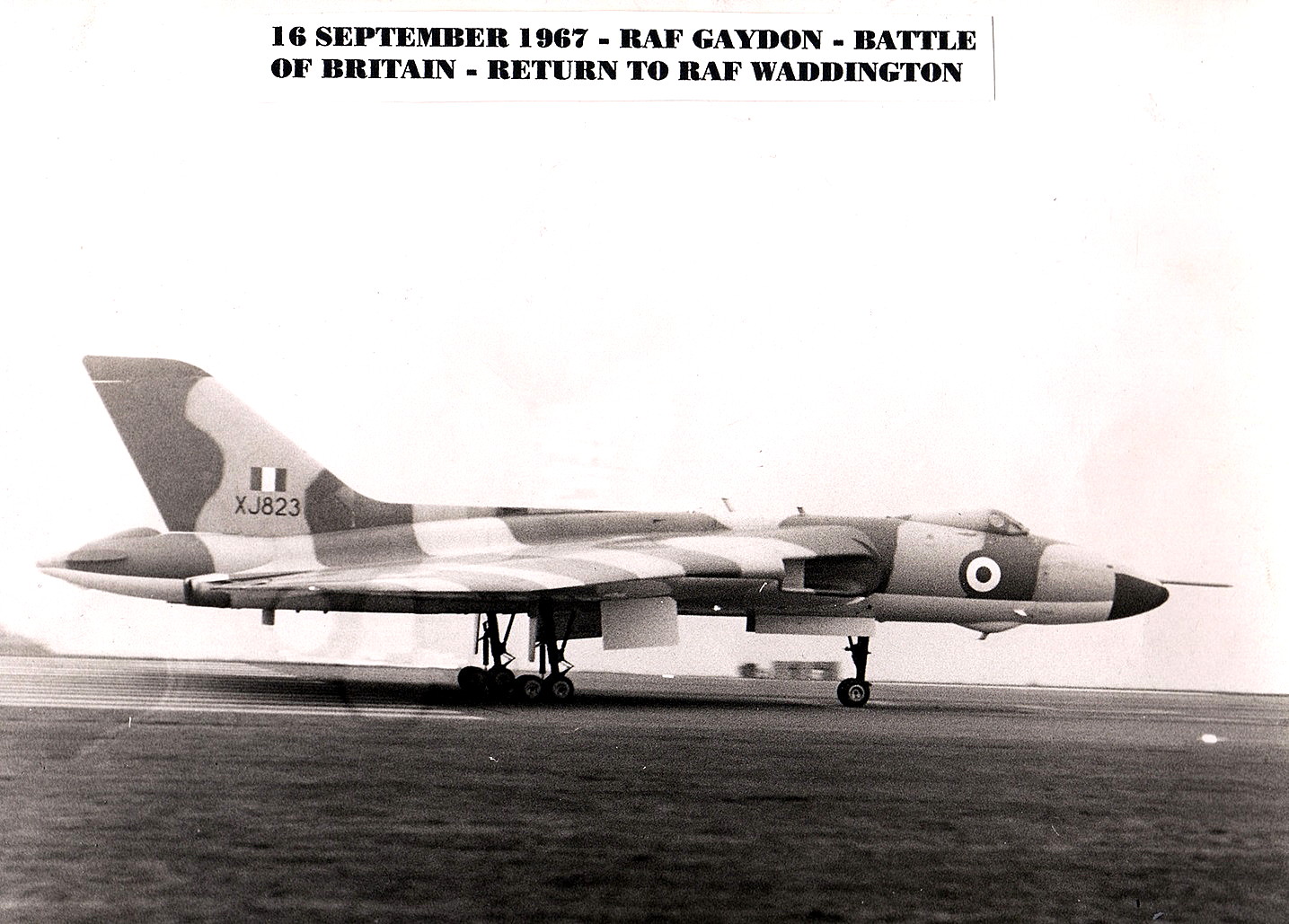
This picture was kindly sent by Mike Holder, a great friend of this 'Guide'. The Vulcan Mk.2 XJ823 of 44 Sqdn had been flown across from WADDINGTON to be a static display during the Battle of Britain Day air show on the 16th September 1967. Mike was the navigator and flew six times in XJ823.This example is, and has been, on display at the Solway Aviation Museum at CARLISLE (LAKE DISTRICT) airport.
FROM 'V' BOMBERS TO VARSITYS AND VALETTAS
In September 1965 No.2 Air Navigation School arrived equipped with Vickers Valetta and Varsity aircraft and stayed till April 1970. From the late 1950s to the early 1970s GAYDON played host to the famous ‘Battle of Britain’ air shows organised by the RAFA. No record of any significant ‘heavy duty’ flying activity can be found between April 1970 and the closure of this aerodrome in October 1974. British Leyland, (later Rover Group) have used this site as a car test track facility and open storage area since 1978. It is now mostly known as being home to the British Motor Heritage Collection.
Terry Clark
This comment was written on: 2018-02-02 23:59:29637 VGS formed at Gaydon in about 1967; I know because staff cadets at 613 VGS Halton (of which I was one) were asked to volunteer to help start the school. I was told by one of the staff that their gliders were housed in a hangar off the airfield and they had to be towed across the B4100 every day. They operated mainly at weekends. On Gaydon's closure, 637 moved to Little Rissington along with most of the staff.
Mark Lewis
This comment was written on: 2018-03-05 12:20:45I would Gaydon is now best known as a design and test centre for Jaguar Land Rover. It also has an Aston Martin facility. Avro Vulcan crews were not trained here.
Tony Dring
This comment was written on: 2019-04-08 01:17:39637 Gliding School was a two line Gliding School (2 winches, 2 T21 Gliders, 3 Kirby Cadet Mk 3 Gliders. As well as providing Air Experience Gliding for Midlands Air Cadet Squadrons , Profiviency Training (up to solo standard) was provided to Air Cadets and CCF Cadets. As No 2 Air Navigation School was still operational gliding could only take place at weekends. Opened in 1967 the Gliding School moved to Little Rissington in about1968.
ANDREW SAYERS
This comment was written on: 2019-09-16 23:57:10I went solo with 637 VGS on 27 July 1971 from RAF Gaydon. I sometimes flew with Tony Dring and remember pulling gliders across the road from the 'black hangar'. I hope to achieve 50 years as a pilot in 2021 .
Tony Wood
This comment was written on: 2020-09-07 00:02:01Used to be an instructor there, joined when it first opened. Had many a midnight flight to Berick on Tweed in the Varsities as the navigators practised astral navigation. Pulling the gliders across the main road was fun, today health and safety would have had a heart attack
Alistair Allcroft ex RAF Halt
This comment was written on: 2021-01-19 21:55:33I was on the 'seeing in Crew' who collected Valiant WP217 off the runway at Gaydon on 10th August 1964 (I think) after Flt Lt Foreman had brought it back from North Wales with a fractured starboard rear spar. The wing damage was so bad that all rivets on the wing to fuselage join had been torn out as had the major countersunk bolts holding the lower engine access panel along the fuselage. This was the aircraft that began the process of engineering inspection which ultimately led to the scrapping of the whole Valiant fleet. The act of towing 217 off the runway and back onto it's dispersal pan was carried out by us.... VERY carefully!
We'd love to hear from you, so please scroll down to leave a comment!
Leave a comment ...
Copyright (c) UK Airfield Guide