







Pulham
PULHAM: Airship base, later RAF Experimental Airship Establishment
(Also known in WW1 as PULHAM St MARY)
A MICHAEL T HOLDER GALLERY


Note: Second picture. The R24 is moored at the mast, and the R34 is flying above. (From Aeroplane magazine). The R34 at the shed picture is from Flight magazine.
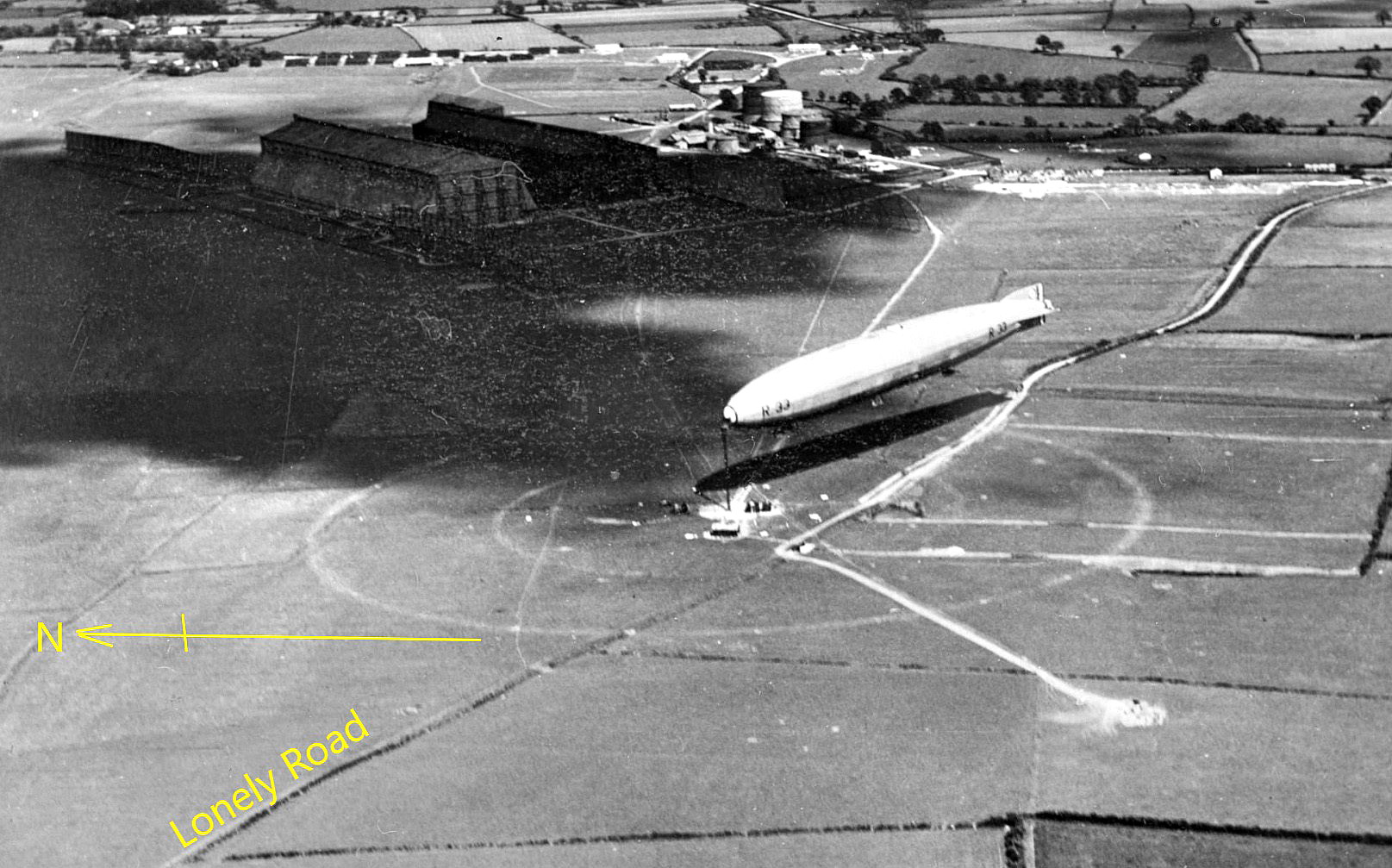


Note: The seventh wider angle picture is from Flight magazine.
A QUITE EXTRAORDINARY EXPERIMENT

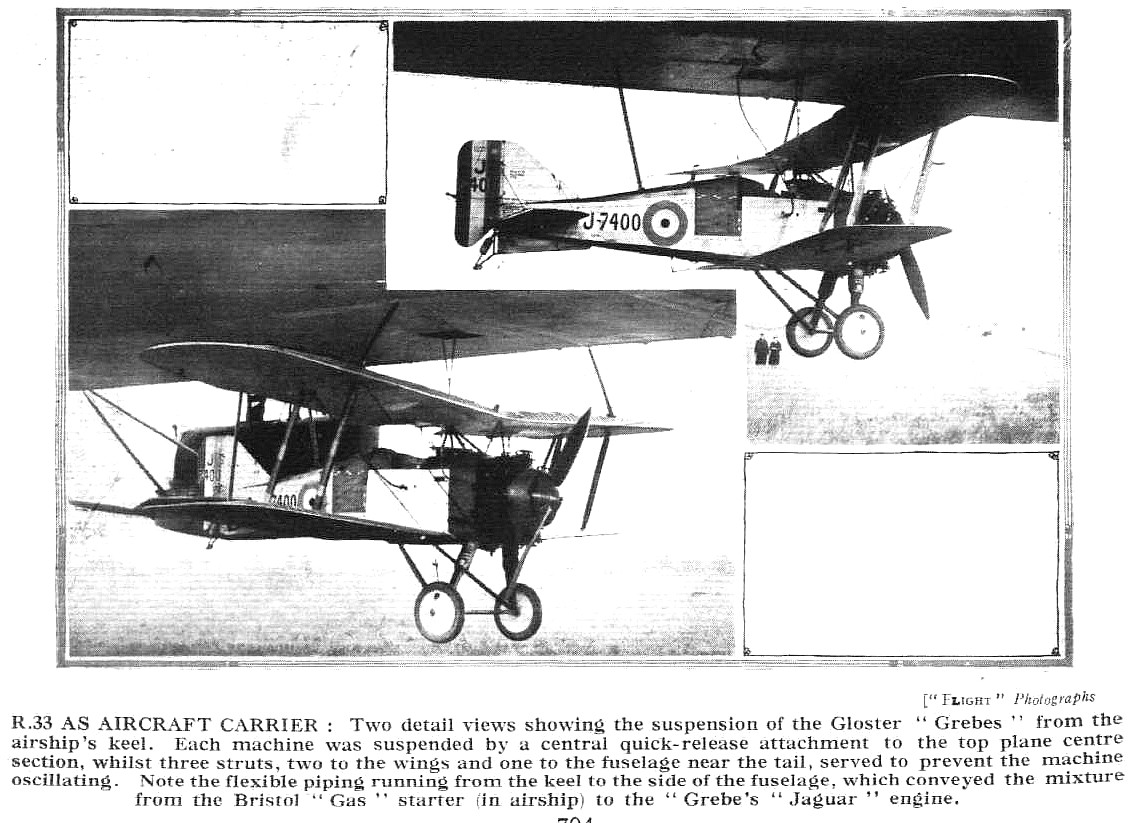
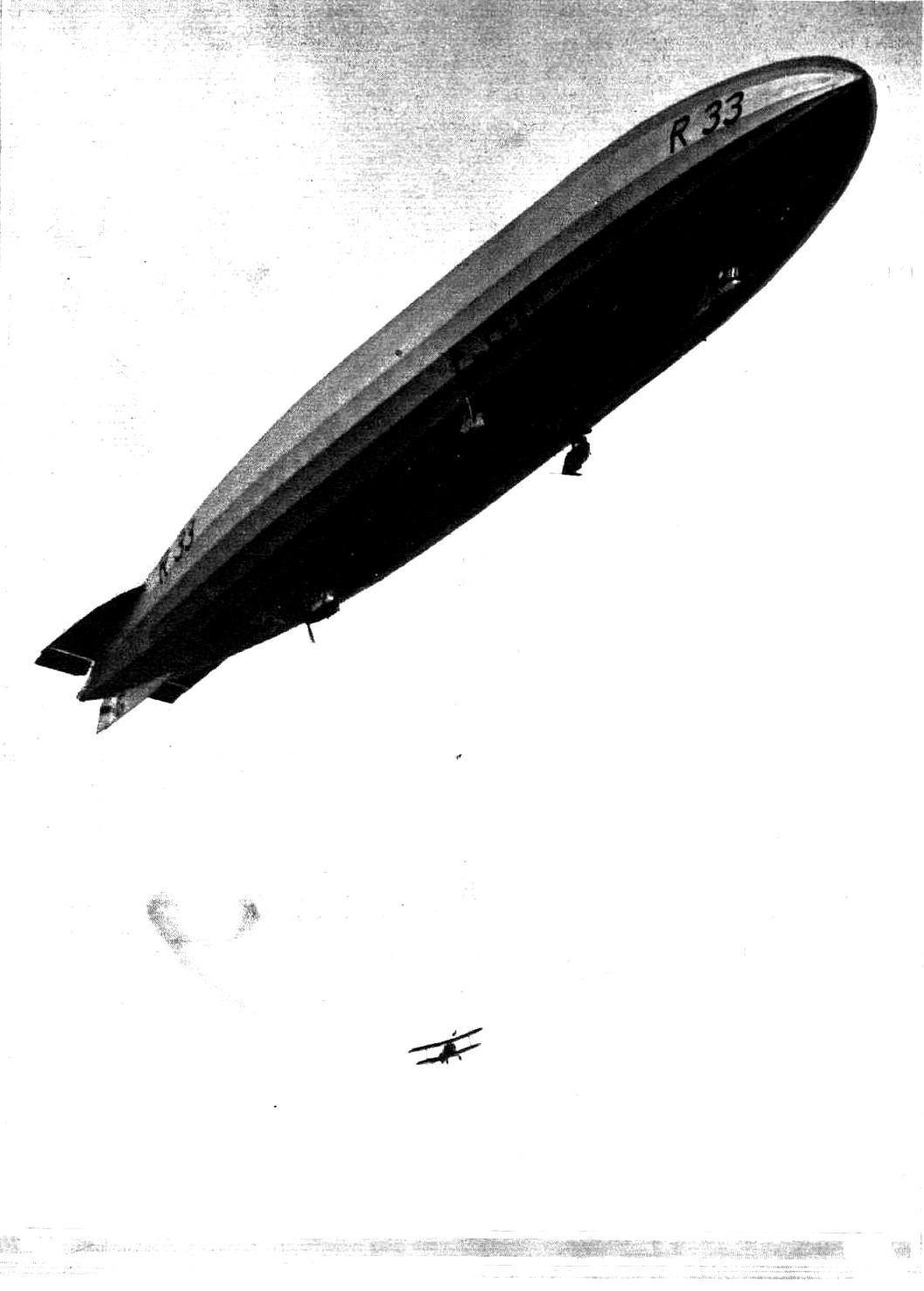
Note: Mike Holder has tracked down these pictures published in Flight magazine on the 21st October 1926. Which show two Gloster Grebes being suspended from and then released from the airship R33. It would appear that the trials were successful, but the idea scrapped. Possibly because it was then belatedly realised that aiships could not play any military purpose in future wars?
Military users: WW1: RNAS/RAF Class G Airship Station for non-rigid airships 1916 to 1918
RNAS/RAF Airship Experimental Station for rigid airships 1918 to ?
Location: Roughly 7nm NE of Diss
Period of operation: 1916 to about 1931?
Site area: WW1: 920 acres 2377 x 2130 (A vast site in WW1) Later 1,100 acres
NOTES: This Station opened in February 1916 as a coastal patrol Station for the Royal Naval Air Service, the first airships arriving during August that year. So, were perhaps fixed wing operations taking place before? As nearly always, and as mentioned several times elsewhere, I have no choice but to trust others in getting these details such as dates etc correct in their accounts of what has occurred many years ago.
Anyway, onto more enjoyable aspects. It seems the original ‘blimps’ which were none-rigid ‘balloons’ with aircraft fuselages slung underneath complete with engine became known locally as “Pulham Pigs”; a name which stuck even into the rigid airship era. Airship types ranged from the relatively small single-engined SS (Sea Scout) and SS (Zero) types to the larger multi-engine C (Coastal) and NS (North Sea) classes. It is claimed these airships enjoyed considerable operational success in coastal patrol, anti-submarine and escort duties.
However, this wasn't often the opinion of the crews at the time. Their effectiveness was revealed mainly after the war when German U-boat captains admitted that they spent a lot of time submerged after spotting one of these.
The fuselages used and especially the engines employed says an awful lot about what was going on even in WW1. The fuselages employed as ‘control cars’ were mostly from Armstrong-Whitworth FK.3, Avro 510, BE.2C and Maurice Farman designs. The engines used being of Fiat, Renault, Sunbeam and Rolls-Royce types. It is claimed that engines of varied type were often fitted to one airship dutring its career.
BIGGER AND PERHAPS BETTER?
On the 15th September 1917 the Vickers R-23 arrived, followed soon after by the Vickers R-26. The R-9 arrived in October 1917 but appeared to spend most of it’s life until dismantled in June 1918 undertaking mooring and handling trials. High winds were, (and still are for that matter – airships are still being built today), always the biggest operational downfall of the type. For example, on the 13th December 1917 a Coastal C-24 type ‘blimp’ was blown across to Holland, where it was interned. At one point in WW1 the R-23 was “equipped” with two Sopwith ‘Ships’ Camels from RNAS GREAT YARMOUTH, (many Camels were modified for operation from ships of course), and released at altitude above PULHAM where they landed,- presumably safely?
Later the US Navy employed a similar method. Quite why this method of operation, (at least to defend airships?), wasn’t more widely adopted seems a mystery. I suppose it would all depend on at least one surface ship to be in the vicinity to rescue the pilots? When Camels and their like were launched from battleships in WW1 for scouting duties etc they ditched near the mother ship when the sortie ended, (or when lack of fuel demanded closure). This became such a well practised procedure that it is said that the best pilots considered it a matter of honour not to get wet before being picked up!
A Camel can be 'stalled in' at next to no airspeed and floats very well for quite a long time. It must also be remembered that these aircraft were regarded as being totally dispendable due to their low cost. I seem to recall learning that a Sopwith Camel cost considerably less than just one of the biggest shells fired by these battleships?
AN UNUSUAL VISITOR
I have come to love learning history, (especially ‘hidden’ history), and the following account is just one of thousands of accounts discovered that have given me a sense of joy and delight in compiling this 'Guide'.
Just think about what this flight actually entailed to achieve, and the adventure involved. At 13.30hrs on the 6th November 1918 the Italian semi-rigid airship SR.1 arrived at PULHAM only a few days after being delivered ‘new’ to Ciampino near Rome. This was, it is probably quite rightly claimed, the very first direct flight from Italy to the UK. But, it appears, the Chief Officer on board the SR.1 was Capt T B Williams AFC!
Here is another little known aspect of WW1 history? The Italian SR.1 flying with the Vickers R.26 escorted Royal Navy ships off Harwich to meet 176 surrendered German submarines on the 20th November 1918. A most amazing sight, a momentous occasion - and now pretty much forgotten about and buried deep in the obscure and frail ‘vaults’ of recent history?
On the 2nd July 1919 the SR-1 along with the R.33 took part in the victory celebrations over London and at one point, when near the Mall, the engines failed - not a total emergency in an airship of course (?), and the crew succeeded in getting them restarted. A few days later the SR.1 completed a 25 hour endurance flight. Perhaps it’s just my failing (?) but I’ve always thought of early long distance airships as being a British and German affair, so it was quite a surprise to discover how good the Italians were.
AN EPIC FLIGHT
On 13th July 1919 the Beardmore R-34 arrived at PULHAM after successfully completing the first East-West crossing of the Atlantic plus the first round-trip across the Atlantic. Leaving EAST FORTUNE on the 2nd July it carried a crew of thirty, commanded by Major G H Scott, two pigeons, a kitten and a stowaway! Arriving in New York 108 hours later, (taking almost exactly the same time as the fastest passenger ships of the era, such as the Cunard Mauretania), a Major Pritchard parachuted down to supervise the ‘docking’ arrangements.
The return journey to PULHAM, (roughly 300nm longer in distance following a Great Circle route), graphically illustrates the benefits that airborne craft gain from the westerly winds – the R34 arriving in 73 hours, a gain of one and a half days! For those of us interested in such things – the R34 averaged about 26 knots outbound and 43 knots inbound.
SOME STATISTICS
Here again, (and just for those of us with anoraky tendencies), the R.34 was 650ft long with a gas capacity of about two million cubic feet. Powered by five 270hp (1350hp total) Sunbeam Maori engines this gave the R34 a top speed of 60 knots. The basic problem with airships is that an enormous amount of extra capacity is required to gain a small amount of extra lifting capacity (or payload) and the power needed to propel the airship increases in a similar fashion mainly due to the extra drag.
For example in 1928 the German Graf Zeppelin was 776ft long with a gas capacity of 3.7 million cubic feet, powered by five 550hp (2750hp total) Maybach engines giving a top speed of 70 knots. The ill-fated R101, (poorly designed and badly made etc), was just one foot longer than the Graf Zeppelin but had 5.5 million cubic feet of gas capacity. Powered by five 585hp (2925hp total) Beardmore engines it could only manage 62 knots top speed.
The superior Germans then came up with the Hindenberg in 1936, 800ft long with a gas capacity of an astonishing 7.1 million cubic feet. Powered by four Daimler-Benz 1200hp, (4800hp in total), engines giving a top speed of 73 knots.
EXPOSING A MYTH
Perhaps this might be a good place to set the record straight about the Hindenberg, especially considering the importance of PULHAM regarding airships. And because the myth surrounding the ‘Hindenberg’ disaster, caused it was alledged because it was full of hydrogen, which still prevails even today. As far as I am aware, the use of hydrogen as a lifting agent never in itself caused a problem in any airship.
There was nothing intrinsically wrong with that airship, it was a superb design, expertly made and top class and a world leader in every respect - but one. It was a NASA scientist who, watching a film of the disaster, realised that the initial fire could not have been caused by hydrogen - it doesn't burn that way. Having spotted the problem and then researching it, he finally nailing the flaw. Which was in fact the hitherto unknown properties of the paint applied to the ‘skin’ or envelope of this airship - which turned out to be highly flammable! He tracked down a sample saved by someone at the scene, and had a small part of it analysed. So, it was this paint that caught fire in the highly charged electrical storm taking place at the time, and not the hydrogen gas used as the lifting agent.
Once the ‘skin’ or envelope of the Hindenberg caught fire the presence of hydrogen in the airship led to the inevitable dire consequences and the future of commercial airship operations was set back at least fifty years. In recent years the concept of airships has been gaining new converts, and indeed, in Germany the ‘new’ Zeppelin company, still based in the same town of Freidrichshafen on the banks of Lake Constance, (Bodensee), have developed a truly astonishing modern airship which is in production.
THE R.33 ETC
Of considerable interest, (but perhaps only in my opinion), is the Armstrong-Whitworth built R.33, based very closely on the Zeppelin L-33 forced down at LITTLE WIGBOROUGH in ESSEX in September 1916. Registered G-FAAG it arrived at PULHAM in early 1920 to take part in civil airship experiments. Due to lack of funds the Airship Service of the RAF was disbanded in 1921, but a few originally military airships were ‘conscripted’ for civilian use - to explore the 'commercial usage' of airships.
Of considerable surprise, (to me at least), is the discovery that two of the surviving Zeppelin airships of WW1, L-64 and L-71, and so called “Prizes of War” were flown to PULHAM arriving in June 1920 and housed in two massive hangars. Without any doubt, the British having no flair in this area of aviation whatsoever, the capture of German airships gave us a huge advantage.
But it now appears, we still couldn’t master the disciplines, science, technology and expertise required. As we still see in manufacturing today, (from China especially), just making copies does not reveal the essential secrets involved. However, delving deeper into this story it now appears that the government funded R.100 built by the Airship Guarantee Company at HOWDEN (YORKSHIRE), and a subsidiary of Vickers, was a very good design, whereas the career of the ill-fated R.101 was a disaster waiting to happen. But, only due to circumstances, and not because the design was intrinsically flawed. Indeed, when the R.101 set out for India it hadn't even completed the first full series of air tests.
And, lest we now forget, the R.100 had successfully completed a trans-Atlantic voyage to Montreal in Canada.
A NEW DEVELOPMENT
In February 1921, when arriving back from HOWDEN in YORKSHIRE the R.33 was the first airship to use the new experimental mooring mast constructed at PULHAM. Before this time about a hundred or so ground handlers were required and in winds above twenty knots this was a very fraught and hazardous operation. With the revolving mast-head airships approached into wind and only about a dozen ground crew were needed to complete the operation in relative safety. In fact it seems, though hard to believe (?), it is said a mooring of one airship was carried out in 80mph winds.
ONE OF THE FEW
This Station became, along with CARDINGTON, one of just a few famous British airship bases. One claim to “fame” PULHAM had is in the area of developing mooring masts for airships and in the 1920s up to six airships could be seen ‘moored’ here. The first mast was 120ft high, and unlike the CARDINGTON mast had no lift. Therefore crew and any passengers had to climb a ladder onto a circular platform at the top. A ‘flexible’ walkway angled at 45º led up to the airship. Wouldn’t it be so very nice to transport a couple of Health & Safety inspectors back in time to assess this arrangement? Possibly the other masts at PULHAM were of similar design?
THE R-36 ARRIVES
On 2nd April 1921 the R-36 arrived, registered G-FAAF. Designed to carry 50 passengers it was a tad larger than the R-33. The engines were three Sunbeam Cossack (350hp) and two German Maybach IVs (260hp), giving a total of 1570hp. The history of this airship is a story in itself and well worth reading, but too long to give here. Indeed, the history of airships at PULHAM, and elsewhere, is a fascinating study for anybody interested in the subject.
A MOST SINGULAR VISITOR

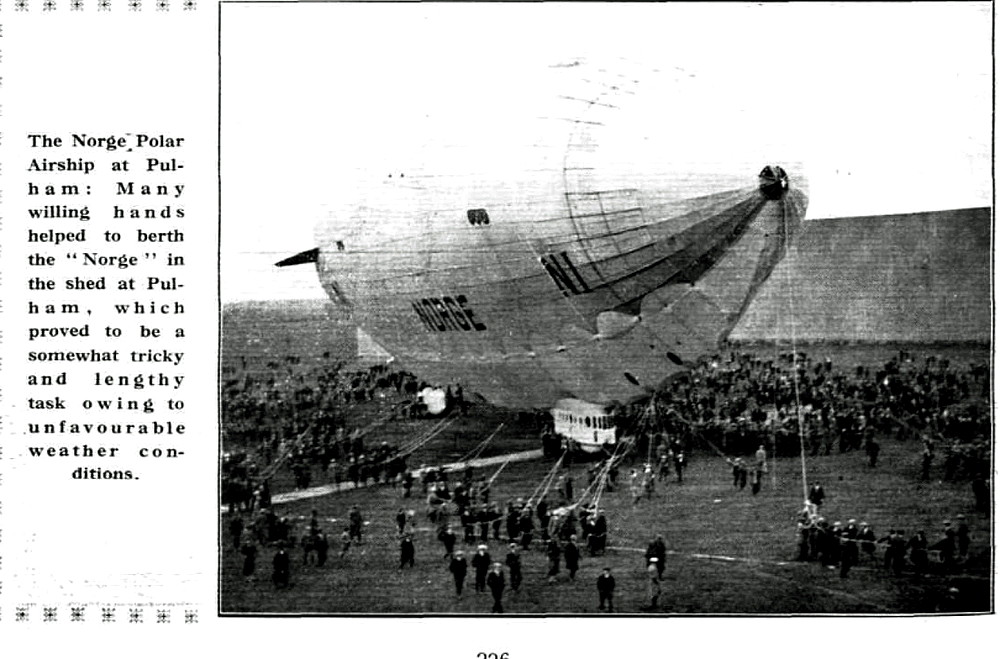
We have to thank Mr Michael T Holder for tracking down these two pictures, published in Flight magazine on the 15th April 1926. The Norge arriving on the 11th April.
QUITE A STORY
The Norge airship was built in Italy for undertaking the first flight across the arctic from Norway to Alaska via the North Pole. One of the biggest problems was locating suitable mooring masts along the way, and indeed, a couple had to be erected.
Without any doubt the voyage from Italy to the launching point in Norway was a quite remarkable achievement in itself. The route being CIAMPINO (Rome), PULHAM, OSLO, LENINGRAD (Soviet Union), and then via VADSØ to NY-ÅLESUND, an island of Spitsbergen. (Both in Norway).
They departed from Ny-Ålesund on the 11th May and arrived over the North Pole on the 12th, but from then on storms with high winds blew them all over, invoking many perils, before they eventually managed to land safely in Alaska. They had been airborne for 72 hours.
WW2
In WW2 the RAF took command of PULHAM, but not for flying duties as such. No.53 Maintenance unit being formed here as part of 42 Group. It seems the site was unique in accepting in handling the receipt, storage, repair and issue of all types of ammunition boxes, both new and returns, from operational stations all over the country.
Towards the end of WW2 PULHAM was used as a dump for crashed aircraft, mostly USAAF bombers crash landing in the Norwich area. It is reported that a Hurricane R2685 landed here in July 1941, (possibly flown by a Polish or Czech pilot?), after running out of fuel after a ‘dog-fight’ over the North Sea? An unconfirmed report is that a few Ansons landed here during WW2? Possibly undertaking 'communications' duties?
John Turner
This comment was written on: 2018-06-19 12:23:13I've recently come across a photograph by Ian Allen on 'Steam Railway' magazine no. 119, March 1990 which shows a goods train on the freight only line from Upper Vaunce's Farm (for airfield) in 1955. The photo shows a metal plate on a sleeper to mark the start of air ministry ownership. If you haven't a copy, I could scan and send.
Reply from Dick Flute:
Hi John, That would be an unusual addition - if you could be so kind. Best regards, Dick
We'd love to hear from you, so please scroll down to leave a comment!
Leave a comment ...
Copyright (c) UK Airfield Guide