





Pwllheli flying sites
Note: This map only gives the location of Pwllheli town within the UK.
PWLLHELI see also BODVEL HALL
PWLLHELI see also BROOM HALL
PWLLHELI: Temporary ‘intended’ flying site


Note: The period map was kindly provided by Mr Graham Frost.
Operated by: Pwllheli Town Council and Mr H.J.D. Astley
Location: Adjacent to Tal-cymerau Field.
Note: A photograph in the Air Caernafon Museum Archive shows Mr Astley getting his machine ready for flight and offers a few clues. Behind the aircraft is a large block of five storey buildings, (therefore near the town centre?), and as they are in shade, presumably the flying site was north of these buildings.
Period of operation: 15th June 1911
Runway: About 300 metres
NOTES: In the April 2008 edition of Light Aviation magazine, (previously Popular Flying), John Beeswax gives a fulsome account of the event and the construction of a replica of Mr Astley’s Blériot XI intended for the Air Caernafon Museum. In June 1911 a flying meeting was held here and has been described as being a fiasco. It seems it was billed as “The First Flying Meeting in Wales” on the 5th and 6th of June but only the lone and rather inexperienced H J D Astley turned up with a ‘Birdling’ monoplane which he crashed on his first attempt to take-off!
One aspect of this story is rather interesting. Some accounts say he was flying a Blériot XI, others a Birdling Monoplane built by the Universal Aviation Company. I am no expert by any means, but that Birdling Monoplane bears a strong resemblance to a Blériot XI. I suppose those designs were not 'trademarked' in those days?
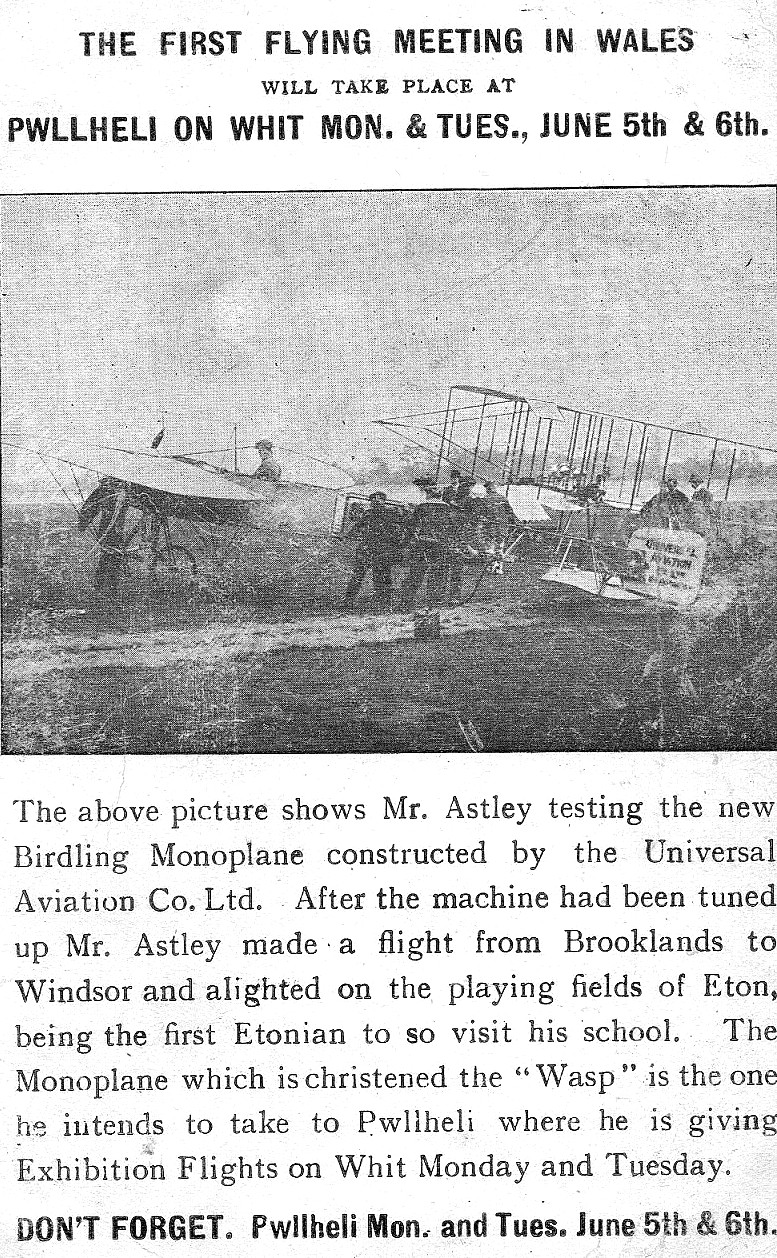
In September 2023 Mr Mike Shipley very kindly sent me a scan of this postcard gleaned from the family collection. Advertising the "First Flying Meeting", the picture was taken elsewhere, possibly at BROOKLANDS?
One important aspect of this event was that the Town Council had determined to both advertise widely but also ‘contain’ the event thereby maximising revenue charged at 6d for entry, hence the rather short take-off run allowed. At that time Pwllheli had become a very popular seaside resort and the Town Council thought it a good idea to exploit the new fangled flying craze that was sweeping the nation and hold the first 'display of flying', or ‘public air show’ in North Wales. The Council had judged correctly as an estimated 10,000 people arrived to view the aeroplane and see it fly.
It is suspected that Mr Astley, (who was criticised in the press for spending so long on his ‘preflight checks’), fully realised that around 300 metres was probably not enough to become airborne, but, with 10,000 onlookers he’d ‘give it a go’ after making as certain as possible his machine was as fit for flight as it could be. To the modern pilots eye, this picture gives another clue or two. Three poles can be seen, two having what appear to be windsocks, the other a flag. All indicate next to nil wind conditions but the ‘windsocks’ are in slightly different directions!
Hence the possibility of a light tailwind when taking-off? A very bad thing for such a slow and low powered aeroplane like the Birdling. These conditions also suggest a high pressure weather system being in place so it was probably a quite a warm day? Even so, these machines could usually get airborne in well under 300 metres. Had the machine been correctly rigged? Was the engine developing less than maximum power? It might be suspected, given his extra long pre-flight inspection, that Astley knew his machine was not fit for the job.
In this case, even though Mr Astley had a more powerful six cylinder Anzani engine fitted to his Blériot, (or Birdling), than many examples of the time, he failed to get airborne. He first hit a raised cycling track then a boundary wall, the resulting impacts catapulting him from his machine. They didn’t wear safety belts in those days and the absence of these probably saved him from a very serious injury and possibly a fatal accident?
“Boy Scouts quickly brought a stretcher, but Mr Astley appeared on top of the wall casually smoking a cigarette, and received a huge ovation from the crowd.” The British taste for seeing a ‘Whizzo prang” being nearly equal to watching a successful outcome?
This episode certainly didn’t seem to put him off flying because in July he lined up at BROOKLANDS (SURREY) with twenty others to take part in the Daily Mail ‘Circuit of Britain’ but he failed to complete the course. This story has a sad ending though because on September 24th 1912 he was killed when apparently desperately trying to avoid the crowds on an 'airfield' which was hosting a flying meeting in BELFAST. (See BALMORAL)
PWLLHELI: Temporary aerodrome
NOTES: On the 11th September 1933 Sir Alan Cobham’s No.2 Tour displayed in/near Pwllheli. Did they also use the beach for their venue? The same question applies of course when, on the 18th July, Cobham’s 1934 Tour visited Pwllheli.
PWLLHELI: Private airfield (?) See BROOM HALL entry
Charter/air taxi: Airmotive
Location: ? See notes
Period of operation: 1950s
NOTES: This operation would almost certainly have been at RAF PENRHOS?
PWLLHELI: Private airstrip
NOTES:
Typically for this area many questions abound as to exactly where this airstrip existed, it could easily be the one listed above for example, but I long since learnt that so very often different sites existed. In the mid 1970s it seems that the Jodel DR.1051 Sicile G-AYEW registered to Mr J R Webster was based at PWLLHELI. Also, the Jodel D-112 Club, G-BCGL (ex F-BIGL), was registered to joint owners here from 29.09.75 until 19.01.83.
We'd love to hear from you, so please scroll down to leave a comment!
Leave a comment ...
Copyright (c) UK Airfield Guide