





St Andrews Sands
St ANDREWS see also BALGROVE
St ANDREWS SANDS: Military later civil aerodrome (Also known as WEST SANDS)
Military user: Used for instructional training by pilots of No.2 Sqdn at MONTROSE
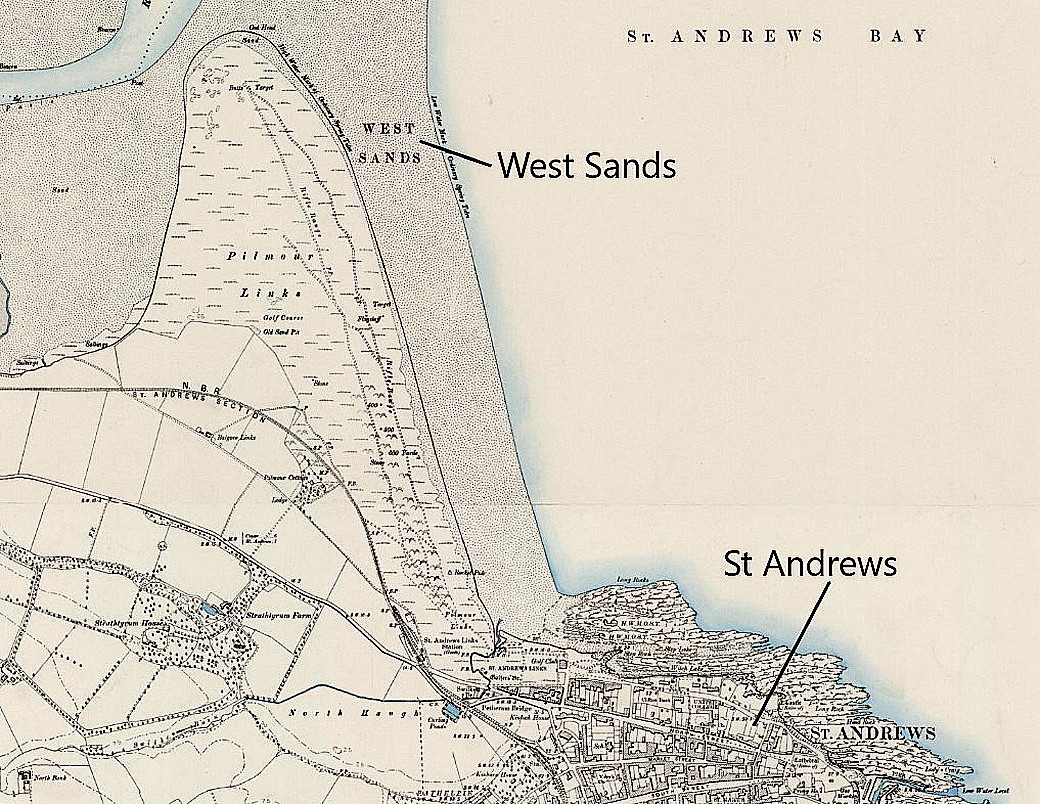
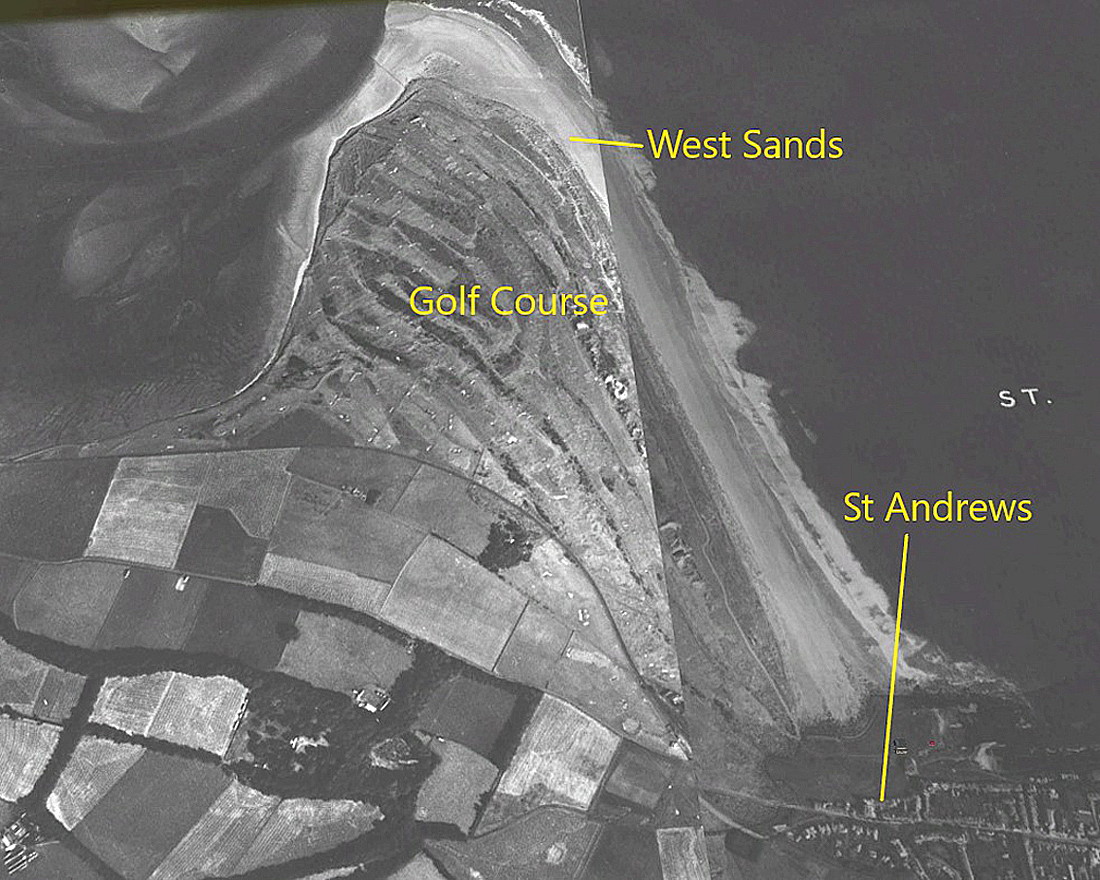
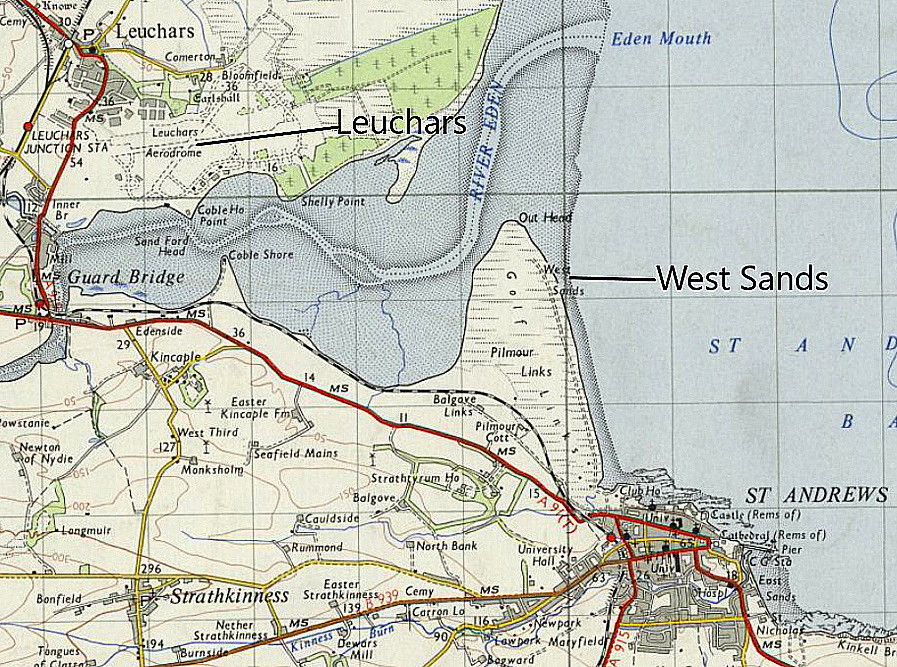
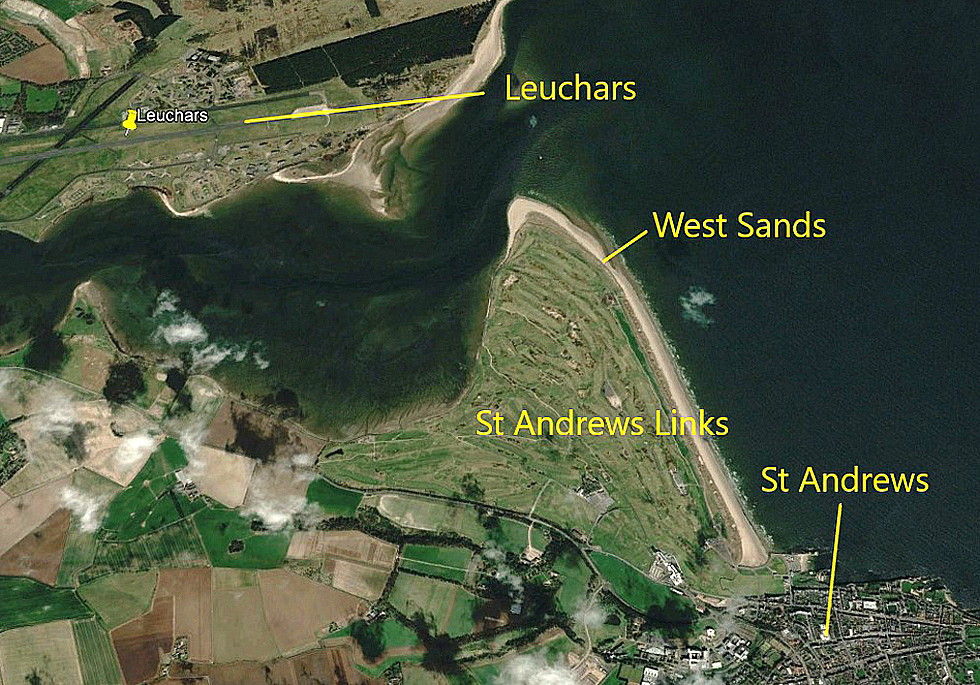
Location: On the West Sands just N of St Andrews
Period of operation: Military: 1913, also in 1919 Civil: 1921(?) to -
NOTES: Tents were erected from June 1913 to house the aeroplanes. Floatplanes also arrived here from DUNDEE. See photographic proof in ‘Montrose Airfield from 1913’. It seems Captain Longcroft was the first to arrive on ‘West Sands’ arriving an hour before expected by the local population.
The site was seen as ideal for training, enabling pilots to undertake short, straight flights over a period of three or so weeks to get used to flying a new and unfamiliar type of aeroplane like the Royal Aircraft Factory B.E.2 perhaps?
A MICHAEL T HOLDER GALLERY
We have to thank Mike Holder, a great friend of this 'Guide', for providing the following items to illustrate this listing.
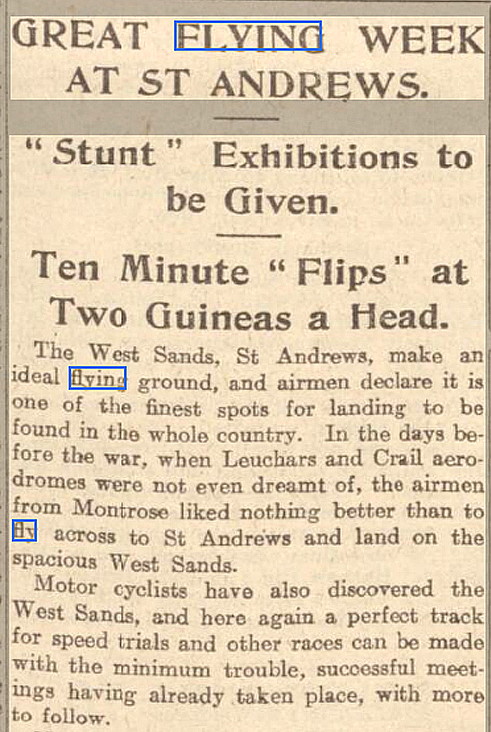
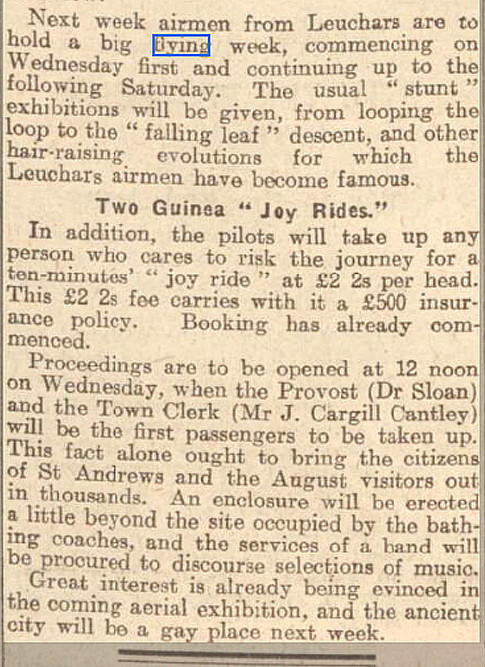
This article in two parts was published in the Dundee Courier on the 2nd August 1919.
NOTE: I may well be mistaken of course, as at my age, (78 in 2025), I often cannot remember exactly what I had for dinner last night, etc. But, my long term memory is still in reasonable condition. I cannot remember ever recording an RAF Squadron making arrangements to take the public flying, for a fee, (including insurance), basically for a joy ride. The fee of two guineas in 1919 is very hard if not impossible to determine, but, a reasonable guesstimate would be the equivalent of about £200. But, when searching for this information, discovered that a guinea coin today had a value of £440 due to its metal value.
CIVIL FLYING BETWEEN THE WARS
Mike Holder has discovered a considerable amount of information, mostly from press items, regarding civil operations on the sands, the first appearing in 1921.
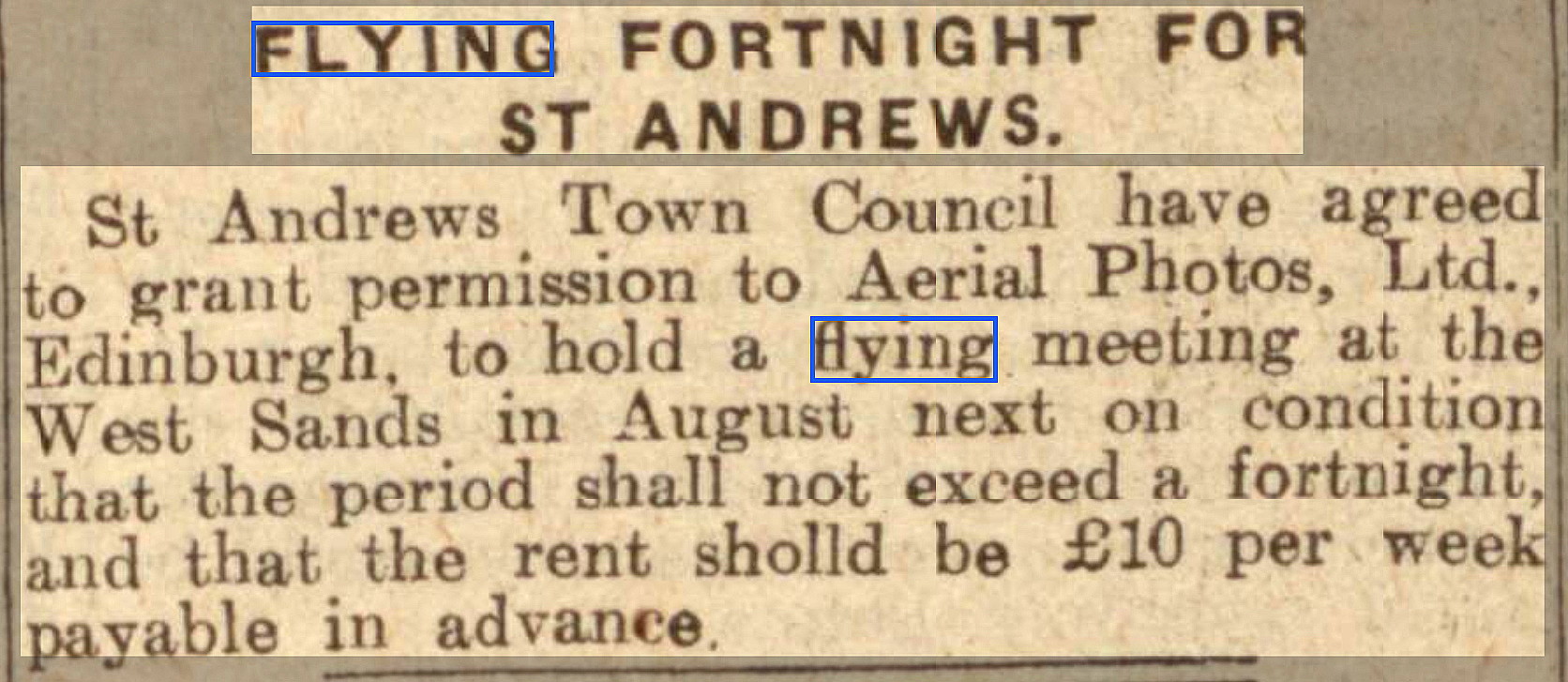
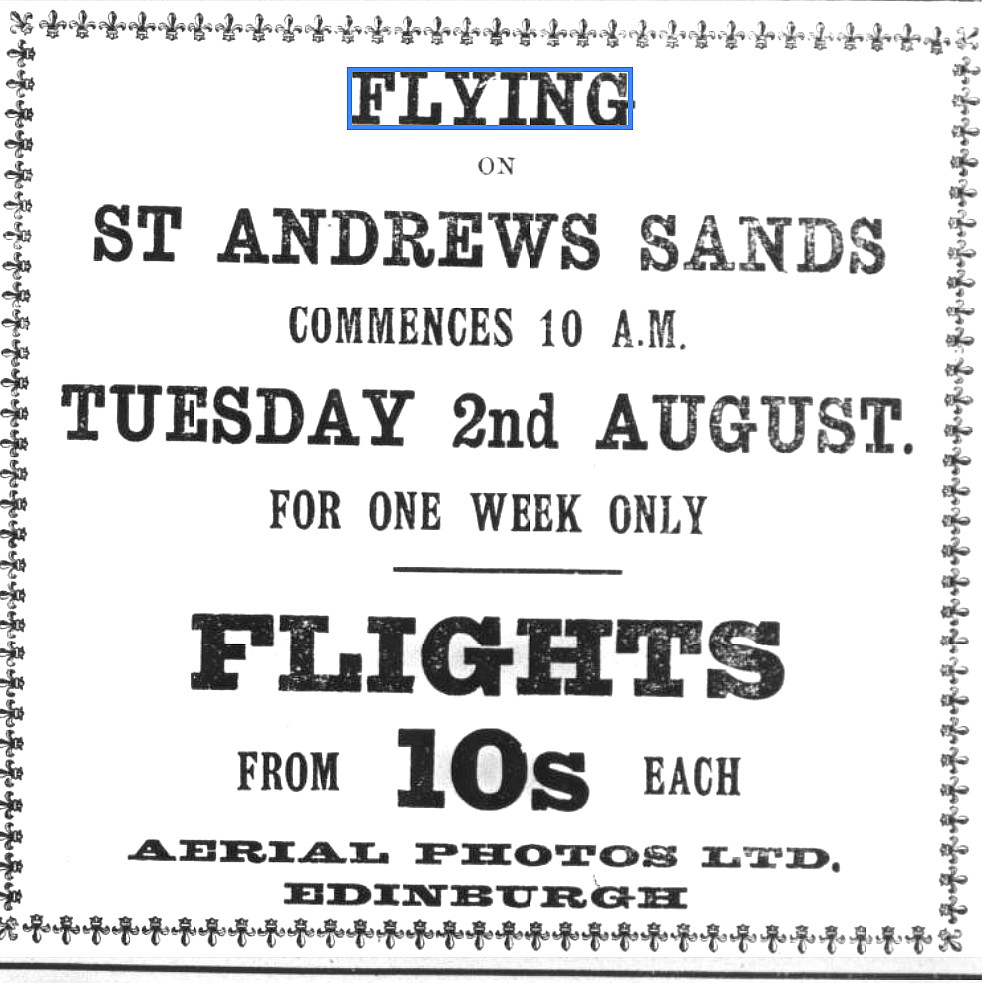
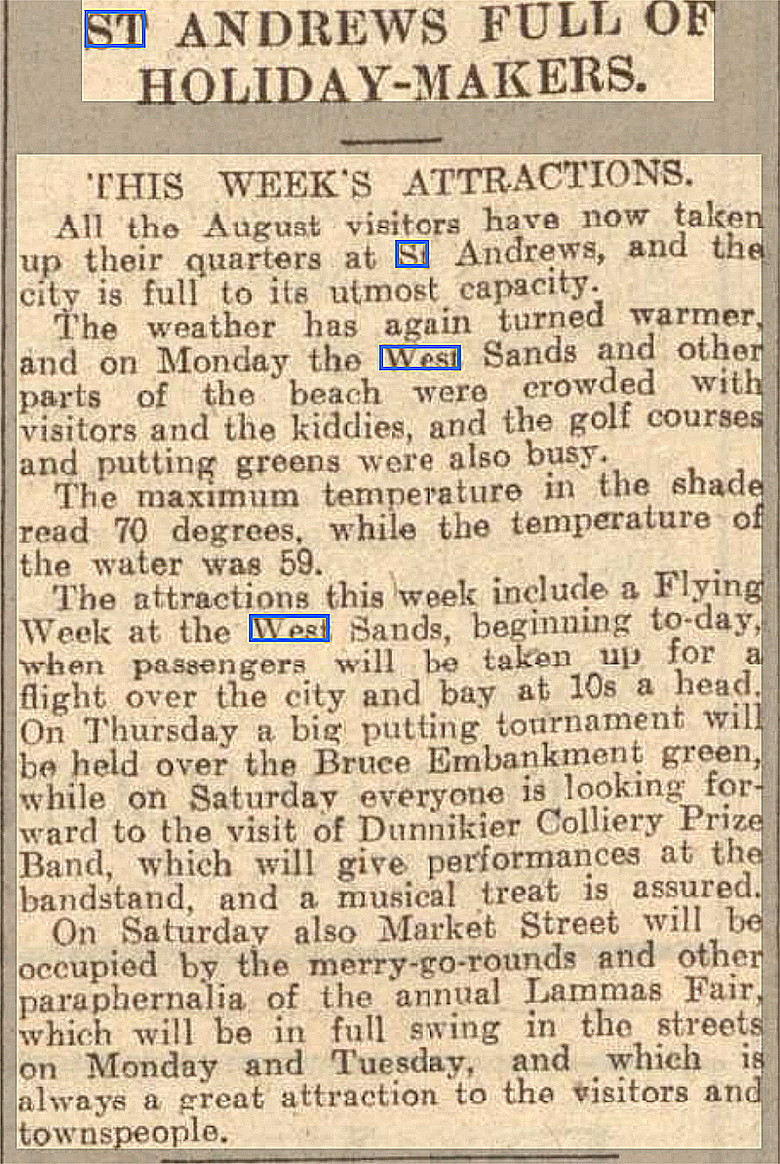
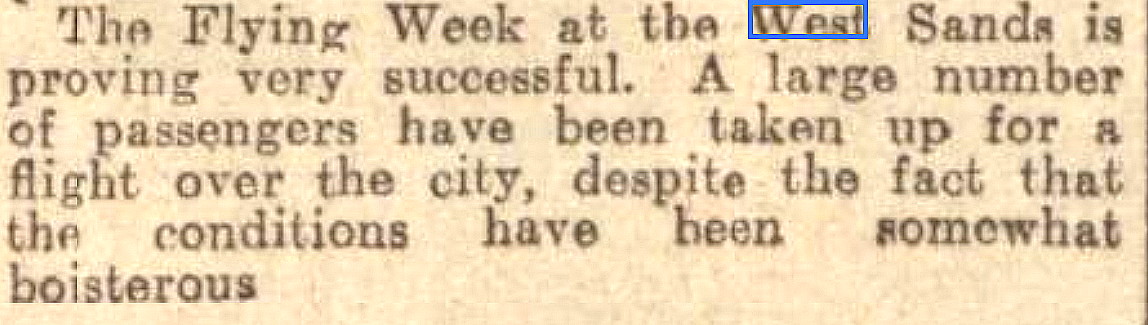
The Notice (One) appeared in the Dundee Courier on the 5th July 1921. The Advert (One) was placed in the Fife News on the 30th July 1921 and the Article (One) was published in the Dundee Courier on the 2nd August, followed by the Short article (One) on the 6th August. There then appears to be a rather long lull in joy-riding operations until 1928.
AN UNEXPECTED ITEM IN THE BYGONE AREA
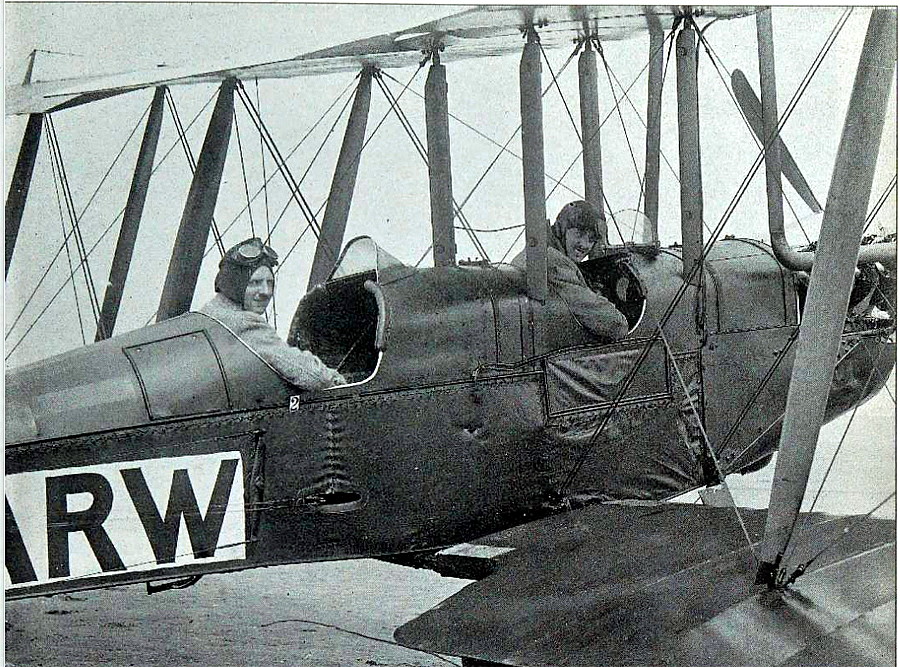
This photo of the Royal Aircraft Factory BE.2E, G-EARW (ex C6953), is from St Andrews by Raymond Lamont-Brown. One reason for not expecting to see a BE.2E used for joy-riding is because it could only carry one passenger and Avro were offering conversions of their 504 variants, mostly 504K and 504N, that could carry two adult passengers. Since trying to develop 'anorak' tendencies due to this project, I decided to see if any others had appeared on the Civil Aircraft Register in the 'G-E' period up to 1928, when the 'G-A' sequence started.
I might well have missed one, (or more?) of course, but amongst the several hundred aircraft listed, I did find these BE.2Es:
G-EACY (ex C7175) G-EAGH (ex C7101) G-EAJA (ex A1298) G-EAJN (ex A1404)
G-EAJV (ex A1410) G-EANW (ex C7185) G-EAQR (ex 9468) * G-EARW (as above)
G-EATT (ex C6968) G-EATW (ex C6964) G-EAVA (ex C7178) G-EAVS (ex C7179)
* This was the sole BE.2C I found.
NOTE: So, as far as I could find, no BE.2E types were registered after 1922 I also have no idea if any of the above, apart from G-EARW were employed for joy-riding, but suspect that some probably were? If anybody can kindly offer advice and information, this will be much appreciated.
THE START OF A NEW ERA FROM 1927
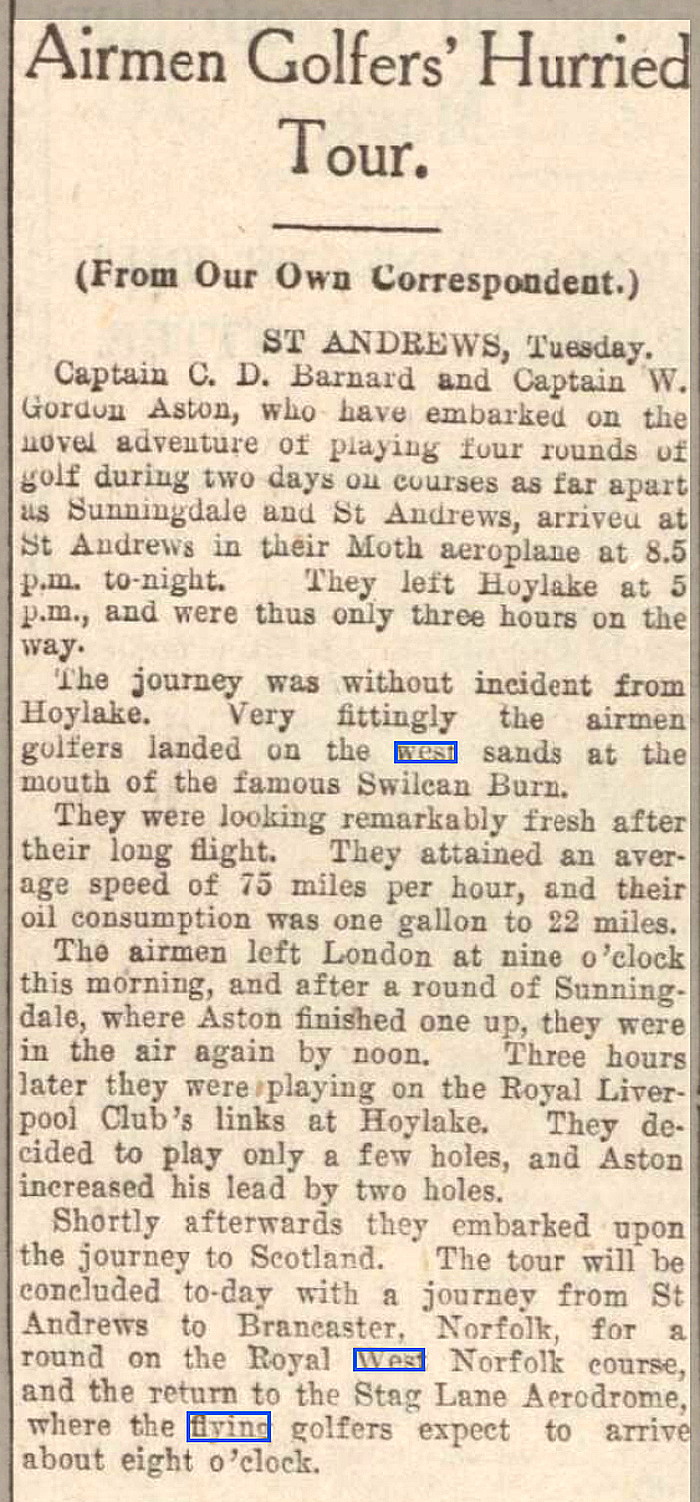
The Article (Two) was published in the Aberdeen Press and Journal on the 15th June 1927. At this time C D Barnard, (later to become quite famous in the "Flying Circus" era from the early 1930s), was working for de Havilland at STAG LANE, partly as an instructor. By this time the DH.60 Moth was already transforming light aviation, so no doubt this exercise was largely intended for promotional purposes. A good excuse anyway.
1928
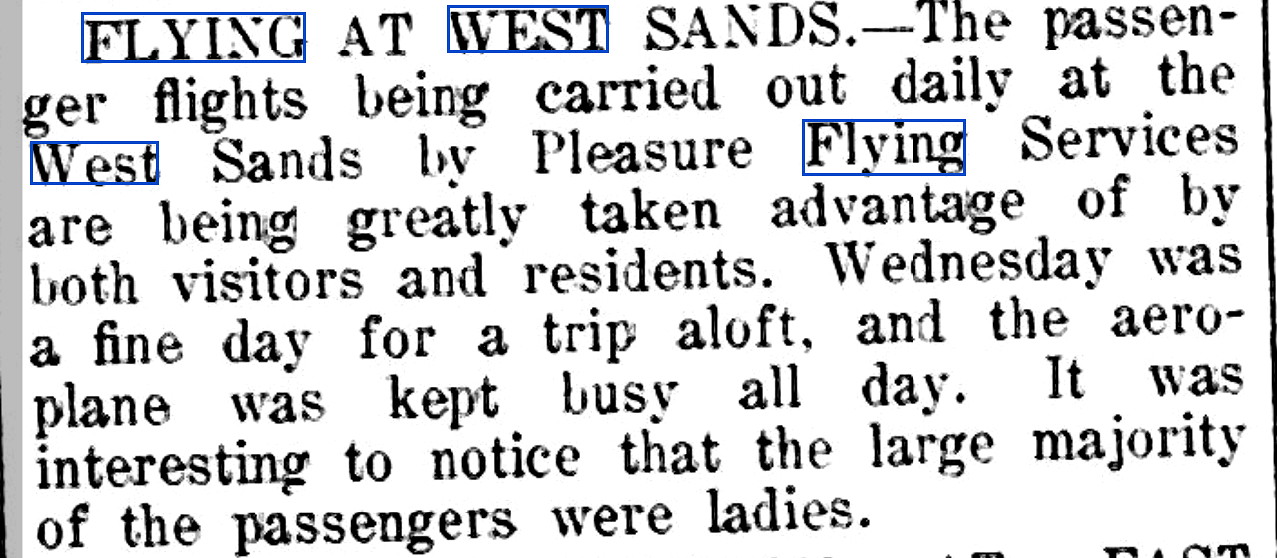
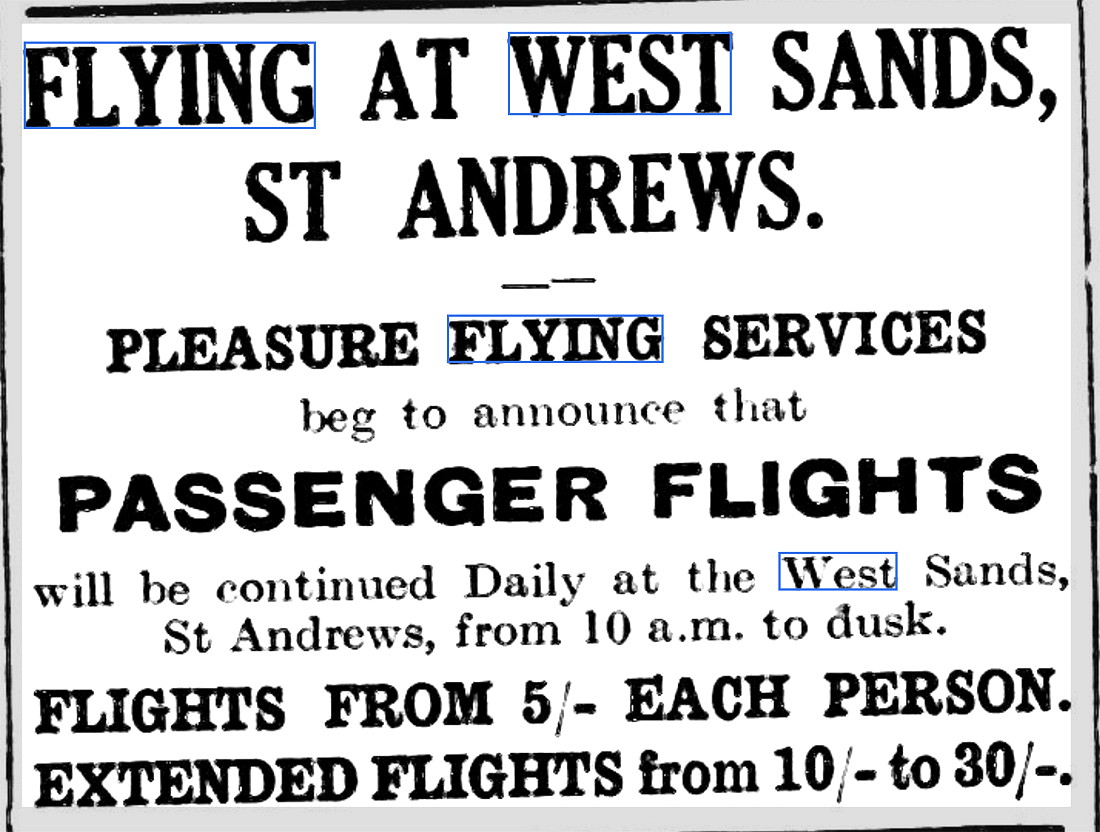
The Short Article (Two) was published in the St Andrews Citizen on the 25th August 1928, followed by Advert (Two) which was placed on the 1st September. Pleasure Flying Services were based at CRAMLINGTON in Northumberland, and it appears at this time were operating with just the Avro 548, G-EBPO (ex E3387)?
1929
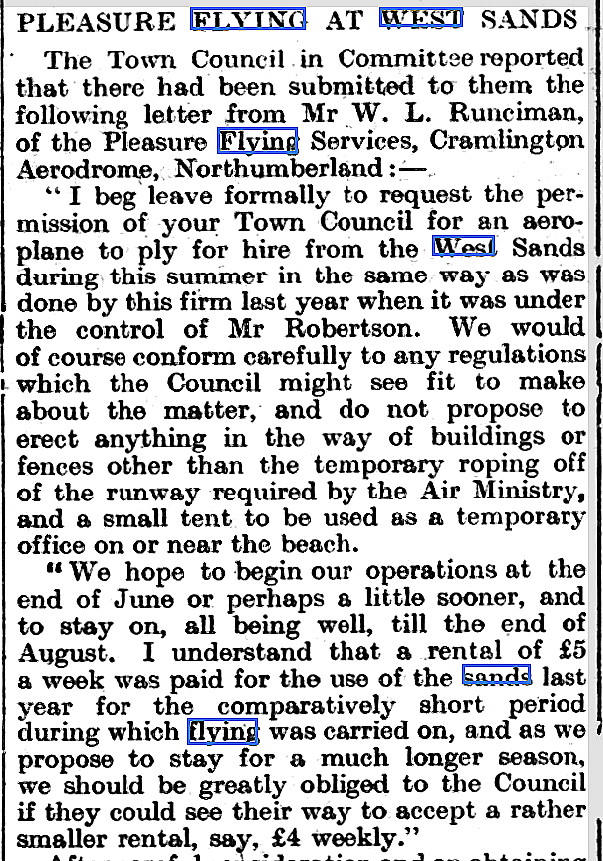
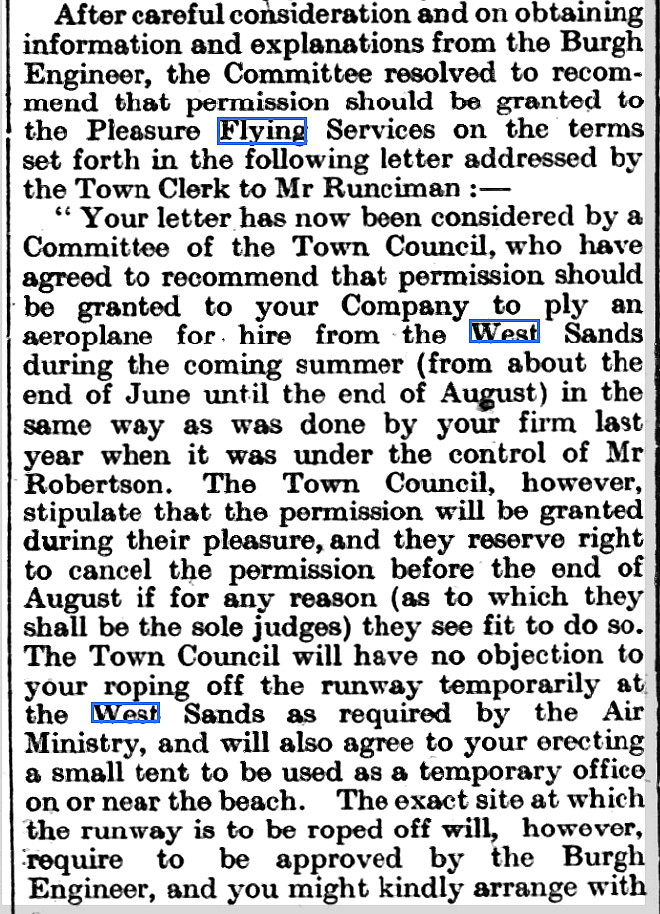
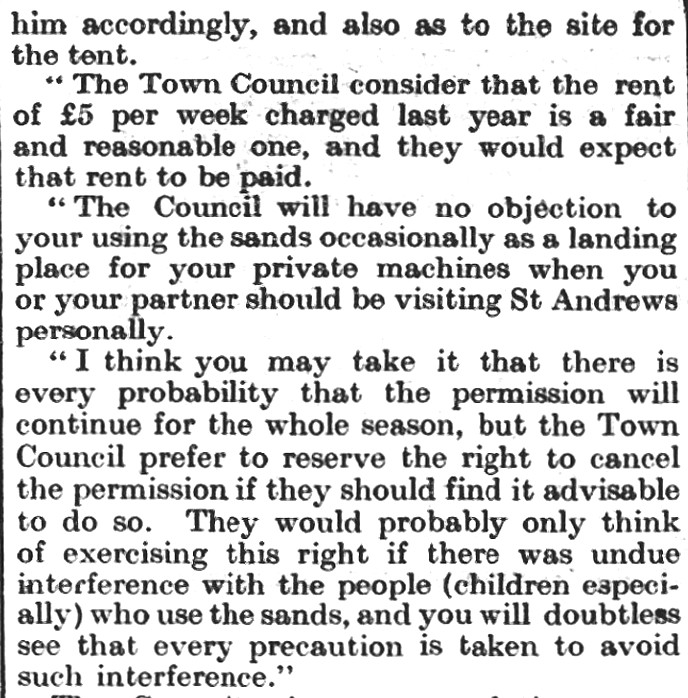
This article, in three parts, was published in the St Andrews Citizen on the 11th May 1929.
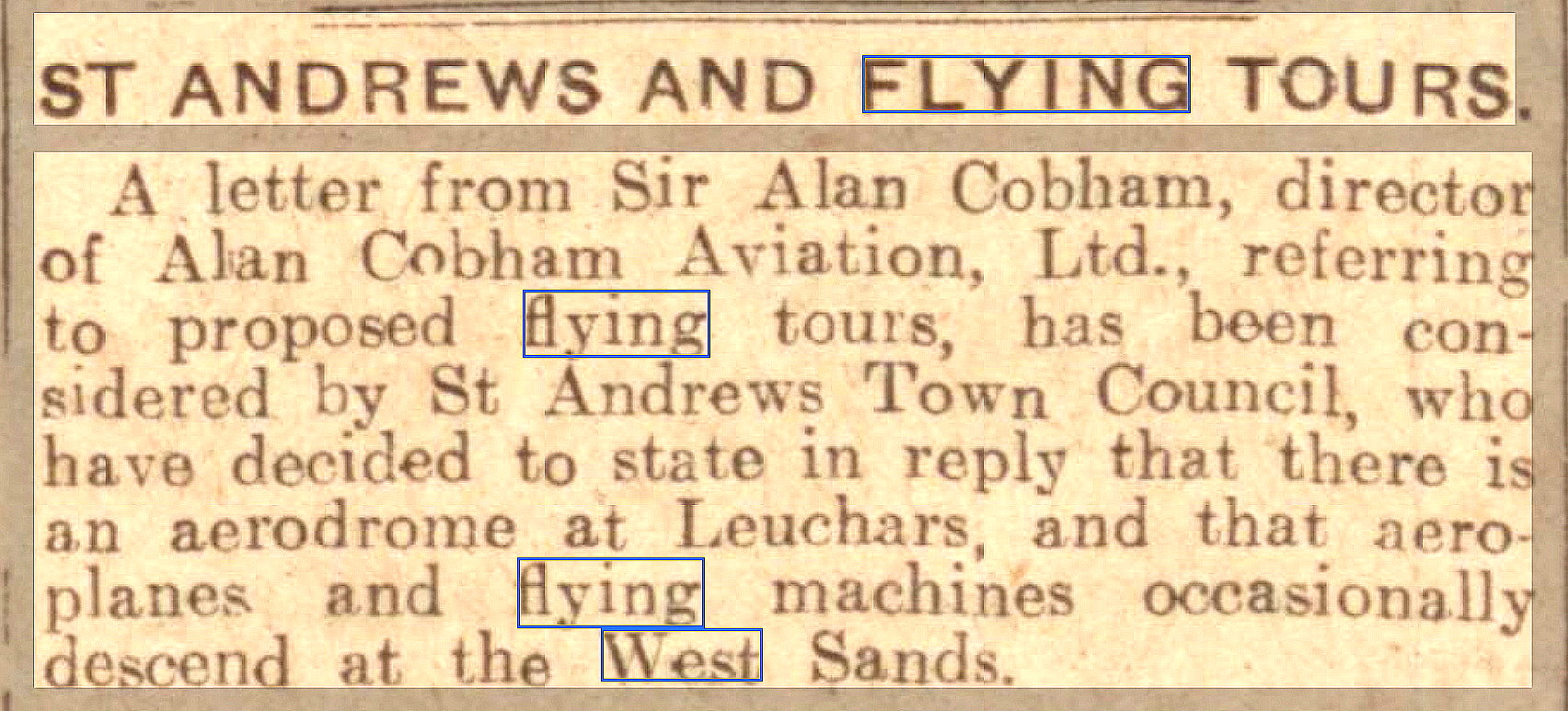
The Short article (Three) was published in the Dundee Courier on the 2nd April 1929 and is of quite some interest because it indicates that Sir Alan Cobham was considering visiting St Andrews during his Municipal Aerodrome Campaign which he conducted on his own as pilot, usually flying the de Havilland DH61 'Giant Moth' G-AAEV. Starting in May and finishing in October, he visited 107 towns and cities - but not St Andrews. Note that the article refers to "flying tours" whereas it was of course just one tour. (Please see my article on this subject).
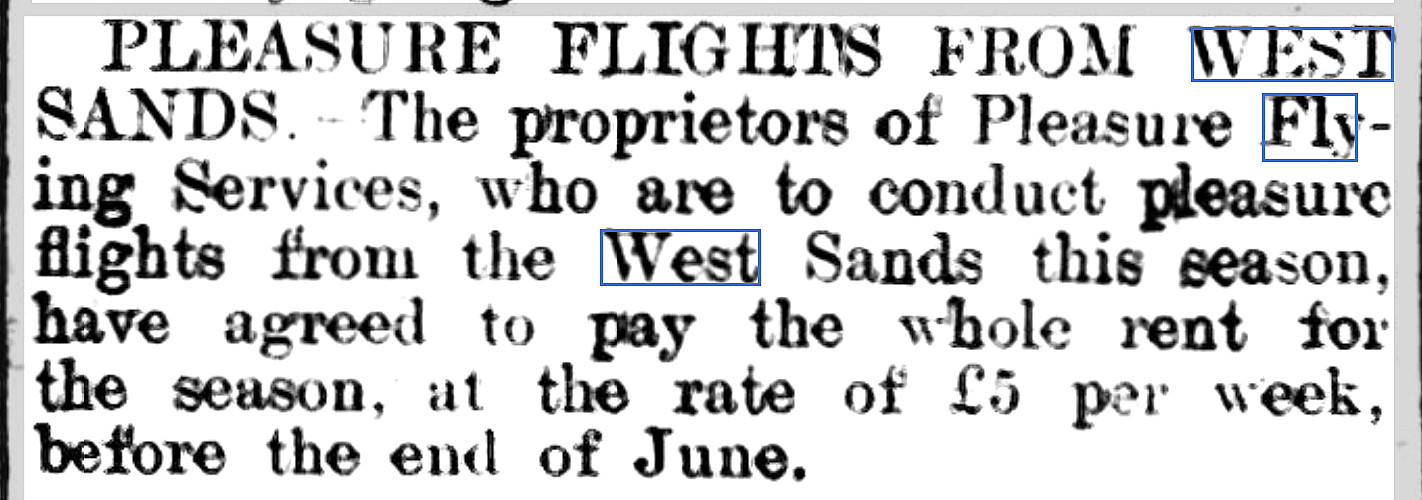
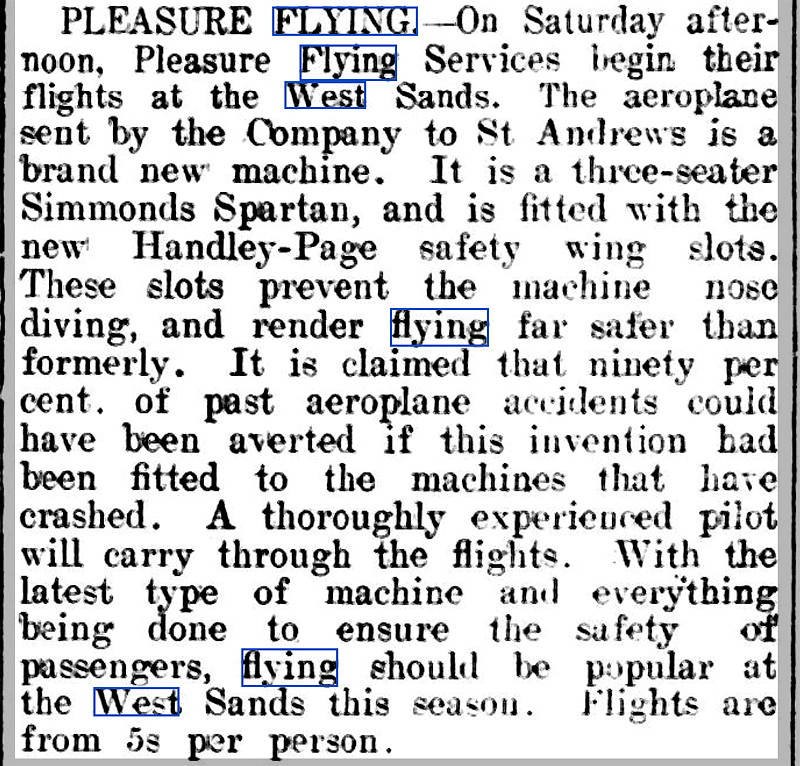
The Notice (Two) appeared in the St Andrews Citizen on the 8th June, whereas Article (Four) was published on the 6th July. In 1929 Pleasure Flying Services had acquired two Simmons Spartan 3-seaters, G-AAGV and G-AAHV. At the end of the season, in October, all three of their aircraft were sold to Cramlington Aircraft Ltd.
THE 1930s - The Jazz Age
Whilst the "Jazz Age" was taking hold around the 'western' world it seems that at St Andrews proceedings and attitudes were still at a rather more sedate pace by and large. As will soon be seen in this section - see Article (Six) in 1934.
1930
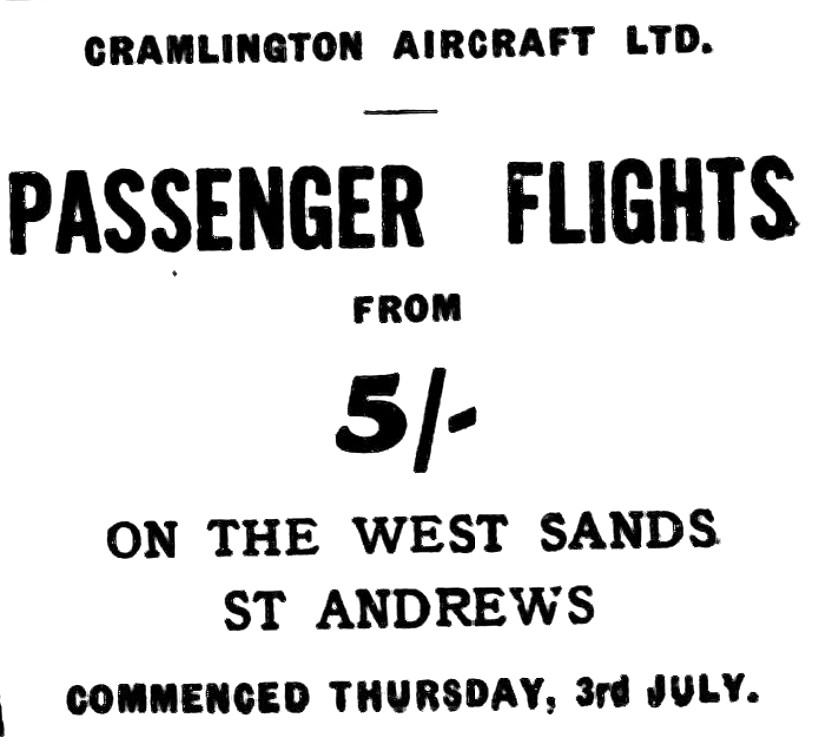
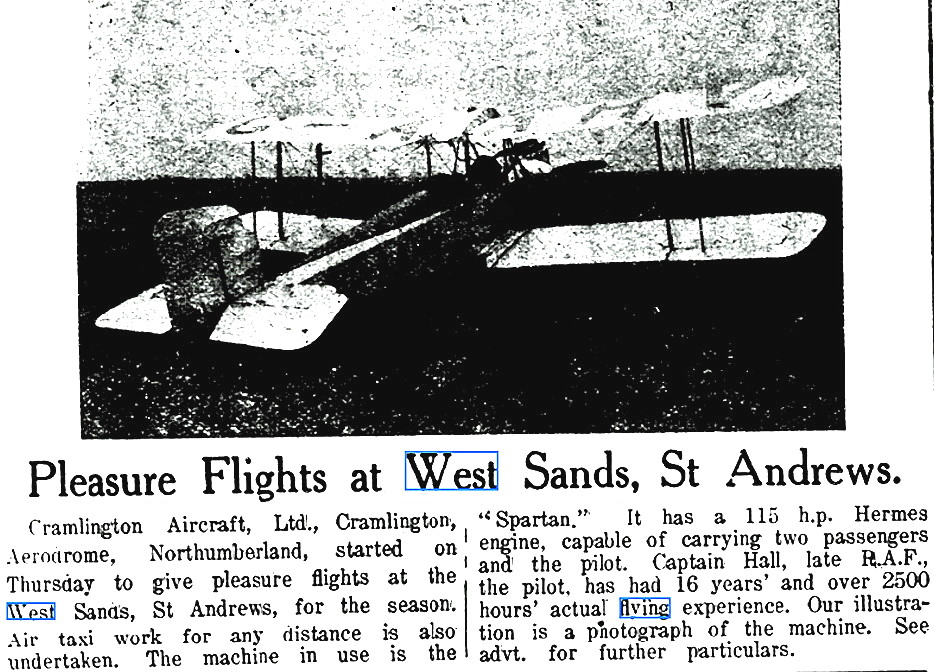
The Advert (Two) and the photo with caption both appeared in the St Andrews Citizen on the 5th July 1930. Note how Cramlington Aircraft Ltd had continued with the joy-riding and charter enterprise begun by Pleasure Flying Services.
1932
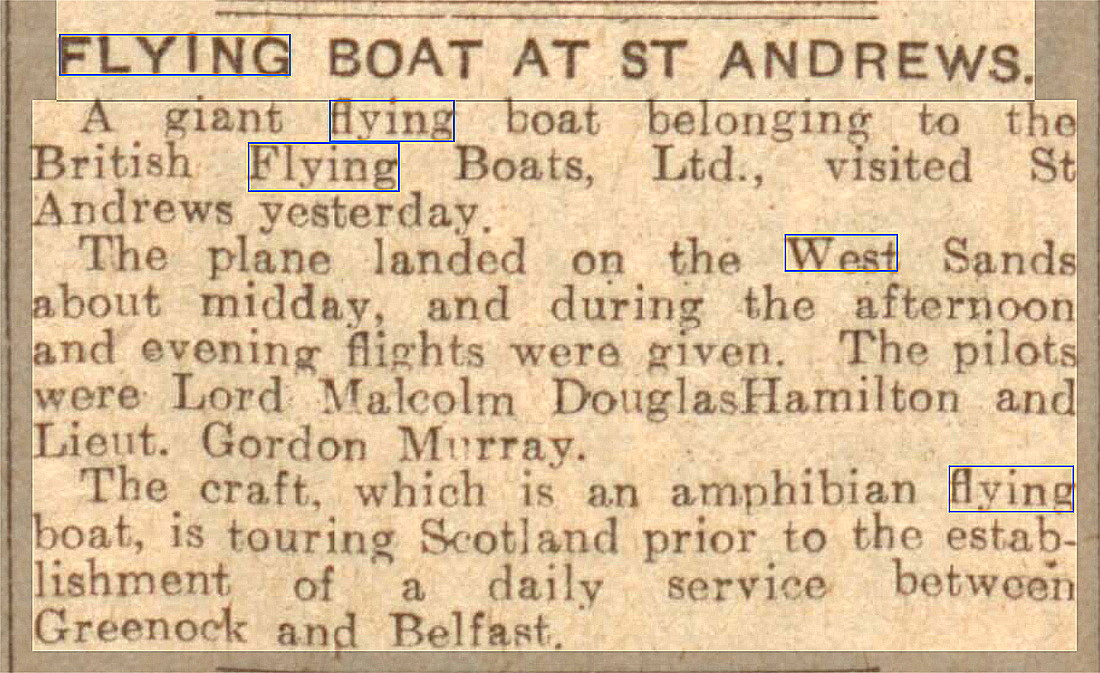
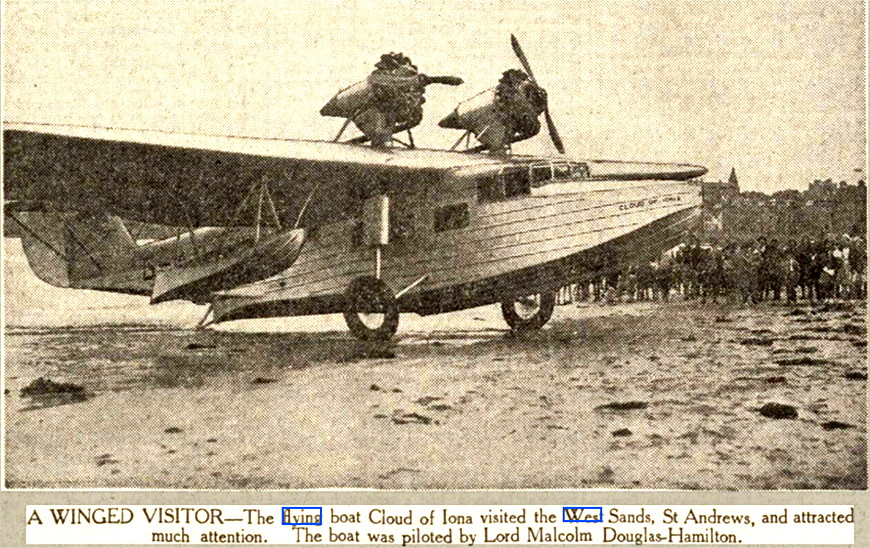
The Short article (Four) was published in the Dundee Courier on the 2nd August, followed by the photo the next day. It amused me to see it described as "a giant flying boat", as it was nothing of the kind, quite small in fact compared to, for example at that time, the largest flying boats being operated by the Royal Air Force and Imperial Airways.
It was intended to be primarily used as a trainer flying boat by the Royal Air Force and 22 were built, only four going to civil operators. This example of the Saunders-Roe, (often shortened to 'Saro'), A-19 Cloud, named 'Cloud of Iona', was G-ABXW. Registered in July 1932 it was brand new when it appeared here. It was operated by British Flying Boats Ltd until it seems 1934 during which a large part of its duties was flying a regular service between Greenock, (Glasgow), and Belfast.
1934
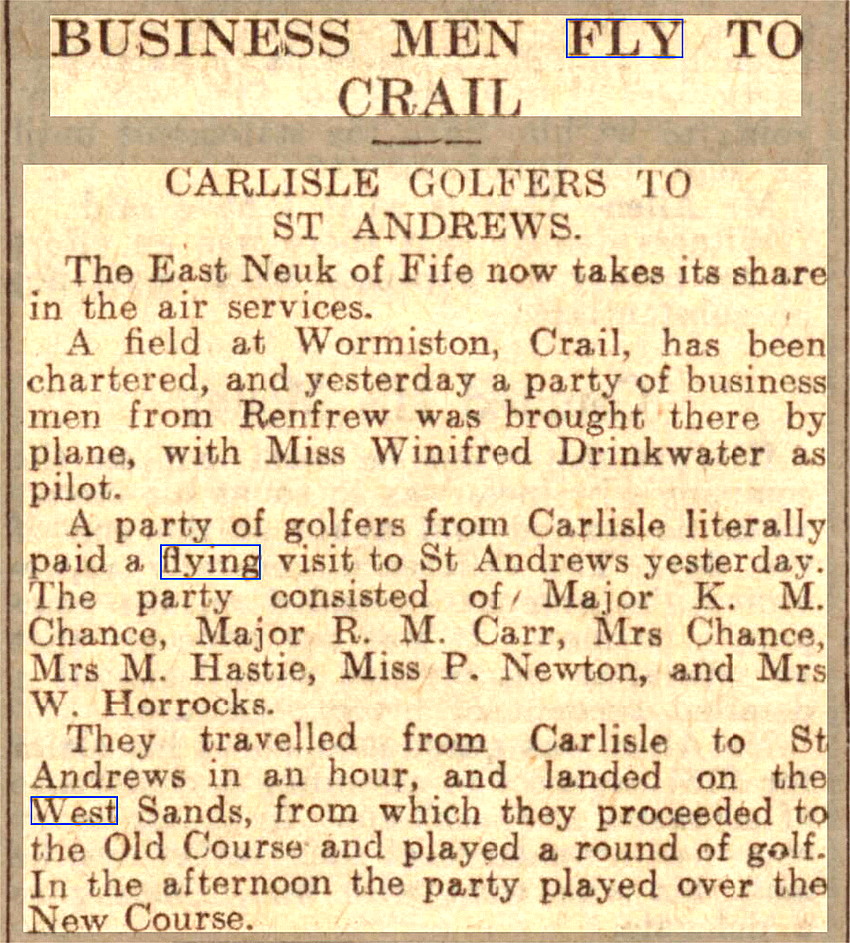
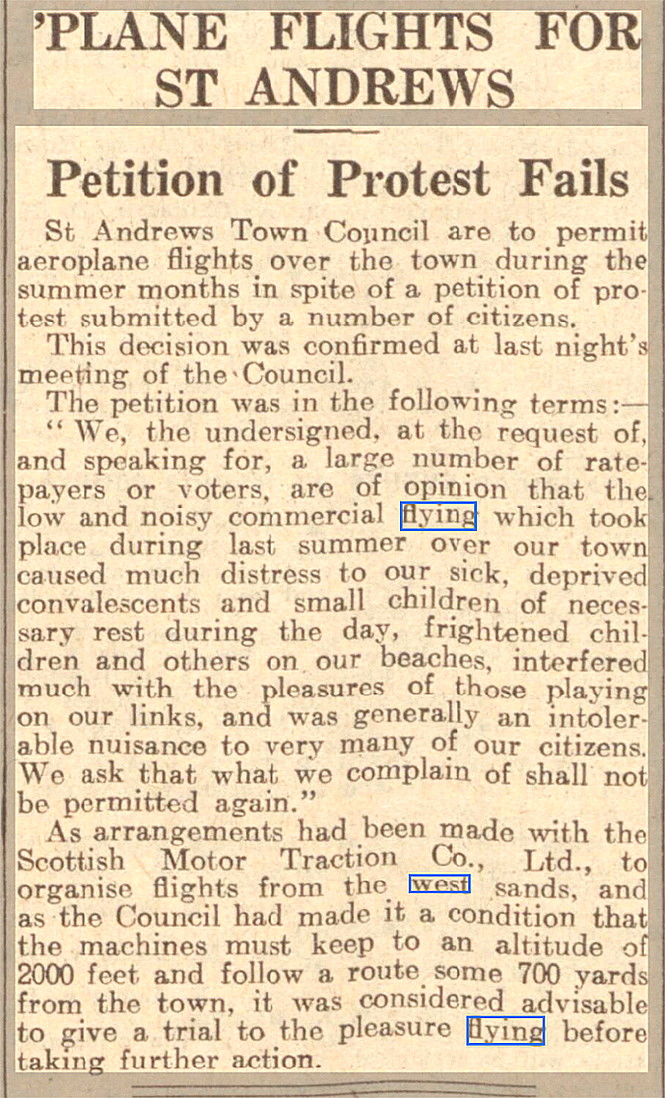
These two articles were published in the Dundee Courier, Article (Five) on the 1st June 1934, and Article (Six) on the 5th June. As can be seen in Article (Six), many of the local population strongly opposed any joy-riding operations. Seems that they had no sympathy with anybody selfish enough to want to have an enjoyable, let alone exhilerating experience in an aeroplane.
1936 - The end was nigh.
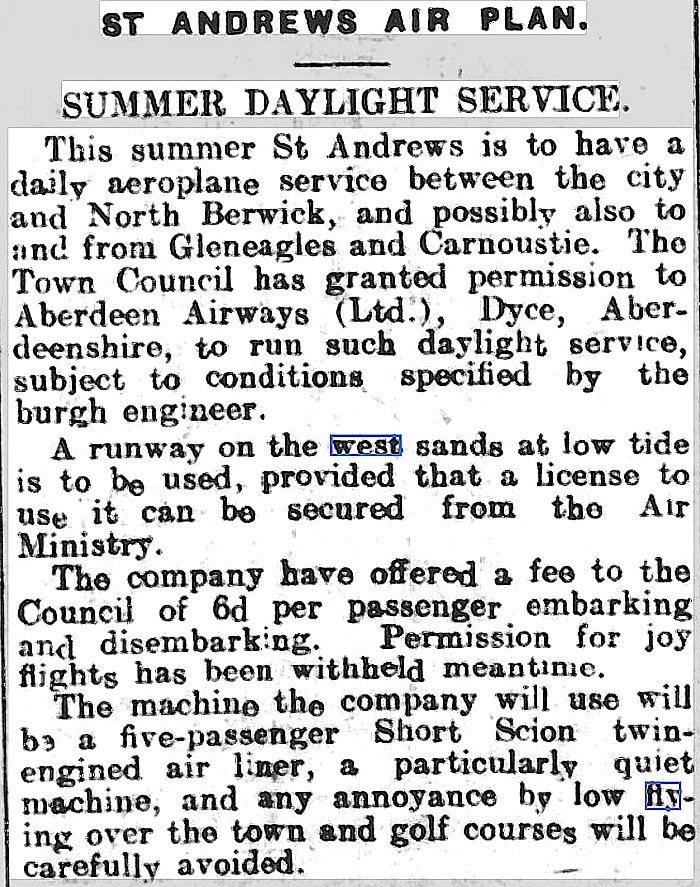
This article was published in the Fife Free Press on the 7th March 1936. Note that joy-riding operations would not be allowed. As this is the last press item Mike Holder could find, (and he is an ace at unearthing these), it seems reasonable to suppose that joy-riding from the WEST SANDS finished in 1935? For those having 'anoraky' tendencies, (like me), the Short Scion was G-ACUV, one of only five built including the prototype G-ACJI. The rest of the 22 Scion series built were the Scion II version.
AND FINALLY, A BONUS PICTURE
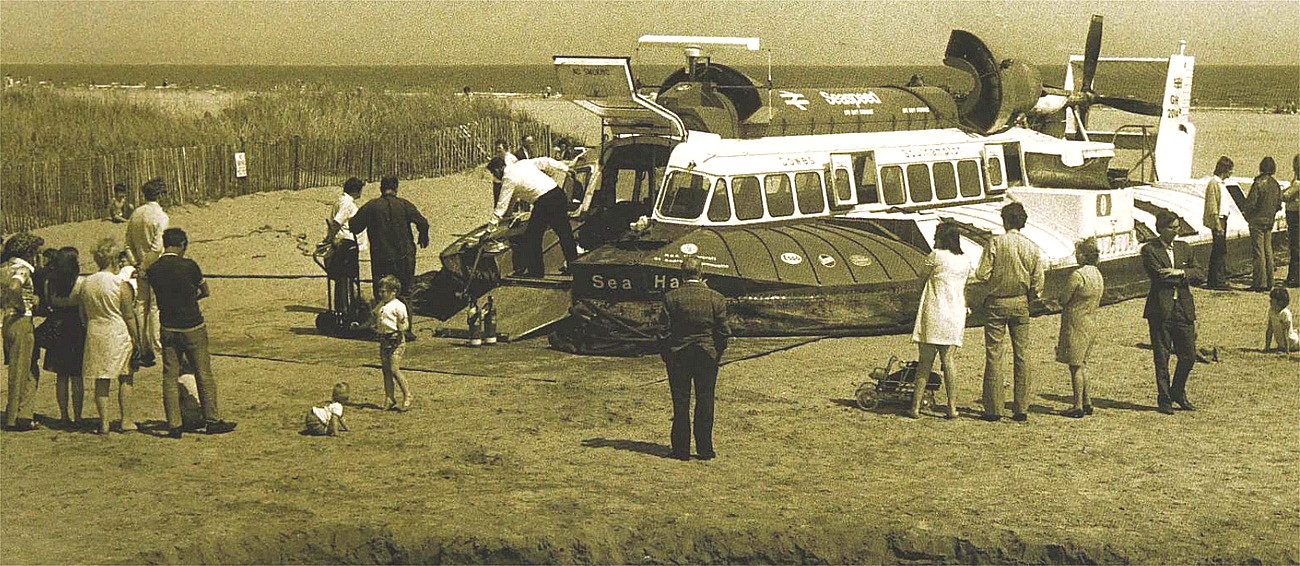
Mike Holder, who does not give up easily, also found this picture of the hovercraft "Sea Hawk", (presumably a Saro type built at Cowes on the Isle of Wight?), arriving on the WEST SANDS on the 8th July 1975, from St Andrews by Helen Cook. Not an aircraft of course, but certainly a type that operates by being 'airborne'. I know it shouldn't of course, but this machine arriving does amuse me to think that any of those still around objecting to aircraft noise in the 1930s, must have been having conniptions when this monstrosity arrived!
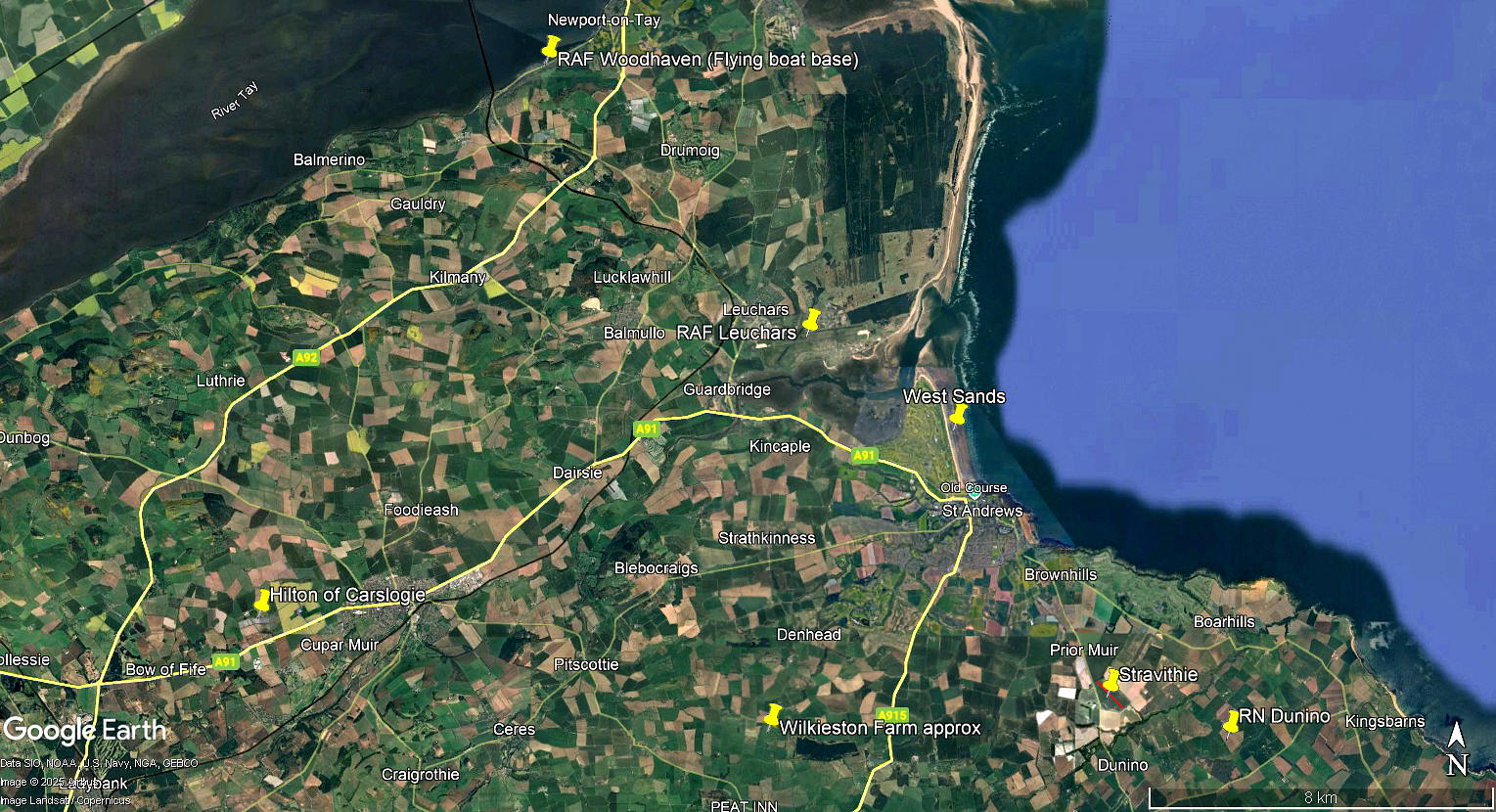
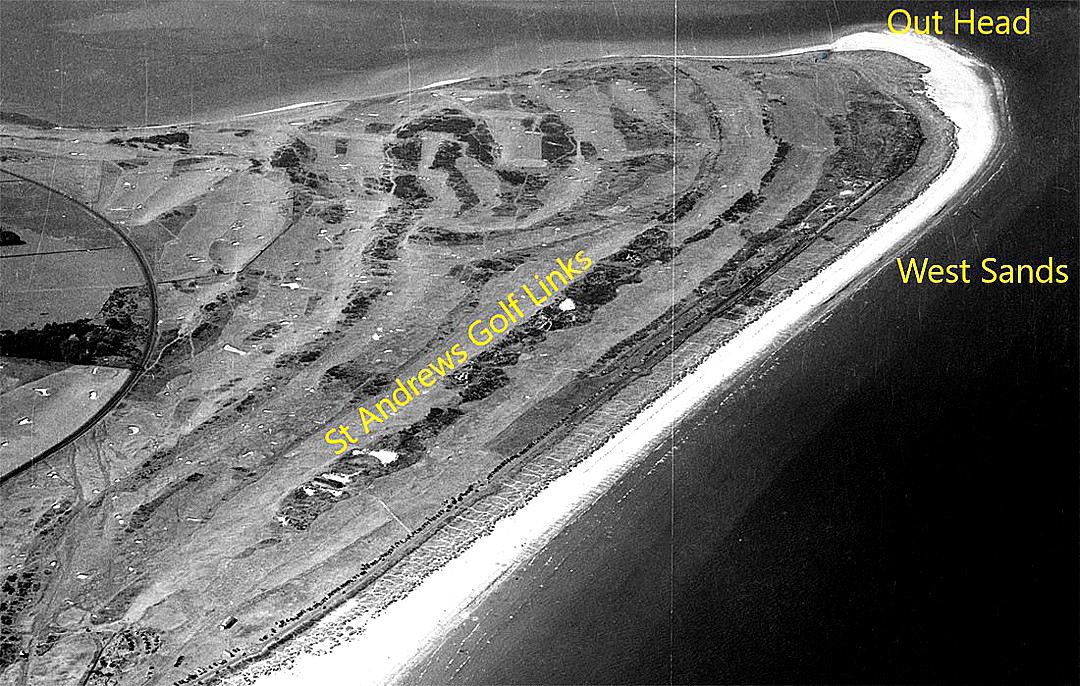
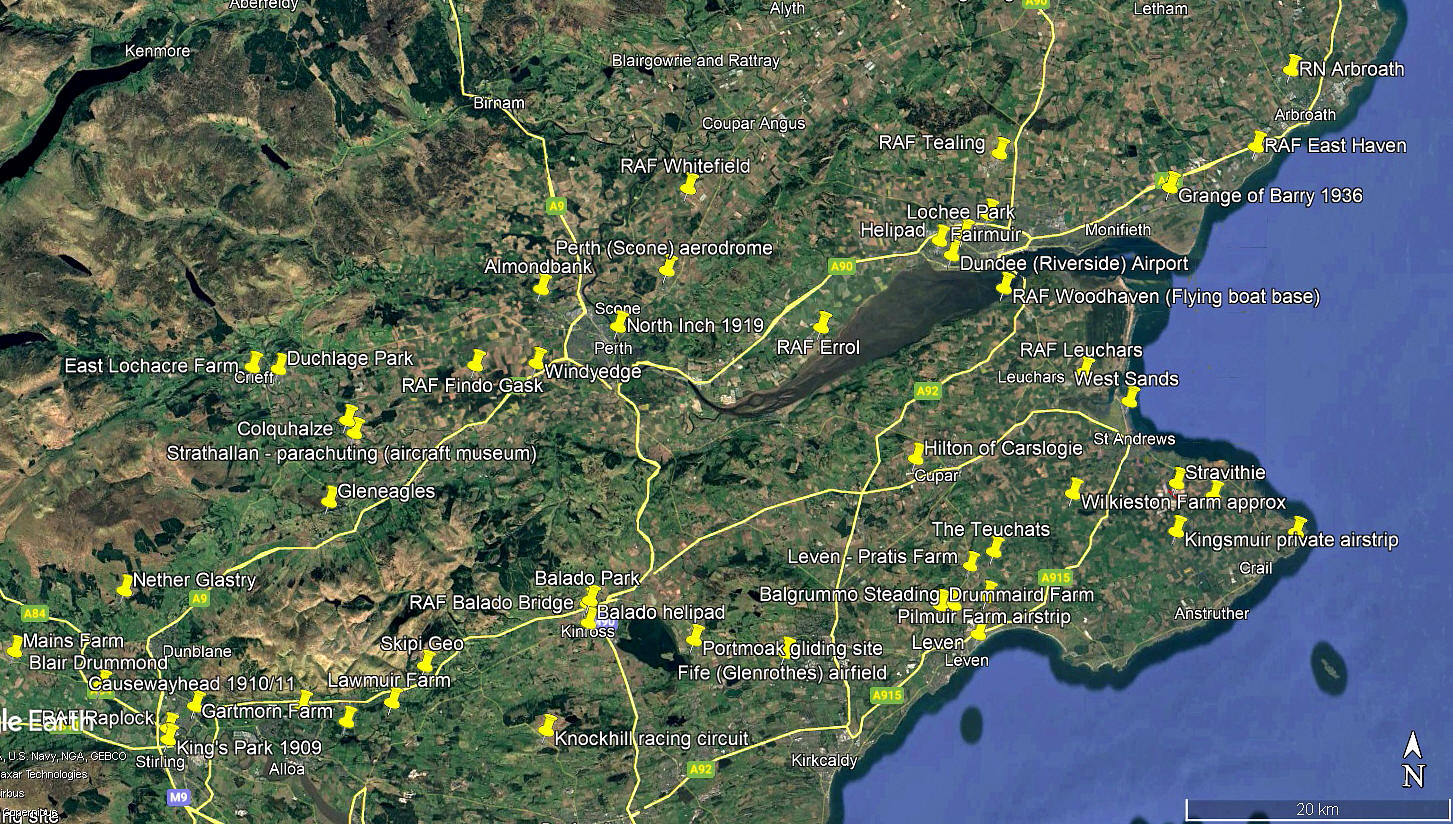
The local area and area views are from my Google Earth© derived database.
END NOTE
It certainly makes me wonder if, in more recent years, any microlight aircraft have landed on the SANDS? I imagine the temptation would be hard to resist for some? As always in this 'Guide', if anybody can kindly offer more advice and information, this will be much appreciated.
We'd love to hear from you, so please scroll down to leave a comment!
Leave a comment ...
Copyright (c) UK Airfield Guide