





Swingate
Note: This map shows the position of the South Foreland Lighthouse. As can be seen it is close to the WW1 SWINGATE DOWNS aerodrome, but, as these notes below refer to operations before WW1, it certainly seems to justify a seperate entry. Especially because, although close and perhaps even on the later WW1 aerodrome, it appears that no exact records exist of precisely where these events occurred.
SWINGATE: Temporary Landing Ground (aka St MARGARET’S BAY)
Location: Just behind the South Foreland lighthouse
NOTES: On the 21st May 1910 the second crossing of the English Channel, (or La Manche if you’re French), was flown by Jacques de Lessups in a Blériot fitted with a 50hp Gnome and flotation bags. It seems possible C S Rolls had set up a camp at SWINGATE and allowed de Lessups to use it?
On the 2nd of June, (C C Turner was at Calais and he says it was June 1st ), C S Rolls took-off from SWINGATE for France returning to SWINGATE ninety five minutes later being the first pilot to make a RETURN trip from England to France…but he didn’t land in France.
In his excellent book RAF Hendon Andrew Renwick reports, concerning the activities of Claude Grahame-White who had; “…arrived back at Liverpool on 6 December 1910 on the SS Mauritania and was given a hero’s welcome, having won the Gordon Bennett Cup for aeroplanes for Britain.”
Incidentally, it is often reckoned that the phrase ‘Gordon Bennett’ derives from an incident when he arrived at a ‘top society party’ in America, pissed as the proverbial newt, and relieved himself into the fireplace – in front of everybody attending.
But to get back to flying: “Within a week of his return he travelled to Dover in search of another trophy, the Baron de Forest prize.” This was for the longest flight into Europe from the UK and eventually won by Tom Sopwith flying a much greater distance from EASTCHURCH (KENT).
Grahame-White: “…had ordered a Bristol Boxkite, which was delivered to him at Dover after being test flown by Maurice Tetard, the company pilot. After a couple of setbacks, including a dog being killed by the turning propeller and damage during a winter gale, the biplane was repaired.
On 18 December he decided to try his attempt at winning the prize and took off from Swingate Downs despite strong winds. While turning the aircraft was hit by a gust, side-slipped into the ground and was wrecked; although Grahame-White needed medical treatment, he planned another attempt before the close of the competition on 31 December 1910. On Christmas morning, however, a fire destroyed his replacement aircraft and brought the attempt to an end.” It appears the fire was caused when his hangar collapsed!
By a somewhat bizarre coincidence it appears that Tom Sopwith was also making his attempt to win this prize on exactly the same day as Grahame-White’s first attempt, the 18th December, albeit taking off from EASTCHURCH (KENT), and Sopwith succeeded in gaining the £4000 prize, a fortune in those days.
What is slightly more worrying is that, according to some, Grahame-White was attempting the flight from the SHORNCLIFFE Army Camp near Folkestone rather than SWINGATE DOWN near Dover. According to a contemporary account in Flight only Lt Watkins was making the attempt from SHORNCLIFFE. Claude Grahame-White, Robert Lorraine and C H Cresswell were at SWINGATE DOWNS, Cecil Grace and Tom Sopwith were at EASTCHURCH and Samuel F Cody announced his intention to start from FARNBOROUGH (HAMPSHIRE).
At this time Tom Sopwith was virtually unknown outside of aviation circles and very much the ‘outsider’ whereas Claude Grahame-White was a national hero, having recently won the Gordon Bennett Trophy in the USA. Indeed, when Grahame-White announced he had been forced to retire from the competition it made headlines in the national press.
ANOTHER DEVELOPMENT
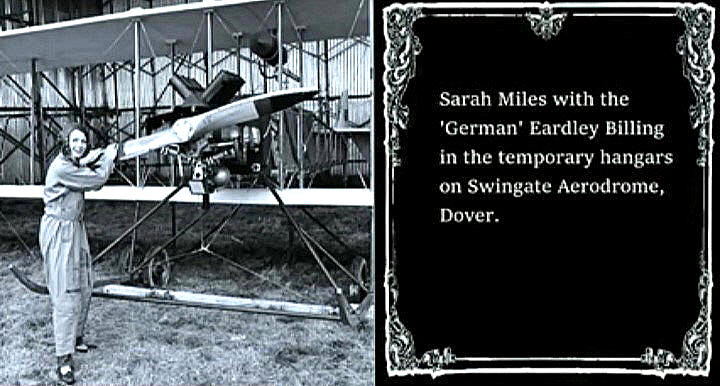
In 2022 Mr Graham Frost, a great friend of this 'Guide', sent me this photograph. He thinks he acquired it in the 1960s but cannot remember its source. Is it safe to assume that copyright doesn't apply?
The Eardley Billing tractor biplane was built at BROOKLANDS in 1911. It was crashed by N S Percival on the 4th October and he rebuilt it as the Percival Parseval.
Although I have described this site as being a 'Temporary Landing Ground' the fact that a pretty solid hangar had been erected, as seen in the picture above, does make me wonder if the Landing Ground was more than just temporary?
There is no evidence of a Sarah Miles obtaining a Royal Aero Club Certificate, so, as the Eardley Billing machine was a single seater, she presumably would not have been training on it? Unless of course she had already flown solo? If anybody can kindly offer advice this will be most welcome.
We'd love to hear from you, so please scroll down to leave a comment!
Leave a comment ...
Copyright (c) UK Airfield Guide