





Uxbridge flying sites
Note: This map gives the position of RAF UXBRIDGE.
UXBRIDGE: Forced landing ground
NOTES: To try and list forced landing grounds in the UK would be utterly impossible, they run into the tens of thousands I’m sure. But here is one example from July 1911, (I’ve included a few more sites elsewhere), when Lieut. Barrington-Kennet of the Coldstream Guards was flying a Bristol biplane from FARNBOROUGH to HENDON to take part in the celebrations to honour the arrival of the pilots in the ‘Circuit of Europe’ air race.
When over UXBRIDGE “his petrol feed-pipe went wrong” and, “he landed in a space so confined he was said to have - alighted on a table cloth”. But, it seems, (here is my reasoning), not so confined that he then took off having made a repair and performed at HENDON during a lull in the arrivals.
UXBRIDGE: Temporary aerodrome?
NOTES: Venue on the 3rd May 1933 for Sir Alan Cobham’s No.1 Tour.
Does anybody today know where this event took place? If so this advice will be most welcome.
UXBRIDGE: Military Landing Ground, much later temporary helicopter useage
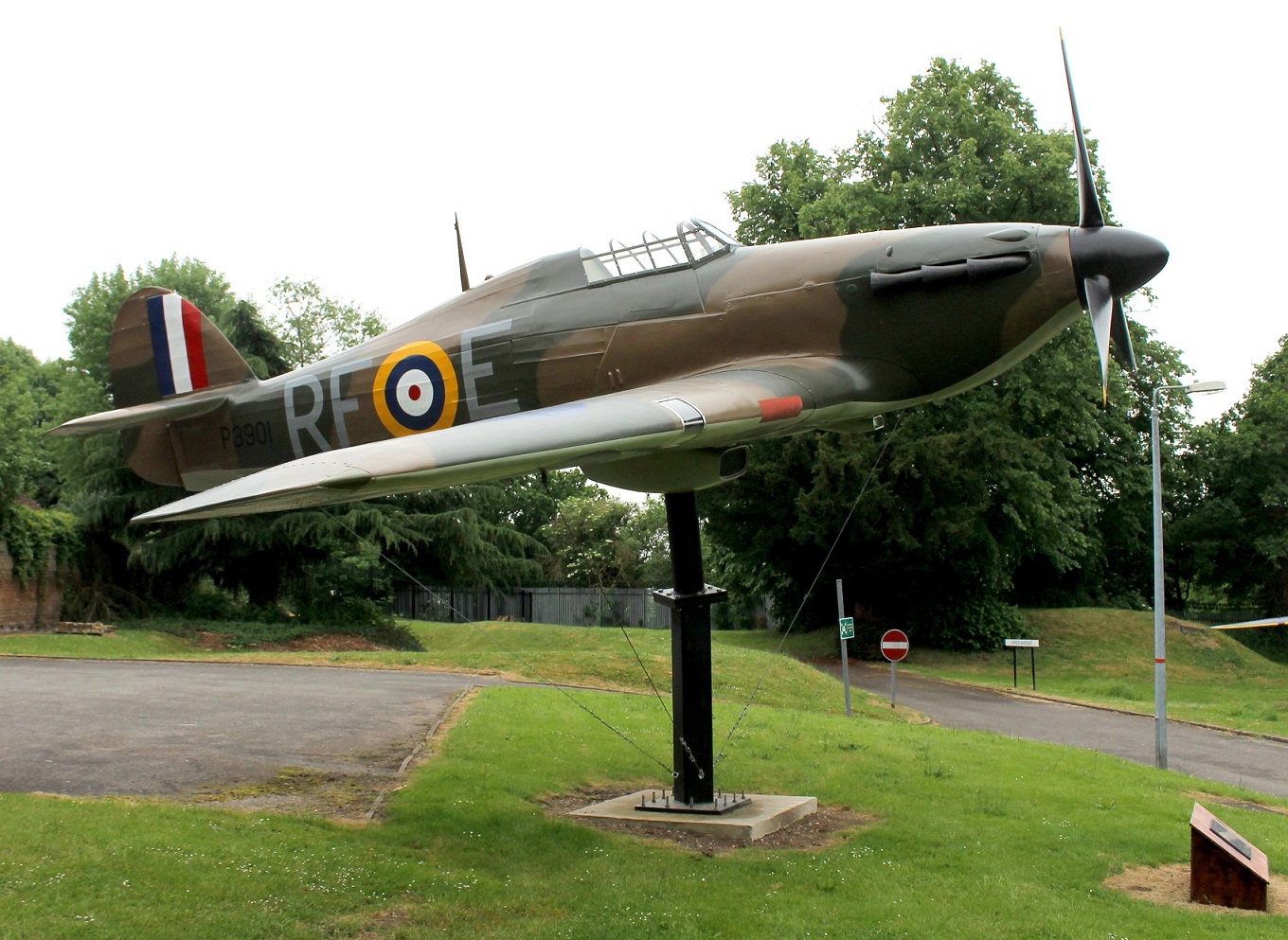
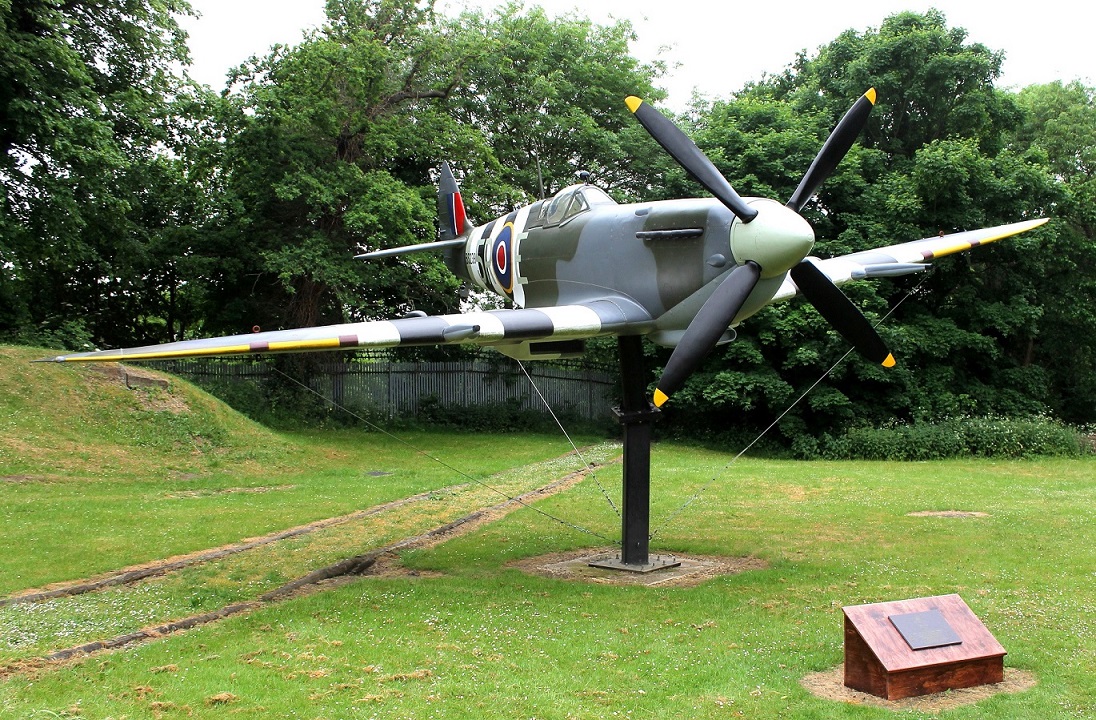
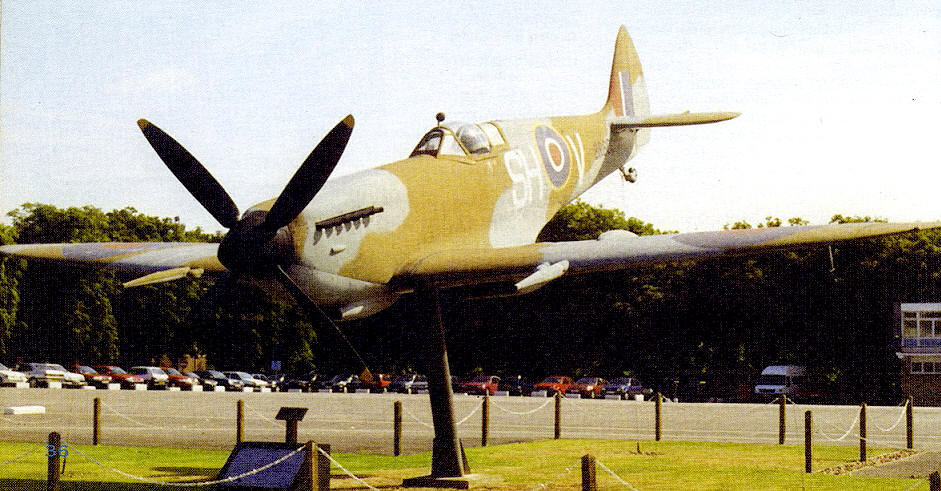
Note: The first two pictures are by the author taken in June 2012. The third picture of the Mk IX Spitfire is reproduced from 'RAF Uxbridge - A Fond Farewell' and it was this that replaced the original real Spitfire in 1988.
I could easily be mistaken but I think this could well be the Spitfire replica now on display (see my picture above) although sporting another colour scheme?
A MIKE CHARLTON GALLERY
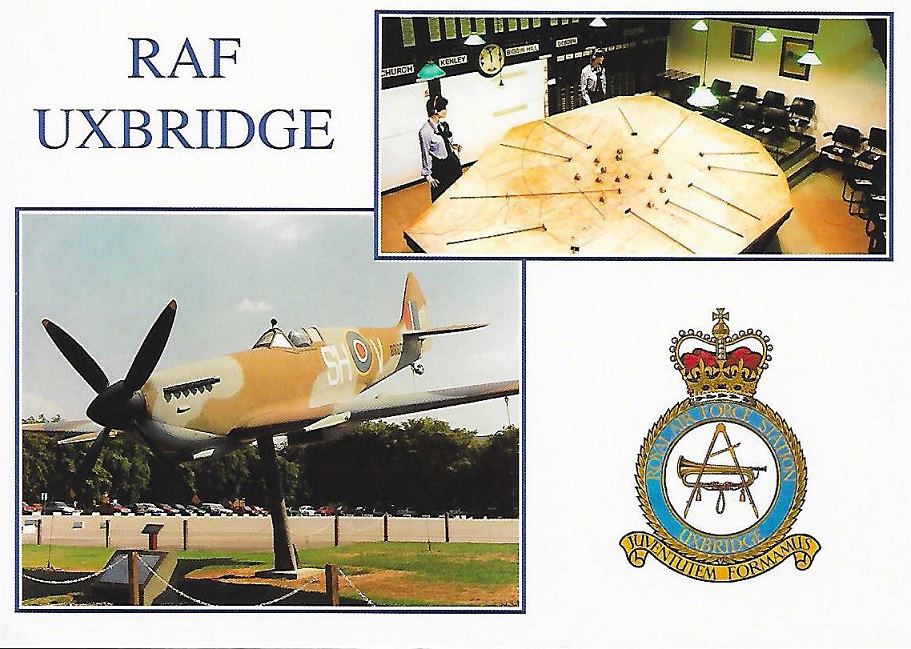


Note: These pictures from postcards were kindly sent by Mike Charlton who has an amazing collection. See, www.aviationpostcard.co.uk
The first picture appears to show the replica Spitfire IX, possibly BR600, before being repainted as BS239? Trying to get a handle on this seems to be remarkably complicated today.
The second picture. I'm no expert, far from it, but the uniforms worn in this picture appear to date from an early era, possibly from WW1? If anybody can kindly offer advice, this will be most welcome.
The third picture: This is most interesting. Can anybody kindly put a date on this? The Landing Ground marked with an 'X' is clearly visible, but the area looks too small for fixed wing operations. And of course this picture was surely taken before helicopters entered RAF service? Or was it? When did sepia pictures for postcards fall from favour?
Military users: 1918: RAF No.4 Sqdn? (Airco DH.6s)
Period of operation: (Mostly non-flying) November 1917 to March 2010
Runways: A large aerial photograph of the site, dated 1925, clearly shows the Landing Ground with a large‘X’ painted in the centre. This is in the ‘bunker’ museum and until 2012 at least, wasn’t on public display although it will be in years to come.
Helicopter areas: Although not marked out with specific helipads the Parade Square and sports field have been used several times by RAF helicopters to transport ‘top-brass’ and dignitaries to the site. The first helicopter visit appears to have been in 1951.
Notes: The dates that the RAF DH.6s used RAF Uxbridge have not been confirmed, but 1918 seems highly likely. It is also just possible that infrequent visits took place for some years afterwards.
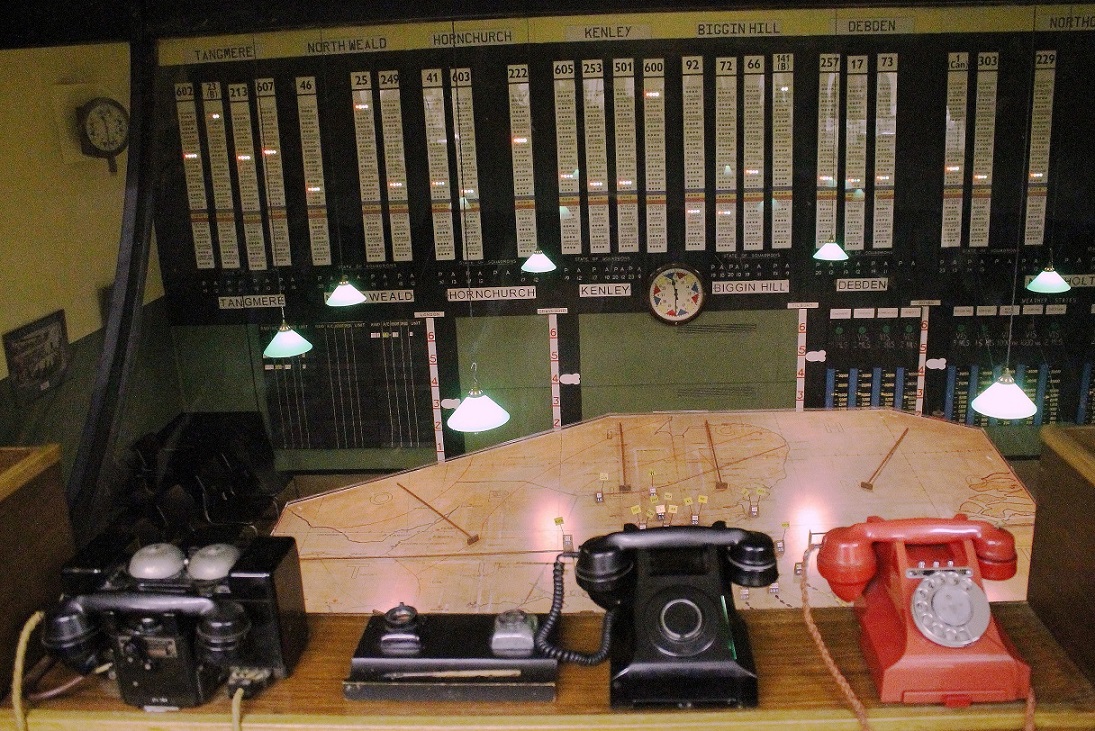
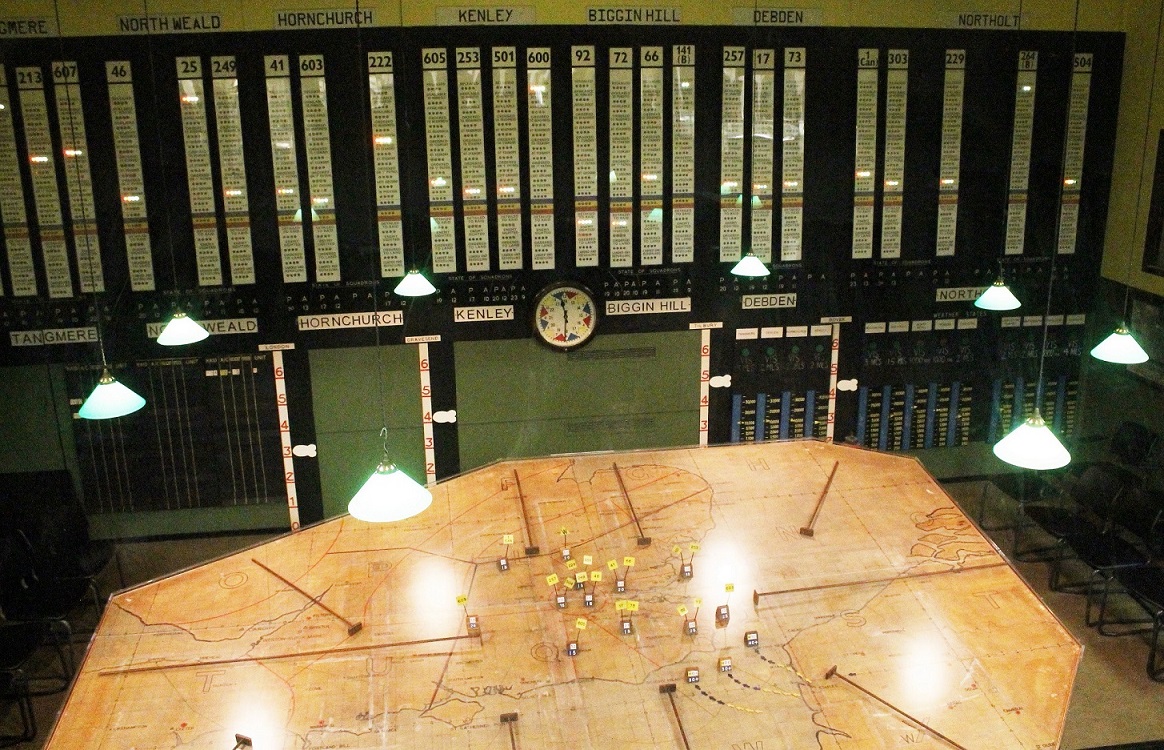
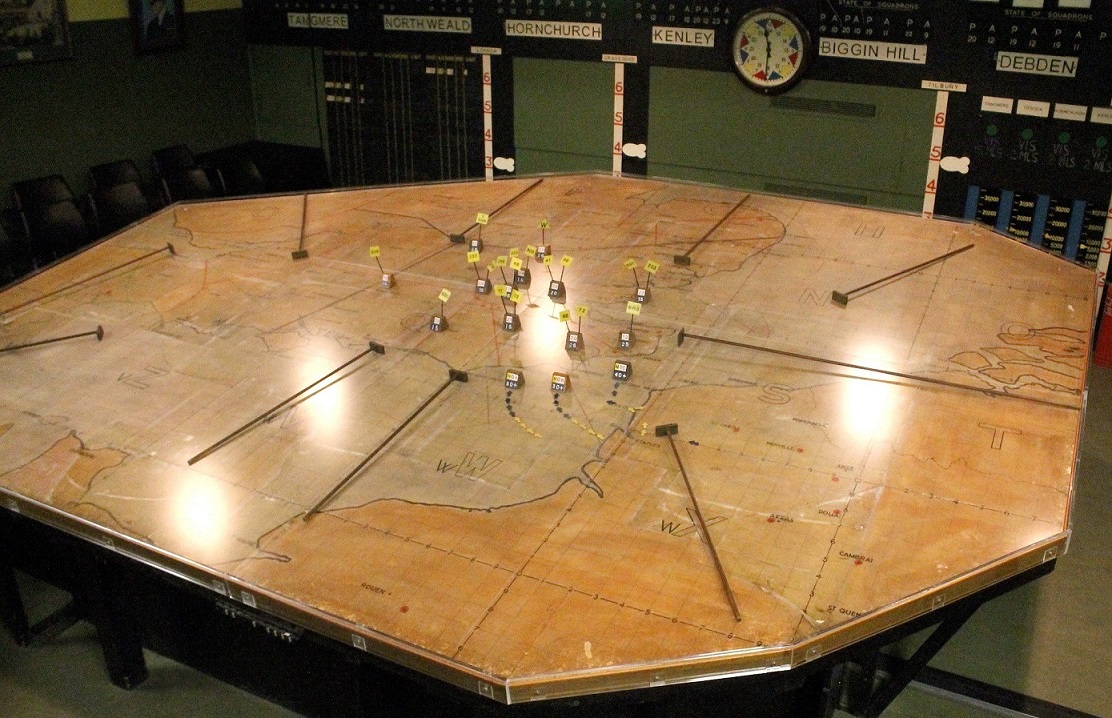
Note: The 'Tote Board' is set as it was at 11.30hrs on September 15th 1940, 'Battle of Britain Day'. The 'Plotting Table' clearly shows that the area of conflict was already known to be mainly in the south-east of England, and possibly spreading across to other southern regions. The percieved threat coming from northern France, Belgium and the Netherlands. As it turned out, most of the Luftwaffe offensive took place from northern France.
This certainly serves to prove my point that the so-called 'Battle of Britain' was nothing of the sort and should be called the 'Battle of the South' or something similar. The majority of the RAF took no part in this and it did not affect most parts of the UK. Quite how this myth took hold escapes me. The threat of an invasion was just that - a threat. As those in power already knew, it was simply posturing by Hitler and his cronies, and the possibility was by then very remote. Except that, due to the blustering campaign by Hermann Goering insisting that the Luftwaffe alone could accomplish the task, the German High Command, for a while, accepted his notion that superior air power alone could win the day.
Quite why the German High Command accepted this notion is hard to explain. It had never been proved to be the case elsewhere as their invasion campaigns always involved massive land forces - which are nearly always severely at a disadvantage invading from the sea. As the D-Day invasion proved. But by then of course the Allied forces had fully understood that only a truly massive force could hope to succeed. And, despite having such a force, it was a very hard and bitter battle with enormous casualties suffered.
By comparison to D-Day, if an invasion by the Germans had taken place, they would have been decimated, quite probably before reaching our beaches by the Royal Navy. But, this was fanciful thinking except for propanda purposes by the British government. RAF photo-reccce flights had already revealed that the German invasion force by sea had stalled.
THE BUNKER (Known as 'The Hole' by those serving in it)
RAF UXBRIDGE certainly deserves a mention for a very important reason. It was from here that most of the aerial ‘Battle of Britain’ movements were orchestrated for 11 Group, (Mark this – 11 Group only!), from a bomb and gas proof bunker built deep underground, (60 ft underground at floor level). A fantastic achievement surely, and also encompassing total belief in the benefits of the only slightly proved ‘state of the art’ technology such as radar.
It is a myth that only the British had radar, the Germans had it to defend their homeland. They didn’t have it in France, (or at least not in widespread useage at the start of WW2), presumably simply because, with as they perceived it having a vastly superior air force, they didn’t need it. But of course, having limited range radar in this case would not have been of any use over SE England.
A VISIT
I paid a visit to the ‘bunker’ in June 2012 as part of a group, (which can be easily arranged), and it was a most memorable day. Not least because the main presentation conducted by the historian Mr Christopher Wren was a tour-de-force which deeply impressed all of us. Here was a man, one of few, who not only knew his subject to an astonishing degree, he was also committed to dispelling the myths and legends surrounding the ‘Battle of Britain.’ And a few more regarding WW2 aviation history too.
I find this of great interest when reading about the history of this period. Some say the building work commenced in 1936, but it didn’t. The idea was first mooted in 1936 when Air Chief Marshall Dowding suggested it should be situated either inside or outside the grounds of the RAF Depot at UXBRIDGE, preferably the former.
It appears the genius was, the Deputy Chief of the Air Staff, C. C. Courtney, when he stated, in a minute sheet dated 31st July 1936, “As regards the Operations Room, it is so small that the chances of its getting a direct hit are not large, provided it is kept reasonably inconspicuous from the air.” But here is the crunch point, “I think it would be reasonably safe to place it somewhere on the Uxbridge estate provided it is kept well away from the main block of the headquarters building and is not placed adjacent to any other conspicuous landmark. It certainly ought to go underground.”
This point was obviously well taken and excavation work began in 1938 and building work commenced in February 1939. It was a close run affair with the ‘Ops Room’ becoming operational on the 25th August 1939, just ten days before the declaration of war! Another irony probably; as McAlpine were the contractors it can well be assumed many if not most of their employees were Irish, coming from a State whose government were utterly anti-British.
POOR TREATMENT
It is a little stated fact that without the help of the Irish, building facilities such as this and many if not most RAF airfields in the UK, we would have stood no chance in taking a major stand in ‘winning’ WW2. And, they were usually treated in the most despicable way, mostly treated little better than farm animals.
This said, at many RAF Bomber Command Stations, the RAF treated their aircrews, (let alone ground crew), with not much better regard.
WOMEN AT THE SHARP END
As Christopher Wren pointed out, when the ‘Battle of Britain’ erupted it was clear this ‘Bunker’ was in danger of becoming seriously understaffed, so some bright spark suggested using WAAFs. The original idea was that three women would be required to fulfil the duties undertaken by two men. It soon became abundantly clear that women were much more capable of ‘manning’ the plotting table than men were, and fulfilling other operational tasks in the 'Bunker'.
DISPELLING ANOTHER MYTH
We are usually supposed these days to regard the entry of Great Britain into WW2 as being pretty much a sudden and political decision decided on a point of principal, and on moral grounds, when Germany invaded Poland in 1939. This is yet another myth. Despite our Prime Minister, Neville Chamberlain, climbing out from a British Airways Lockheed Electra aircraft at HESTON and waving a piece of paper and declaring, “Peace in our time”, the truth is that many people in influential positions, both in military and civilian posts; had regarded war with Germany as being inevitable, and had taken steps to prepare for war several years before 1939.
AND ANOTHER
Another myth which must be trashed is the ridiculous notion that at one point in the ‘Battle of Britain’ the RAF had everything, including the ‘kitchen sink’ in the air. It has become an iconic scene in the film 'Battle of Britain' when Prime Minister Winston Churchill turns to the New Zealander Air Vice Marshall Keith Park and asks what do we have in reserve? To which Park replies, quite correctly; “nothing”. Sadly, that film is mostly a gross distortion of the situation and has been hugely damaging to the appreciation of the real history by the general public. But of course, the film industry is notorious for not letting the truth get in the way of a good story.
That comment applied only to 11 Group on that particular fateful day. The fact is that 75%, (probably more?), of RAF aircraft and aircrew were either not involved, or barely involved, in the ‘Battle of Britain’. As the main force of the German aerial invasion tool place over the south and south east of England, it was 11 Group alone that bore the brunt. Indeed, when Air Vice Marshall Leigh-Mallory, (later Air Chief Marshal), commanding 12 Group in the Midlands was asked for support and reinforcements at the height of the 'Battle of Britain', he was very loathe to provide anything. And it seems, only provided a handful of squadrons.
TWO MORE HISTORIC EVENTS
11 Group was tasked with arranging air cover for Operation JUBILEE, the disasterous invasion of Dieppe in August 1942 which was essentially a trial in preparation to what eventually became Operation OVERLORD, the D-Day invasion of Normandy. One has to wonder why the decision was taken to invade Dieppe, the one port and town in northern France that could be, and was, both very heavily defended and the the most difficult to invade. Did nobody have any maps and photographs of the place? Was no advice taken by those with knowledge of the town and port?
D-DAY
During 1944 RAF UXBRIDGE became a key centre for the preparations. The Joint Air Plan for the Air Operations Assault phase of Operation NEPTUNE was issued at UXBRIDGE. This was it appears, the only executive order the British and US Units recieved for carrying out air operations on D-Day.
And, RAF UXBRIDGE was the Combined Control Centre for Air Operations during the lead-up to, and the invasion on the 6th June 1944.
NOT QUITE THE END
Although the Station closed in 2010, the 'Bunker' has been preserved as a museum and is still open for pre-arranged groups to visit. Highly recommended.
Michael T Holder
This comment was written on: 2020-05-24 17:15:54From the Uxbridge & W. Drayton Gazette – Friday 14 August 1925 – Advert for the World-Famed Berkshire Aviation Tours announcing Passenger Flights from Five Shillings each at Moor Farm, Cowley Mill Road, Uxbridge on Sunday at 4:15 and 7:45pm. And again on Sunday 16th August at 8pm. Cowley is to south of Uxbridge and at the southern end of Cowley are the Cocoa-nut Fibre Mills. The road crosses the Grand Junction Canal and the River Colne by the Mills; past the Colne Bridge (Clisby’s Bridge) on the RH side is Palmer’s Moor Farm – 51 31 47”N 000 29 41”W - which I think is the one referred to in the advert. Couldn’t find a Moor Farm anywhere else.
We'd love to hear from you, so please scroll down to leave a comment!
Leave a comment ...
Copyright (c) UK Airfield Guide