





Watchfield flying sites
WATCHFIELD: Private airstrip/airfield
NOTES: It seems that the U.K. Piper distributor, (prior to WW2), and previously based at HANWORTH AIR PARK, moved to a private airstrip in/near WATCHFIELD just prior to WW2. The big question being of course, did this site eventually become the WW2 RAF aerodrome? Or was it nearby? It now appears that when they moved here in1938, they adopted the rather odd company name of Cub Airport Ltd.
It is very much part of the task of producing this 'Guide', to always keep amending listings as new information is found. Mr Graham Frost, a great long-term friend of this 'Guide', noted that, in the Civil Aircraft Register, the Piper J/3 Cub, G-AFIO, was registered to Cub Airport Ltd from 10.08.39 until 01.12.46, although it also appears, it was scrapped during WW2.
This led me to have a delve, and I suppose that Cub Airport Ltd handled the sale of the J/3 Cub, G-AFIY to Mr Herbert Perkins in Coventry, who registered it from 27.08.38 until 22.03.39. Another J/3-50 Cub, G-AFIZ, was also registered by them from 10.08.39 until 11.02.47. A Piper sales agency was also, it appears, at around this time after WW2, established at GATWICK. (Using the same company name?) But of course it does beg the question about how they survived WW2? Presumably, as they were not impressed, (the RAF having no use for them), being placed into storage.
As always, if anybody can kindly offer advice and information, this will be much appreciated.
WATCHFIELD: Military aerodrome
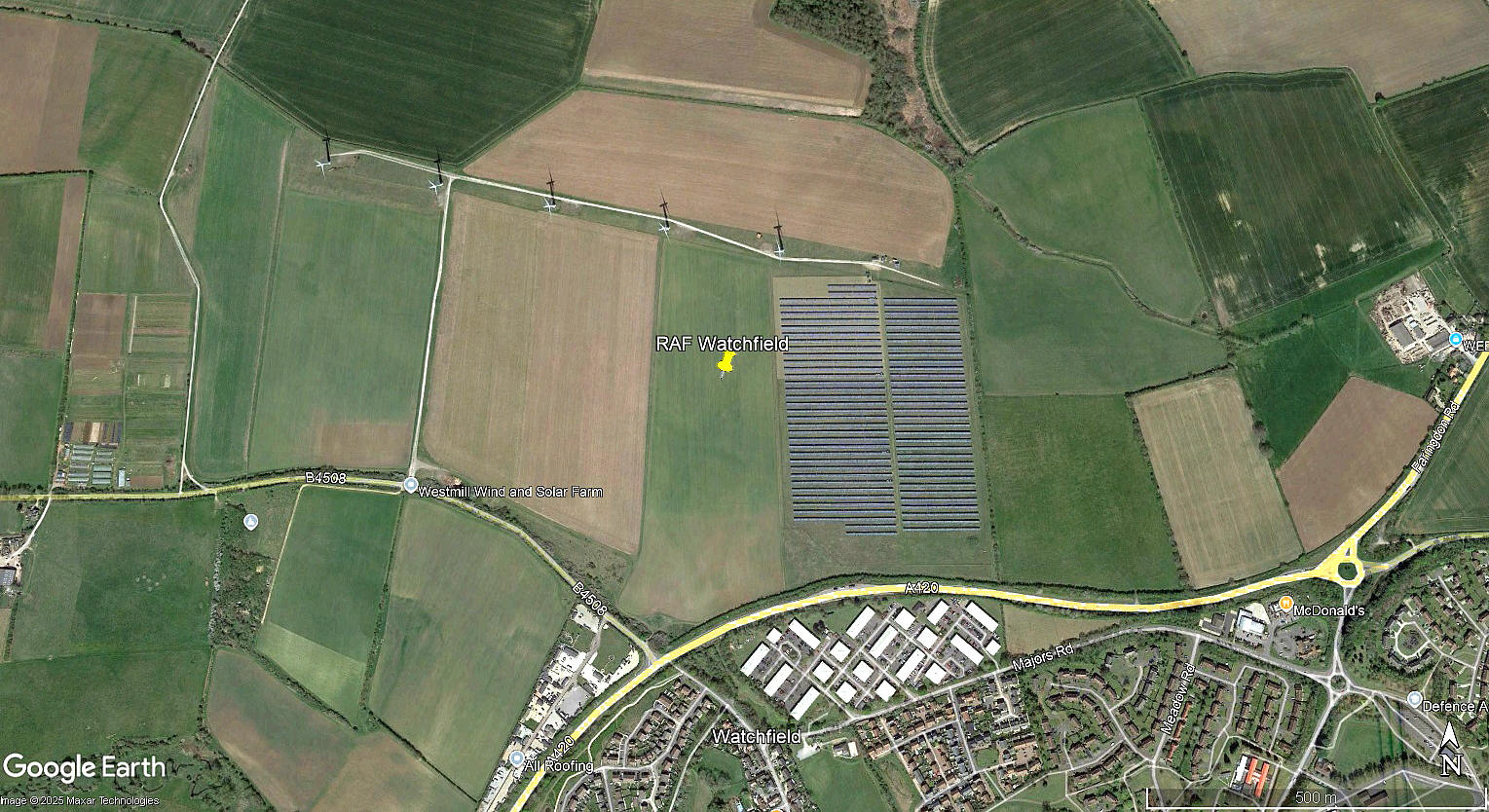
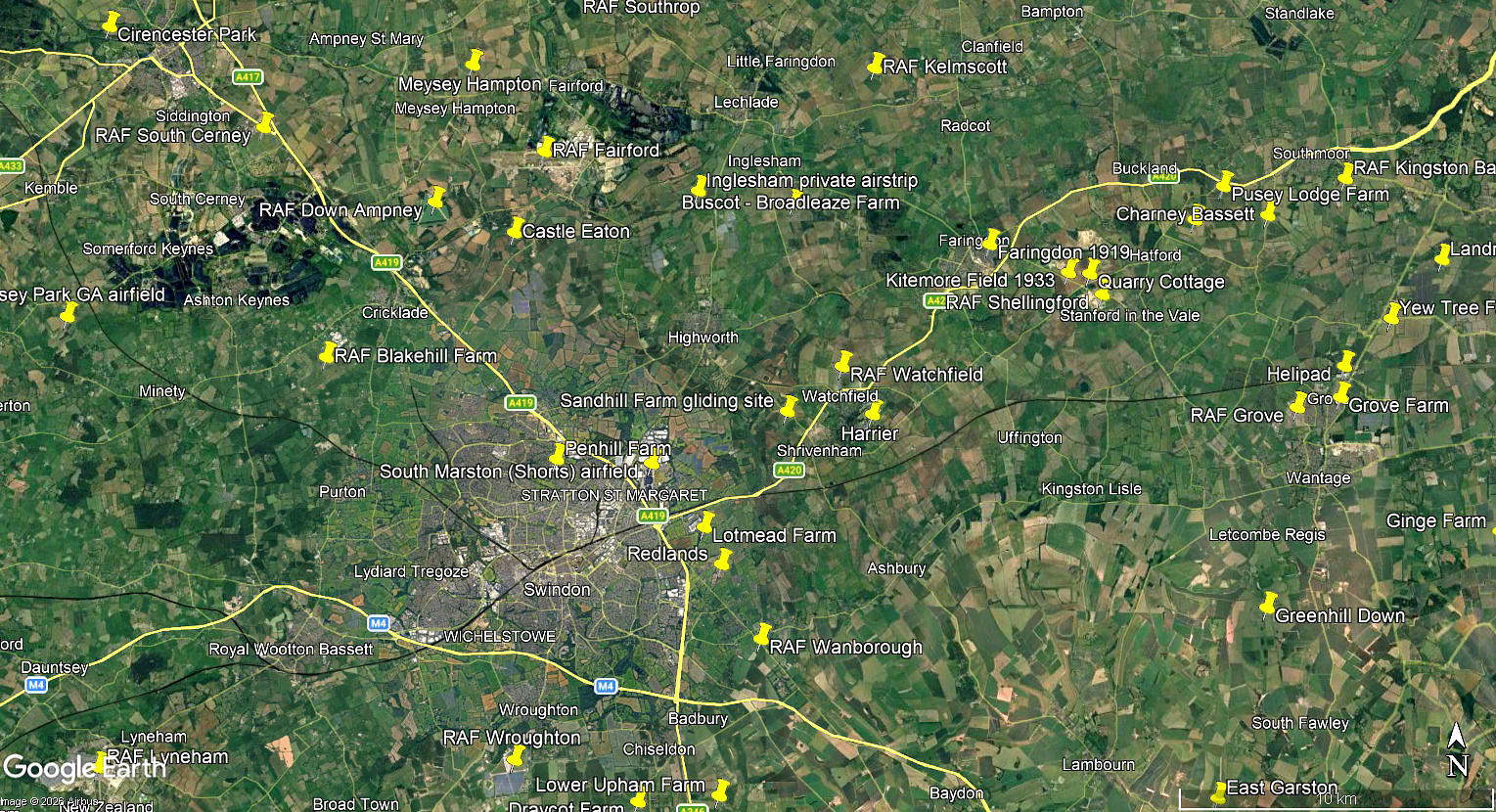
These two pictures are from my Google Earth© derived database.
(Location now in OXFORDSHIRE)
Military users: WW2: RAF Flying Training Command 23 Group
AFU [Advanced Flying Unit] (RLG - Relief Landing Ground )
1 BAS [Beam Approach School] (Airspeed Oxfords)
11 AONS [Air Observers Navigation School] (Avro Ansons)
EFTS (?) (DH 82A Tiger Moths?)
Note: A bit more research reveals that 3 EFTS from RAF Hamble (HAMPSHIRE) were based here for a short period in the middle of 1940.
1944: RAF Transport Command
271 Sqdn (Handley Page H.P.54 Harrows - nicknamed 'Sparrows')
Gliding: 1970s only?
Location: W of A420, NW of Watchfield, 7nm NE of Swindon
Period of operation: 1940 to 1950 (Gliding 1970s)
Runways: WW2: NW/SE 1280 grass NNW/SSE 1554 grass
N/S 823 grass
NOTES: I do love discovering obscure aspects of aviation history. In his autobiography Can Anyone See Bermuda? Archie Jackson starts the book by describing being aloft, in a Tiger Moth from WATCHFIELD, when on his first period for pilot training in WW2. A look at my notes showed no indication of a primary training school here but I very much doubt Capt Jackson was mistaken. After all, he had his logs books on hand to refresh his memory. As now amended, (see above), it appears that No.3 EFTS from RAF Hamble spent a short time here in the middle of 1940. Which seems to fit the bill?
ANOTHER EXAMPLE
For another example in his book Aviation in Doncaster, Geoffrey Oakes describes the history of 271 Squadron which was mostly based there. He makes this observation after ‘D’ Flight had already moved to DOWN AMPNEY in WILTSHIRE for the ‘D-Day’ invasion: “ In July it moved to Watchfield, Berkshire. Its task for the next few months was to evacuate casualties from the front line to the rear. The Sparrow, first designed and built as a bomber, with its antiquated looks, was now being used for humanitarian purposes. It also out-performed its American successor, the Douglas C-47 Dakota, in its ability to land and take-off from very small, unprepared fields.”
How many people today have heard of the ‘Sparrow’ or still appreciate the essential role it and the aircrews flying it then played? It was originally the Handley Page HP.54 Harrow bomber (I think?) and in this role, it has to be said, was an utter failure; virtually useless but even so procured by the RAF in considerable numbers for those days, a hundred aircraft being built.
We'd love to hear from you, so please scroll down to leave a comment!
Leave a comment ...
Copyright (c) UK Airfield Guide