





Wattisham
WATTISHAM: Military aerodrome later major base. Also later gliding site

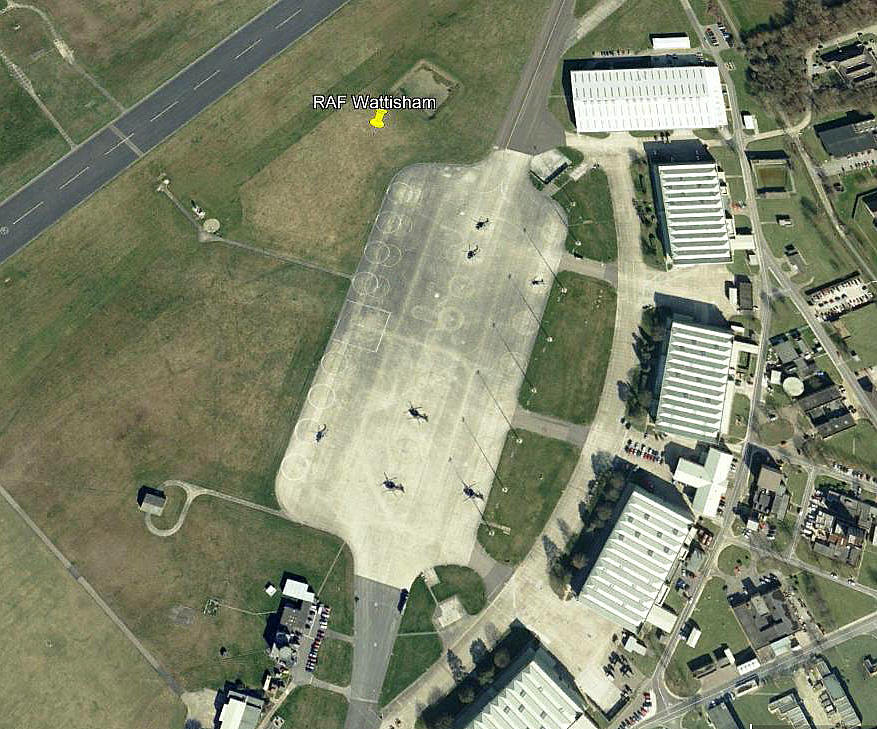
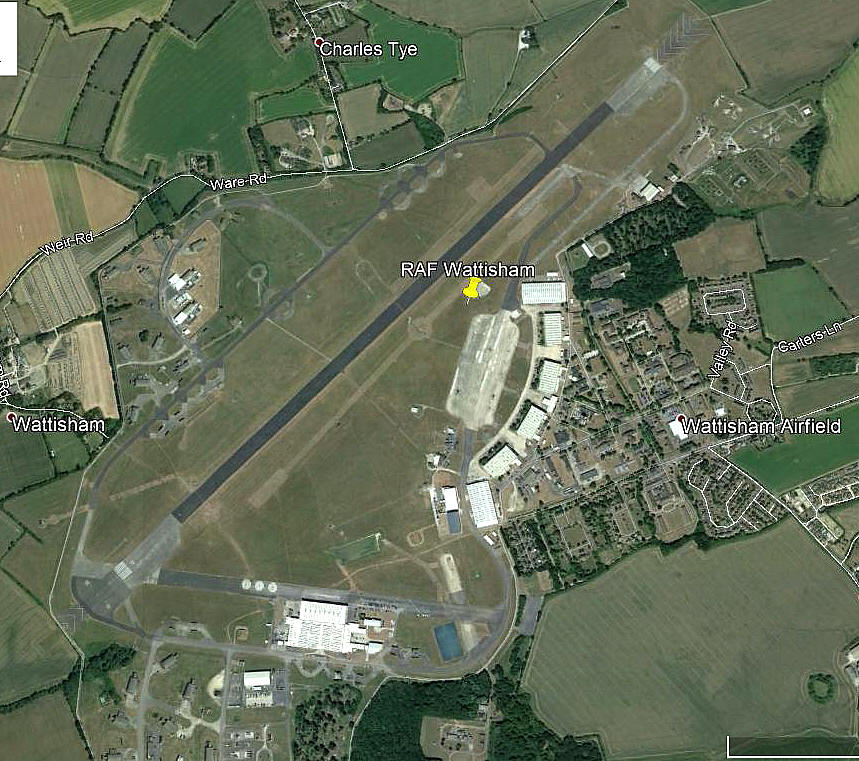
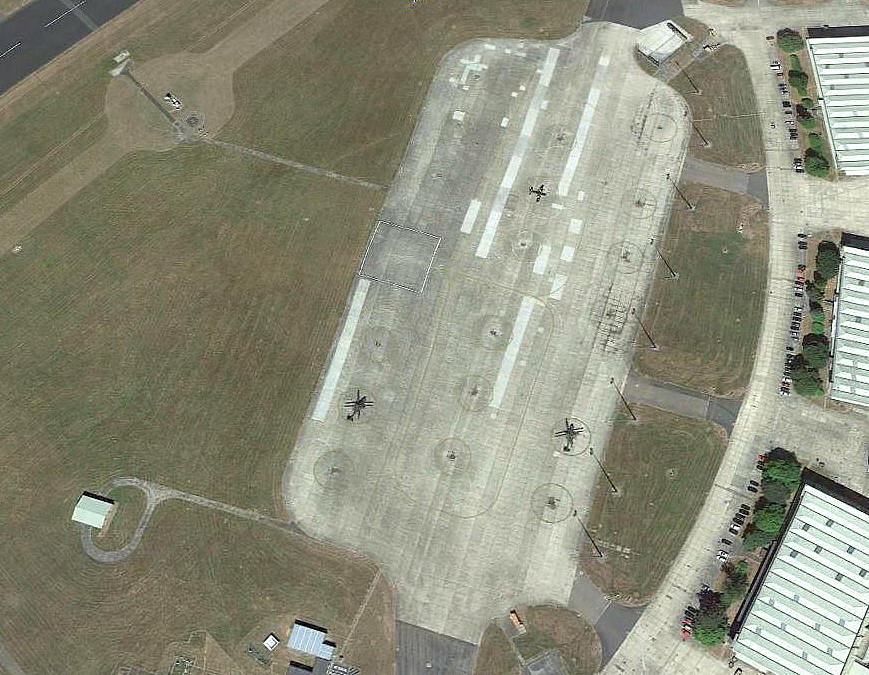
Note: All four of these pictures were obtained from Google Earth ©
Military users: WW2: RAF Bomber Command 2 Group No.83 Wing
18, 107 & 110 Sqdns (Bristol Blenheims)
226 Sqdn (Bristol Blenheims later Douglas A-20 Havocs/Bostons)
RAF Coastal Command
86 Sqdn (Bristol Blenheims)
The USAAF moved in during September 1942.
8th USAAF
Note: Between October and December 1942, the 68th Observation Group moved in flying the Bell P-39D Airacobra.
65th Fighter Wing 479th Fighter Group
434, 435 & 436 Sqdns (Lockheed P-38 Lightnings, later North American P.51 Mustangs)
A MICHAEL T HOLDER GALLERY
We have Mike Holder, a great friend of this 'Guide', to thank for researching what is freely available to illustrate the WW2 USAAF period.


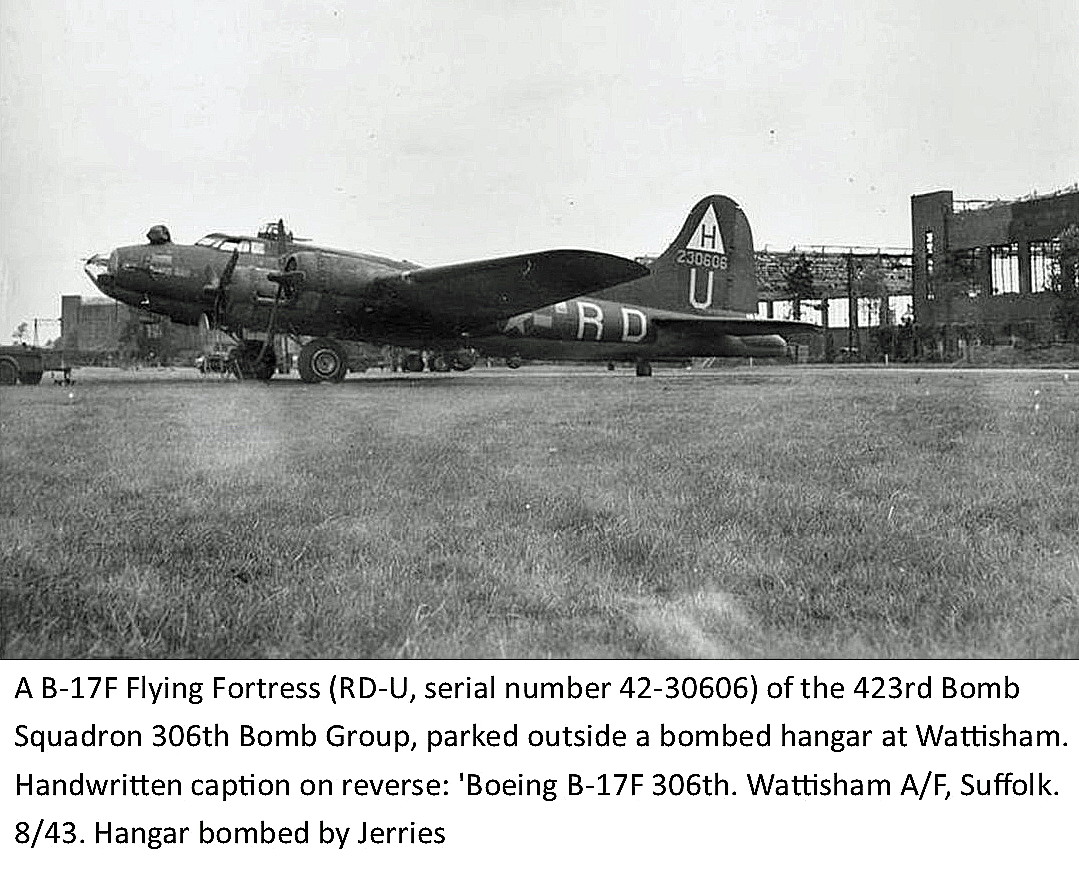
This picture is from the American Air Museum (A.A.M.)
It appears that the 4th Strategic Air Depot serviced many types here until around 1943, when they concentrated on fighter types. Perhaps this was one such? Or of course, possibly a diversion, or indeed just a friendly visit?
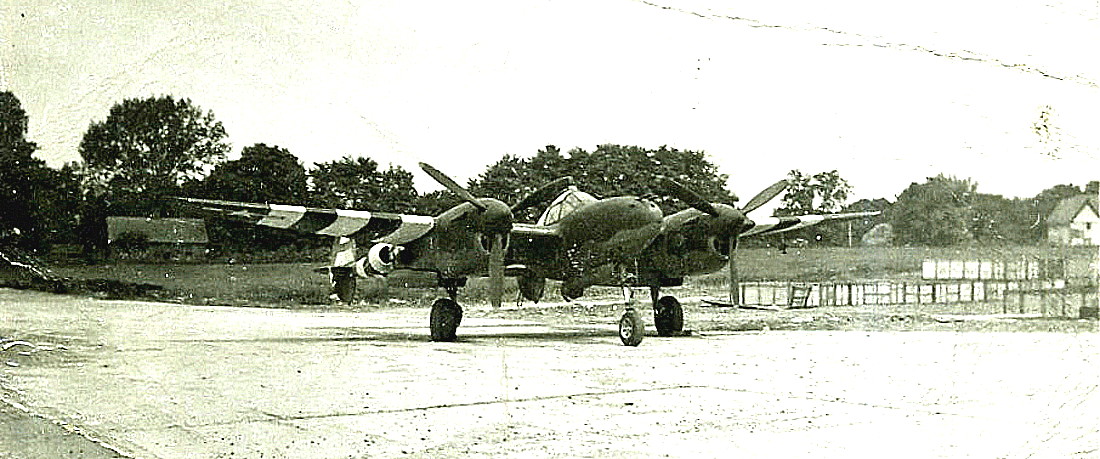

The picture of the P-38 Lightning is also from the A.A.M., so presumably one being flown by either the 434th, 435th or 436th Squadrons?
THE MUSTANG ERA
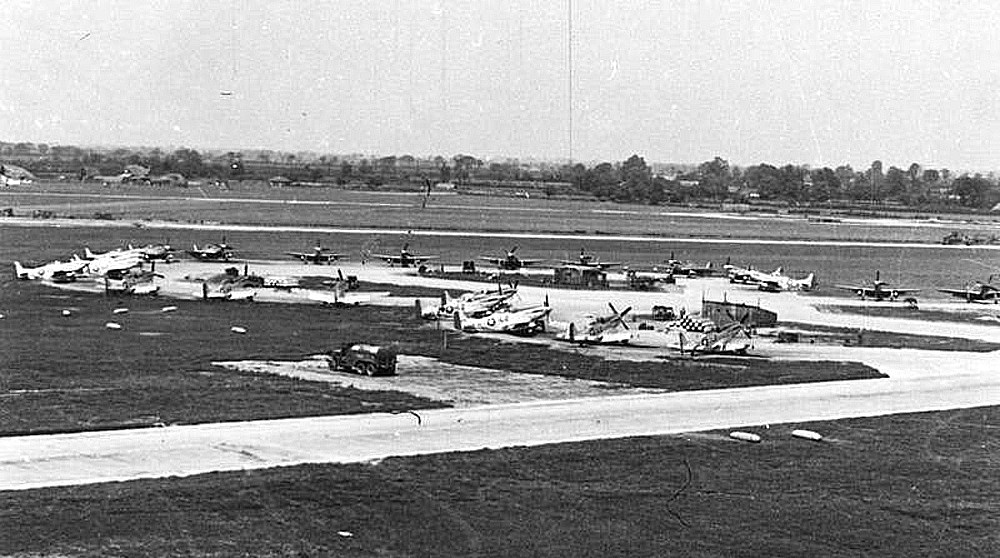
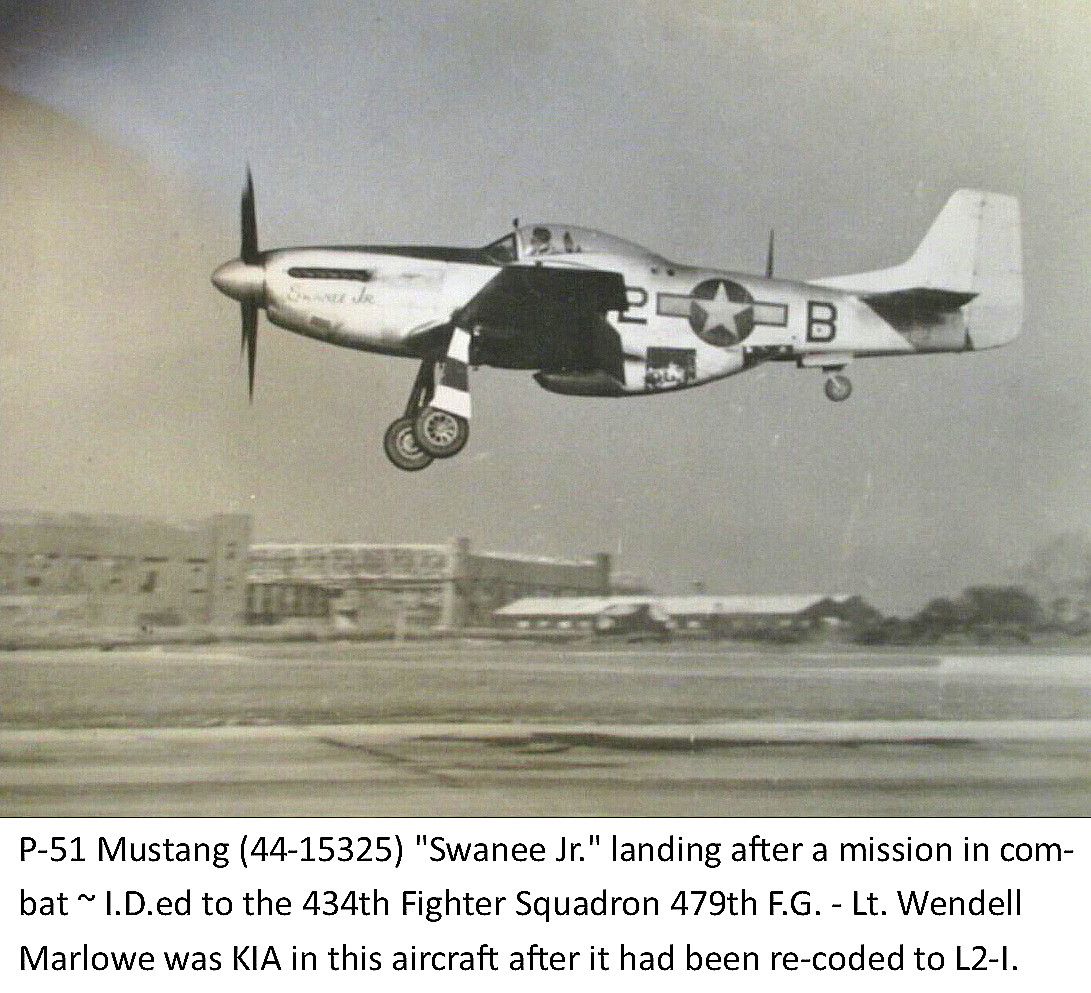
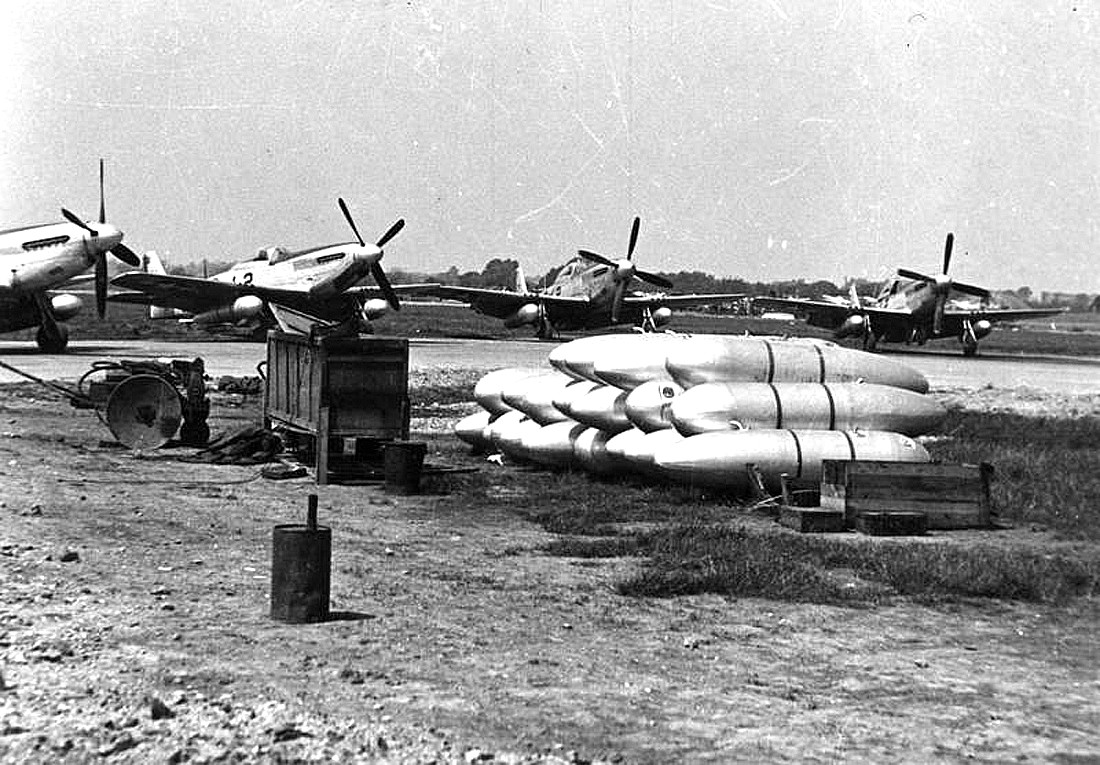
All three of these pictures are from the American Air Museum.


The local area and area views are from my Google Earth © derived database.
Post 1945: RAF Fighter Command
1946 to 1947: 266 Sqdn (Gloster Meteor F.3)
Note: The Air Ministry Servicing Development Unit was formed here on the 1st January 1947. THe types they operated inclused the Avro York 1, Hawker Tempest V, Gloster Meteor F.4 and T.7, Avro Anson T.20 and de Havilland Vampire F.3.
'V' Bomber dispersal airfield
22 (SAR) Sqdn (Westland Whirlwinds?)
1950s: 41 Sqdn (Gloster Javelins)
56 Sqdn (Hawker Hunters, later English Electric Lightnings and later MacDonnell Douglas Phantoms)
111 Sqdn {Black Arrows} (Hawker Hunters)
152 Sqdn (Gloster Meteor NF.12)
257 & 263 Sqdns (Hawker Hunters)
Note: The Station Flight had a de Havilland Vampire, de Havilland DH89A Dragon Rapide and a Hawker Hunter. (The latter being used by the Station Commander!)
1960s & 70s: 29 & 111 Sqdns (English Electric Lightnings)
23, 56 & 74 Sqdns (MacDonnell Douglas Phantoms)
111 Sqdn (Hawker Hunters later English Electric Lightnings)
257 & 263 Sqdns (Hawker Hunters)
1990: RAF Military Emergency Diversion Aerodrome
1998 snapshot: RAF Search and Rescue
B Flight (22 Sqdn) 2 x Westland Sea King HAR 3A
Army: 659 AAC Sqdn (Westland Lynx helicopters)
21st CENTURY
AAC 3 and 4 Regiments
Since 2007? 653 Sqdn (Boeing AH-64 Apache helicopters)
Gliding: 1970s to -
1981: Anglia Gliding Club (RAFGSA)
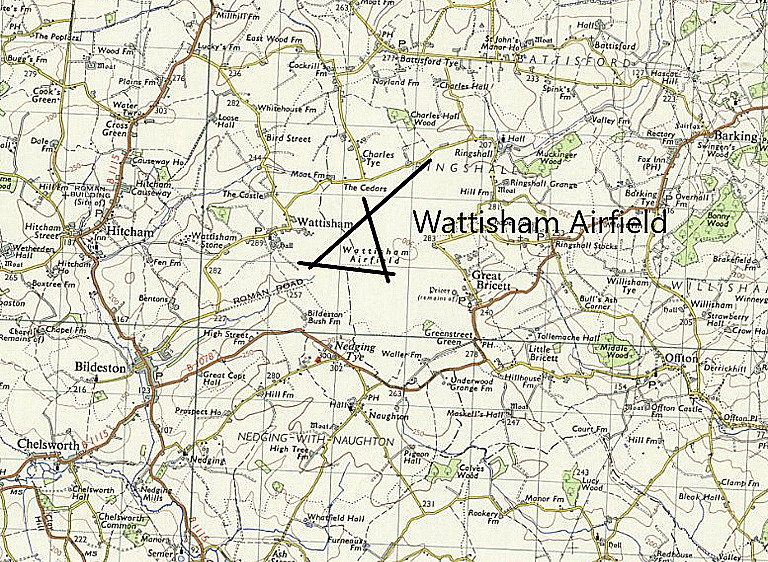
Location: NW of B1078, E of Wattisham, 8nm NW of Ipswich
Period of operation: 1939 to present day?

Note: This map is reproduced with the kind permission of Pooleys Flight Equipment Ltd. Copyright Robert Pooley 2014.
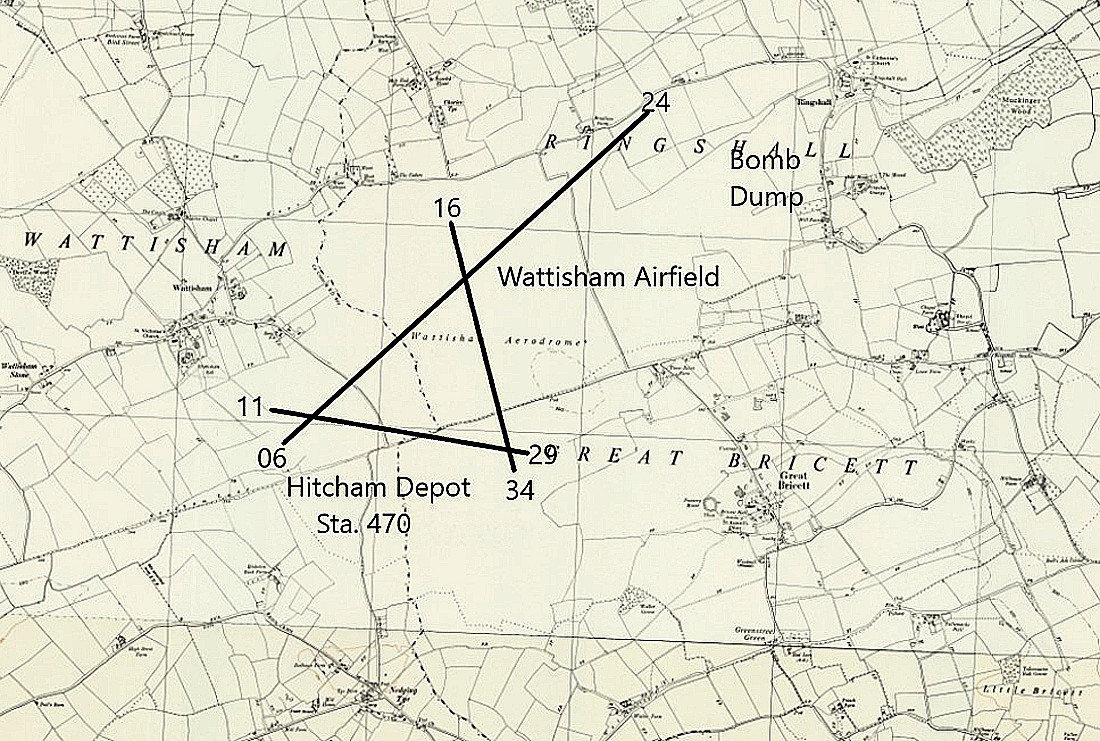
Runways: WW2: 06/24 1829x46 hard 11/29 1280x46 hard
17/35 1280x46 hard
1990/2000: 05/23 2283x46 hard
A PICTURE

In April 2018 Mike Chartlon sent me this rather quaint picture from a postcard he'd recently acquired. Mike has an astonishing collection of aviation postcards, around two thousand in all. See, www.aviationpostcard.co.uk
As you can clearly see, I have no other pictures to illustrate RAF Wattisham, and if anybody can very kindly help to address this sad lack of pictures, this will certainly be much appreciated.
NOTES: Were the above runways actually finished during WW2? I have seen a very basic map of the aerodrome, (supposedly drawn showing the 1944 layout), and it would seem the hard runways were under construction.
SOMETHING TO CONSIDER?
Without much doubt the way the German and Allied bombing campaigns are generally portrayed today leaves a lot to be desired in terms of historical accuracy. We British do have a pronounced tendency to punch ourselves on the nose before anyone else gets close enough to hit us. For example the constant blame accorded to the RAF for not having adequate bombers with which to attack Germany once war was declared. Hindsight is a wonderful commodity and I wish I could bottle it and become a multi-millionaire.
Without any doubt our initial ‘heavy’ bombers were pretty useless considering what came later, but, the Luftwaffe ‘heavy’ bombers weren’t any better either. What they had was vastly greater bumbers - and that is a crucial factor in area bombing. In point of fact the early RAF ‘heavy’ bombers were, speaking generally, superior to the majority of German bombers and, it seems, not too many care to remember this. The difference being that the Luftwaffe launched massive numbers of bombers protected by huge numbers of fighters against countries with little if any effective defence.
See my comments in the article ‘Battle of Britain’ whereby we only just "got away with it". and a much more practical approach would probably have assured an earlier victory. To put it bluntly we shouldn’t have had any fighters based in KENT. The irony being that because we did have fighter airfields based in KENT the Luftwaffe became obsessed with destroying the airfields they operated from.
A HUGE MYTH
Another huge myth still clung to, especially by the press and media, is, if the Luftwaffe had done exactly what they’d done before when working in combination with the German Army and Navy, as had been already proven on mainland Europe; without much doubt an invasion at dawn, (their preferred method), would have succeeded. And, the RAF, (and our Army and Navy), had no means to repel such an attack. After all, we’d just lost a huge amount of ‘hardware’ retreating back to Dunkirk.
The plain truth is that the Royal Navy was vastly superior, especially in sheer numbers of vessels, and a German invasion would have been a wholesale massacre. Plus, even if some of the invasion barges had managed to reach our shores the coastal defences would have quickly wiped them out. It was of course supremely important from a propaganda aspect that the fear of an invasion be kept uppermost in the public imagination. The RAF would hardly have got a look-in if an invasion by night was attempted as they couldn’t operate at night to counter something like this.
For some reason we’ll probably never understand, Hermann Goering (arguably our greatest ally in WW2) devised an attack plan for ensuring dominance of the air over south-east England which was pretty much guaranteed to fail despite the massive superiority of the Luftwaffe. But, as pointed out elsewhere, he was usually as ‘high-as-a-kite’ on medication. One of the principal reasons being that, by insisting on having his huge echelons established in formation before crossing the English Channel, by the time these forces reached London the single-seat fighters were very low on fuel.
However, all this is by-the-by. The British government were very keen to keep the population keyed-up with the prospect of the Germans invading in order to stump up support for the war effort. In reality RAF photo-reconnaissance showed that the invasion force ordered by the buffoon (in military terms) Adolph Hitler, never got anywhere near the force required - as they soon realised it could never be achieved and was quite quickly abandoned.
THE HAWKER HUNTER ERA
This most iconic jet fighter type took quite a long time to be developed into a formidable fighting weapon. The early F.1s as flown by 257 Squadron based here were very short on endurance and these were fairly quickly replaced throughout the RAF by the much better Hunter F.4 and F.5. It will probably remain a complete mystery why the Air Ministry even bothered to order the F.1 and F.2 versions – a massive waste of money. Indeed, major aerial military exercises, carried out before the Hunter F.1 and F.2 entered service quickly revealed this very serious deficiency. Within a year or two most if not all early versions had been replaced in front-line squadrons.
Quoting from Robert Jackson’s excellent book Britain’s Greatest Aircraft regarding the early Hawker Hunter years: “….in addition to working-up operationally on the new type,” (they), “carried out a great deal of display and publicity flying. In February 1955, for example, Nos 43, 257 and 263 Squadrons laid on a major flypast at Wattisham, and in March No.43 formed an aerobatic team with three Hunters. Also in 1955 the RAF’s four-ship Hunter aerobatic team was put up by No.54 Squadron, and both teams represented the Royal Air Force during the year at home and on the continent.” The supreme Hunter display squadron was of course 111 who had formed the ‘Black Arrows’ at NORTH WEALD in ESSEX before being transferred here.
However, to some extent, providing a suitable Cold War defence shield was not the only priority in the minds of the RAF top brass. Flying the flag and baton waving was also high on the agenda and Winston Churchill especially, during WW2, had greatly appreciated the value of positive propaganda. Perhaps the best example being the ‘Dam Busters’ raid which was, to all intents and purposes a dismal failure, (see SCAMPTON - LINCOLNSHIRE - for more info), having surprisingly little overall impact on the industry in the Ruhr region for which the raid had been designed. But, the aerial pictures taking afterwards were stunning and were a huge boost to the morale of the nation. Indeed, some say these pictures were instrumental in persuading the USA to enter the war in Europe.
As was very often the case, especially in the first two decades following WW2, the introduction of a new type could dramatically change the operational circumstances of both civil and military pilots. To quote from Robert Jackson again: “The Hunter F.4/F.5 Squadrons, now having an aircraft with an enhanced combat endurance over that of the F.1, used them to good effect in Exercise Beware, the annual Fighter Command air defence exercise which was held during the last week of September. In fact, this was the first major test of the Command’s Hunter Squadrons in a simulated war situation, and the pilots were impressed. While flying Meteor 8s they had grown accustomed to the disconcerting experience of having Canberras out-turning them at 40,000 and converting mild-evasion-only tactics into perfect quarter attacks on the Meteors’ exposed bottoms. The same pilots, now flying far superior aircraft, reported delightedly that the Canberra looked quite different when seen from above!”
SOMETHING FORGOTTEN?
It is often forgotten that in the early years of WW2 the USA had absolutely no intention of helping the UK resist the Nazi regime, in fact quite the opposite. For example it was a very serious criminal offence for any American to volunteer to take part in the war. Those American pilots for example, who took part in the ‘Battle of Britain’, did so at considerable personal risk of prosecution by the US authorities.
COLD WAR COMMENTS
As a LAP (HEATHROW) based teenager in the early 1960s I cannot recall being much aware of the ‘Cold War’ being an issue to be much concerned about. The Soviet Union obviously hardly posed a threat simply because Aeroflot were flying in every day. Indeed, if anything, we probably regarded the Tupolev Tu-104s arriving, (incidentally the worlds first successful jet airliner), with bomb-aimers glazed noses as something somewhat quaint. Most definitely not a sinister threat. Also, if anything, I now suppose, (proving the effectiveness of propaganda?), the annual air show at FARNBOROUGH in those days was ample proof we Brits had several aircraft which could easily out-perform anything the Americans had, and, through the spotter grapevine – mostly outperformed the Russkie’s types too.
THE ENGLISH ELECTRIC LIGHTNING
For RAF Fighter Command the English Electric Lightning was the star performer. Nothing else could touch it in terms of sheer performance. In 1963, 56 Squadron, then based here, became the RAF’s premier aerobatic display team. Even today I am still ‘lunching out’ after watching their nine-ship formation take-off at a FARNBOROUGH Air Show, when, after lifting off at the LAFFIN PLAINS end of the runway they appeared to go vertical in line-astern and kept on climbing until almost out of sight. It felt, as they commenced their formation take-off roll, that most of the households in Surrey and Hampshire must have been trembling and shaking. It really was an awesome spectacle, the likes of which will never, quite probably, ever be seen again.
I think it true to say that airframe design reached a peak during this era. Tweeked of course but has anything of note been added since in basic airframe design? Indeed, most major advances since appear to be to aircraft systems, such as fly-by-wire, computerised flight management etc. Even so, many so-called advances can be patchy. For example, experience during the Libyan conflict it is said to have been proven that the Typhoon was mostly a waste of space – or certainly the RAF version was. It is said the French Air Force aircraft were vastly superior.
COLD WAR REALITY
Perhaps incredibly, looking back, we spotters were very well informed. But, what of course we didn’t realise was that, just as in WW2, it was essentially a numbers game and in the event of a an all-out nuclear war the RAF, (and the UK), would have been bystanders. This wouldn’t have mattered in the slightest as much of the world would have been laid waste and neither side could win. It was of course the Russians, (to their eternal credit), who knew from very bitter experience the utter futility and suffering, in human terms, the consequences of all-out war during WW2. That an end to the ‘Cold-War’ had to be called for was a decision the Soviets made, mostly under the command of their astonishing leader, Mikhail Gorbachev.
ANOTHER ASPECT OF THE ‘COLD WAR’
See MARHAM for example to learn something about the history of air-to-air refuelling without which the RAF fighters could never have performed an adequate response during the height of the ‘Cold War’ – a concept the RAF top brass were dead against in the early years. To quote from Rowland White in his excellent book Avro 607: “At fighter stations like RAF Leuchars, Wattisham and Binbrook, McDonnell Douglas F-4 Phantoms and English Electric Lightnings sat fuelled and armed in their hangars on Quick Reaction Alert. Their crews maintained a twenty-four hours a day, 365 days a year vigil, ready to scramble at a moments notice to intercept intruders into UK airspace. These were invariably the Bear and Bison bombers of the Soviet Long Range and Naval Air Forces.”
“On average there were five incursions into UK airspace a week, each testing the reaction of Britain’s stretched air defences. The Soviet bombers would come in from the north, probing through the Faroes-Iceland gap. All had to be intercepted, identified and turned back by the RAF. Without the support of the Victor K2s the fighters, particularly the notoriously short-ranged Lightning, simply couldn’t have kept the Soviets at bay.”
It was all, of course, a total farce. Indeed, on being intercepted the Soviet aircrews would usually give a friendly wave and I’d like to think the RAF returned the gesture. On both sides these aircrews must surely have been wondering what on earth this was all about. On the ground, on both sides, demented scientists and their equally manic cohorts in the military, supported by people at high levels in their respective governments, were devising methods to not only destroy the entire world once in a final nuclear holocaust, but several times over!
Obviously nobody had thought to sit them down and calmly explain that destroying the entire World just once was quite sufficient, thank you very much. Let alone asking them what exactly did they think would be the benefits to humanity of achieving destroying the entire world several times over? It seems sad to reflect that amongst elements of the scientific community, as clever as a cage full of monkeys of course, that by and large it is often quite hard to detect any signs of intelligence and learning. They all too often appear utterly bereft of having even the slightest notion of consequences.
We'd love to hear from you, so please scroll down to leave a comment!
Leave a comment ...
Copyright (c) UK Airfield Guide