





Birmingham International Airport
BIRMINGHAM INTERNATIONAL AIRPORT: Civil major regional airport and pioneer heliport
(Previously known as ELMDON and then BIRMINGHAM AIRPORT)
See also HURDLE HALL FARM for temporary use in 1934
Note: All pictures by the author unless specified.
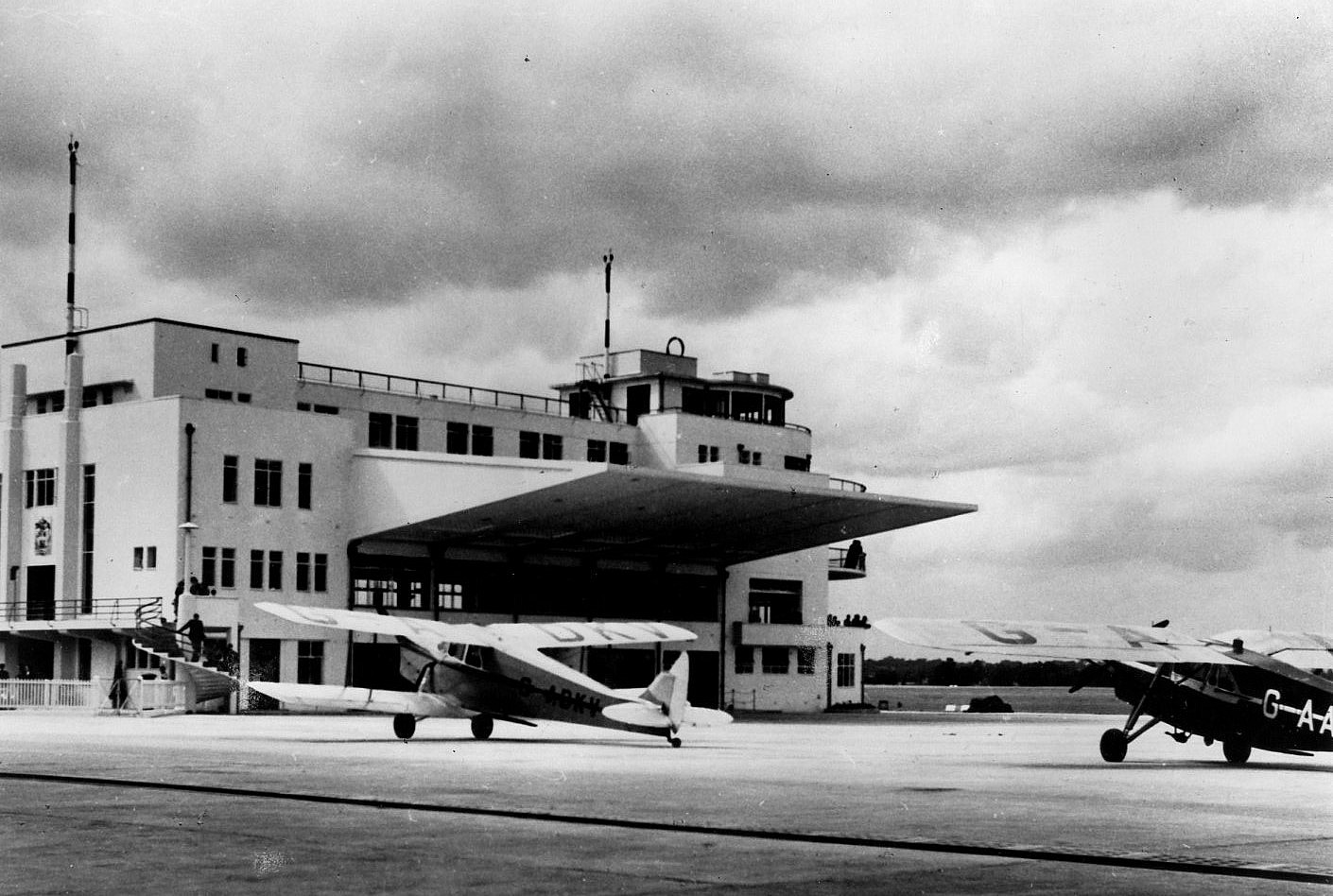
Note: Picture from The Aviation Picture Library
ICAO code: EGBB IATA code: BHX
Military users: Pre 1940: 44 E&RFTS
[operated by Airwork from May 1939] (Hawker Hind & Audax, plus some Miles Magisters)
Note: Closed when war was declared.
WW2: RAF Flying Training Command 51 Group
14 EFTS (DH Tiger Moths)
Bomber Command. 99 Sqdn (Vickers Wellingtons) here for only six days it seems
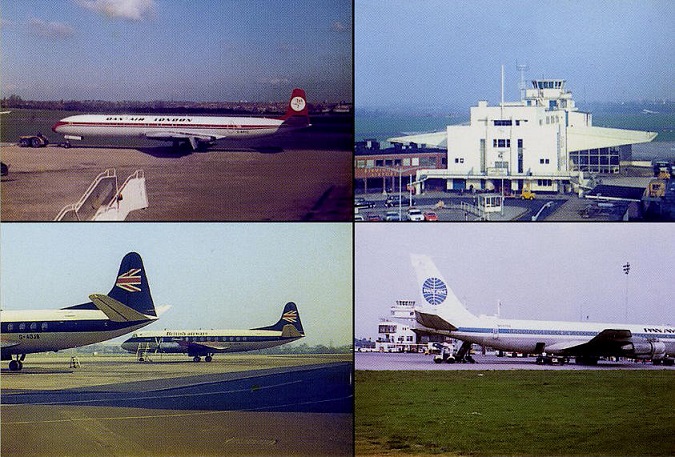
Note: This postcard acquired many years ago, was produced to commemorate the first Birmingham Aircraft Enthusiasts Fair, held on Saturday the 29th October 1994. It was a limited edition of 1000.
All the pictures were taken by Carl McQuaide and the caption is quite detailed: Top left - Dan Air Comet G-APYC in April 1977. (My note: This is a Comet 4B - ex BEA). Top right - Elmdon terminal building in February 1976.
Bottom left: Viscounts G-AOJB and G-AOHT. (My note: British Airways of course and both 802 types). Bottom right: Last but definitely not least - the Pan Am (Pan American World Airways) Boeing 707, N887PA, visiting in August 1977.
Operated by: During and post WW2 (?): Ministry of Civil Aviation
1960: Birmingham City Council
1990s/2000s: Birmingham International Airport Ltd
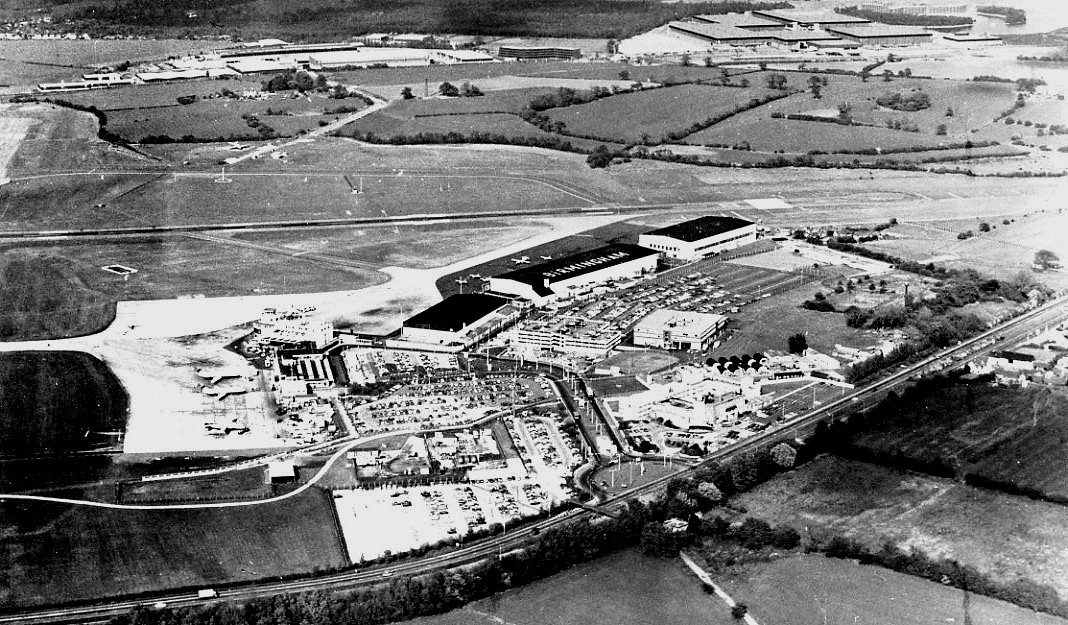
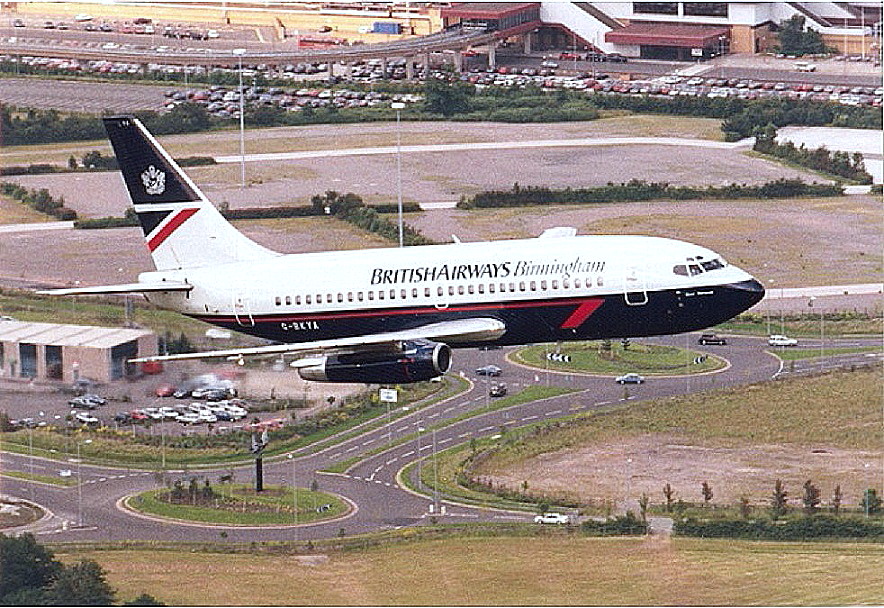
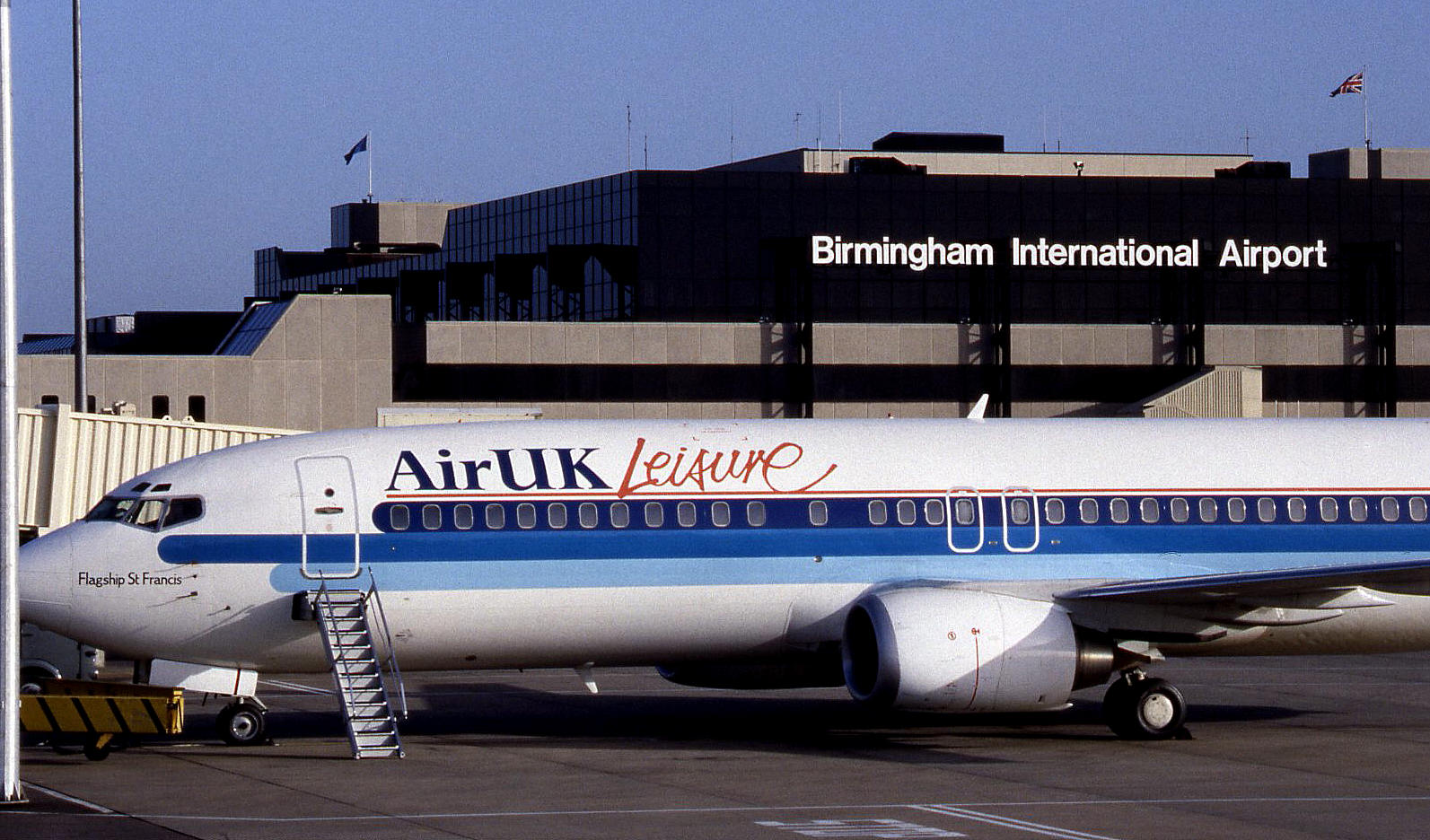
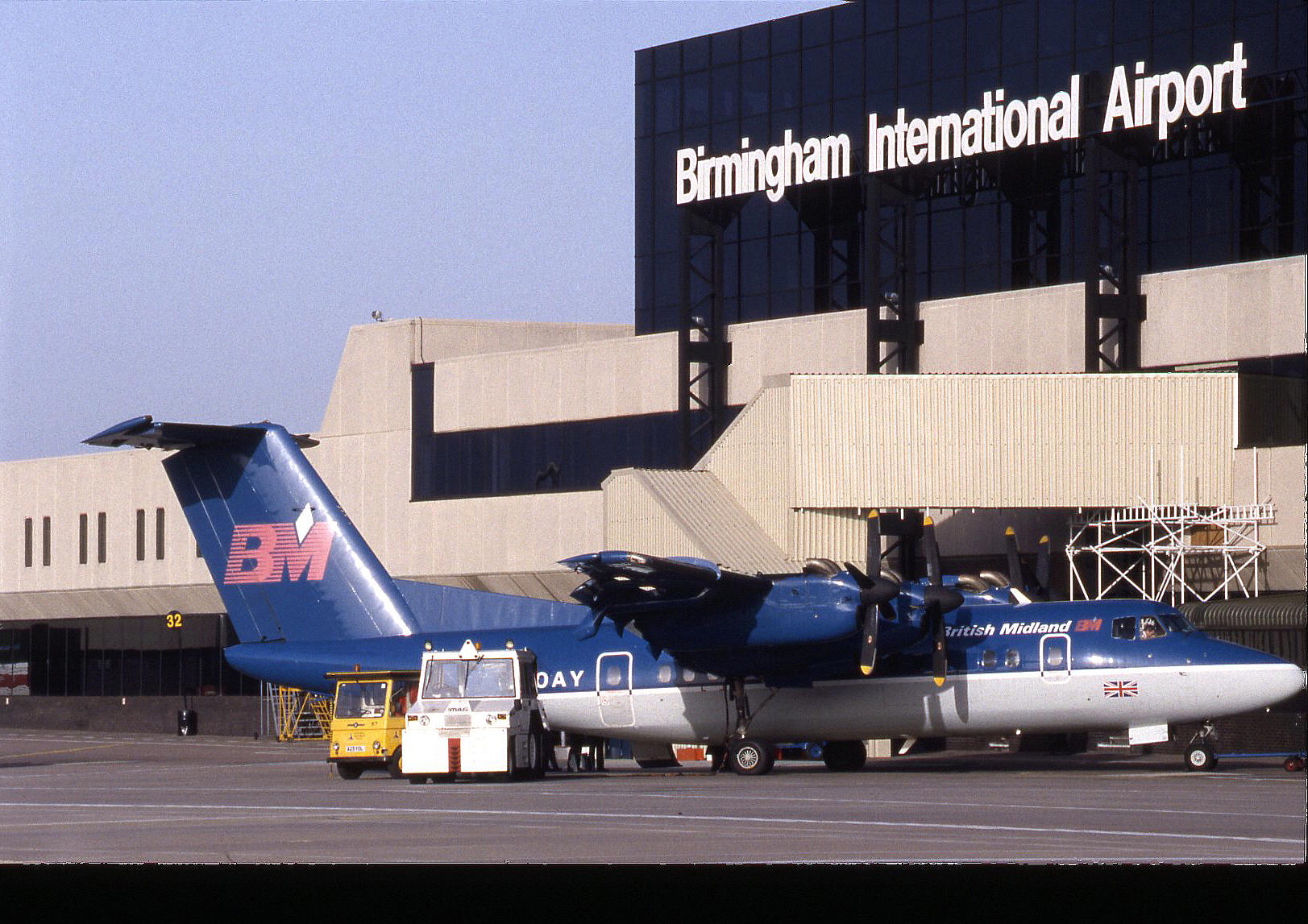
British airline users: Pre 1940: Great Western & Southern Airlines, Railway Air Services, Western Airways
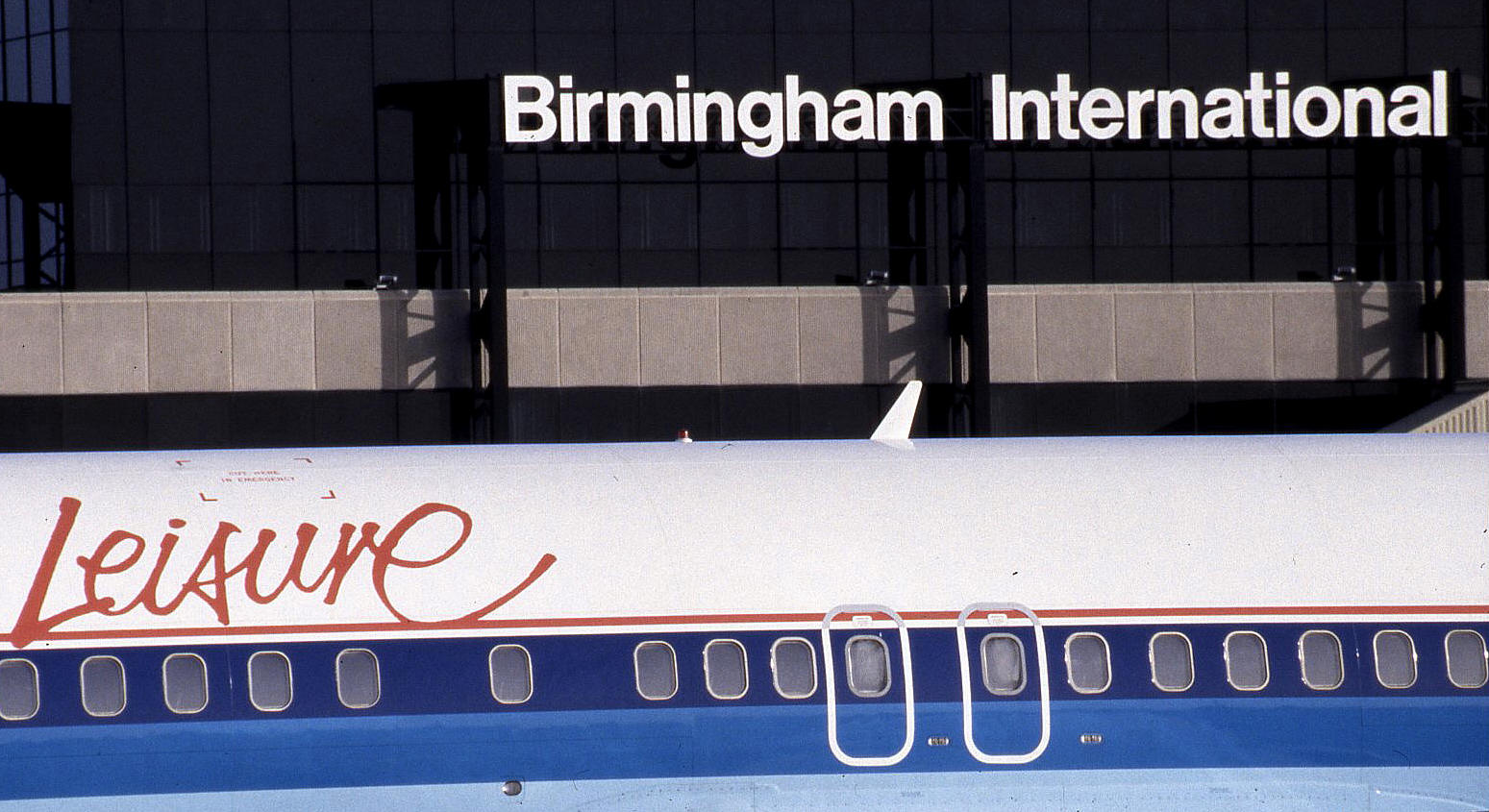
Post 1945: Air 2000, Air Anglia, Air Intra, Air Kruise, Air Safaris, Airtours International, Air UK, Alidair, Autair, Birmingham Executive Airways - later to become Birmingham European Airways, Britannia Airways, British Airways (BA), British Caledonian Airways, British Eagle, British European Airways (BEA), British Midland Airways, British United Airways, British World Airlines, Brymon Airways, Caledonian Airways, Channel Airways, Community Express, Court Line, Dan Air, Derby Airways, Donaldson International, Don Everall (Aviation), Eagle Airways, East Anglian Flying Services, Euravia, Executive Air Transport, Flybe, Jersey European Airways, Lancashire Aircraft Corporation, Leisure International Airways, Lloyd International, Manx Airlines, Monarch Airlines, Morton Air Sevices, Orion, Silver City, Starways and Thomson fly
Foreign airline users: Post 1945: Aer Arran, Aer Lingus, Air 2000 Airlines (Elite), Air Club International, Air Europa, Air Europe, Air France, Air India, Air Malta, Airnautic, Air Spain, Akhal, American Airlines, Aviaco, Aviogenix, Balair, Balkan-Bulgarian Airlines, Bavarian Airways, Braathens-SAFE, Comtel Air,Cross Air, Cyprus Airways, Iberia, Inex-Adria, Intersun, JAT, Kazakhstan Airlines, KLM, Lufthansa, Maersk Air, Newair, NLM, Onur Air, Ryanair, SAM (Societa Aerea Mediterranea), SAS (Scandinavian Airlines Sytem), Spantax SA, Trans-Europa and World Airways, Trans International Airways
Note: Air France operated DC-4 flights, albeit below MTOW limitations in 1953
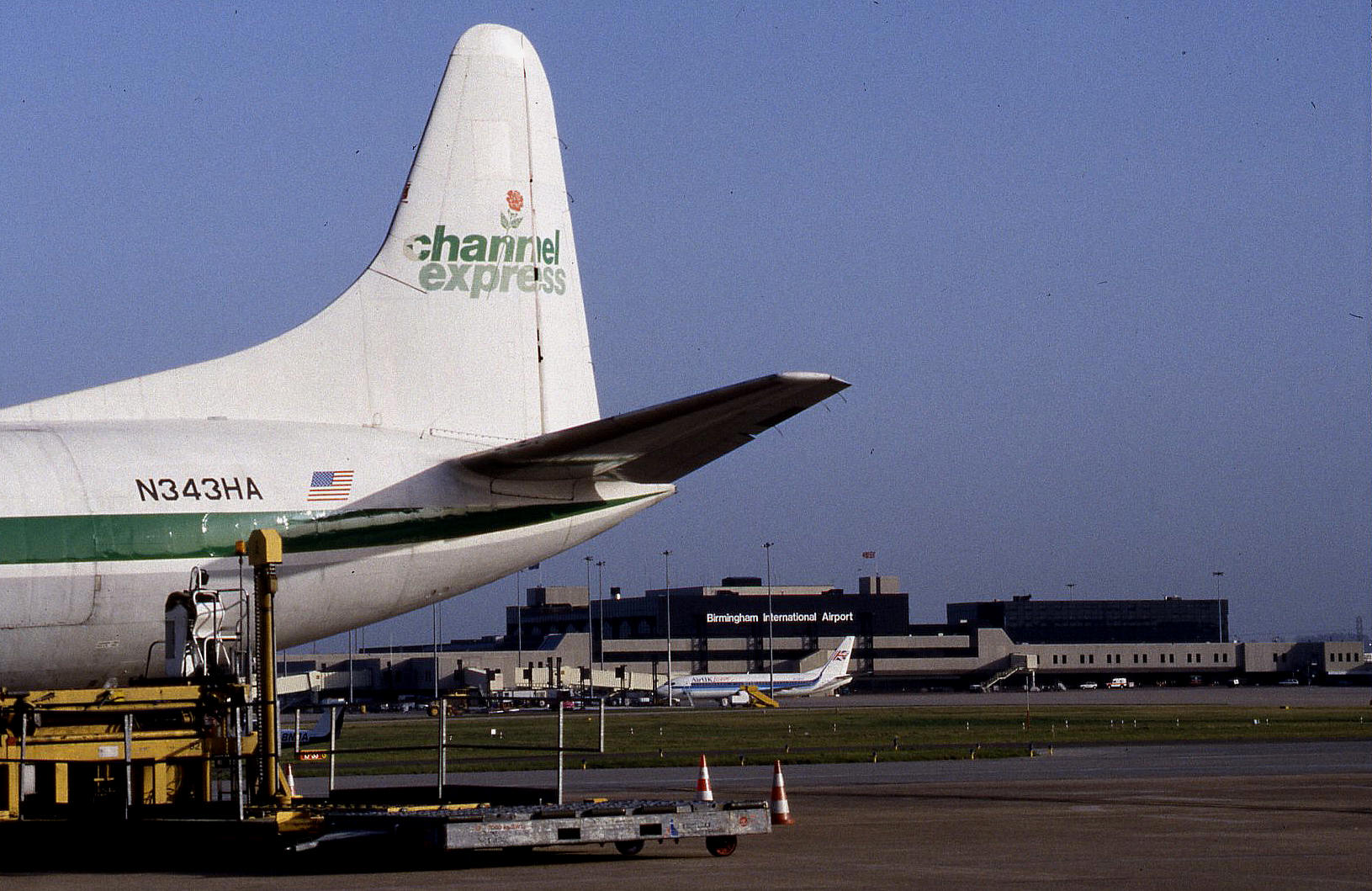
Air cargo: Post 1945: Airwork, Alitalia, BEA, Channel Express, Derby Airways, Eagle Aviation, Sabena, SAS, Skyguard, South West Aviation, TNT International, Yugoslovenski Aerotranport
Aerial photography: Don Everall (Aviation)
Note: In the 1957 'The Aeroplane' directory, Don Everall (Aviation) are listed as being, "Specialists in aerial photography".
Car ferry: Silver City (Mostly ad hoc operations 1953 to 1961)
Charter, air taxi: Post 1945: Aer Turas, Air Condor, Aircruise, Air Envoy (Dakota), Air Gregory (Apache, Aztec?), Air Safaris (Vickers Vikings), Alidair, BEA Airtours (Vickers Viscounts), Britannia Airways, British Eagle, C&M Air Charter, Cecil Kay Aircraft, Central Air Services, Channel Airways, Derby Airways (DC-3s), Derby Aviation, Don Everall (DC-3s & Vickers Vikings), Euravia (Lockheed Constellations), Executive Air Transport, Futura, Hargreaves Airways, Lloyd International (DC-4s), Macedonian Aviation, Mercury Air Services, Mid-Fly (Rapides, Apache and Aztec), Overseas Aviation (Canadair Argonauts), Skyways (Constellations)
Patrick-Duval Aviation (services to the ISLE of MAN, ISLE of WIGHT and CHANNEL ISLANDS). With seats removed in their Miles Aerovans carried flowers from the ISLES of SCILLY in the late 1940s. Wheels and Wings/Hagreaves Airways, (Auster Autocrats G-AIFZ & G-AIGU, later Dragon Rapide G-AIUI and later still Auster J/2 Arrow G-AJAM. Operated from 1947 to 1948. Yellow Air Taxi, (Percival Q.6 G-AHOM, Auster Autocrat G-AHHL, Dragon Rapide G-ACPP, Proctor V G-AHBJ and - apparently, also a Tiger Moth), operated from 1948 to 1952. Lees-Hill Aviation, (Services to ISLE of MAN and CHANNEL ISLANDS).
Flying school/club: Post 1945: Air Gregory, Birmingham Aero Club, Birmingham Air Centre, Birmingham Aviation, Mid-Fly, Midland Aero Club, Solihull Flying Club, Warwickshire Aero Club
Note: In the 1957 The Aeroplane directory, the Warwickshire Aero Club were listed as operating: Two Auster 5s and one Taylorcraft.
1959 ‘snapshot’: Birmingham Airport Flying Group, Douglas Holland Flying Group, Midland Aero Club, Warwickshire Aero Club, Warwickshire Flying Club
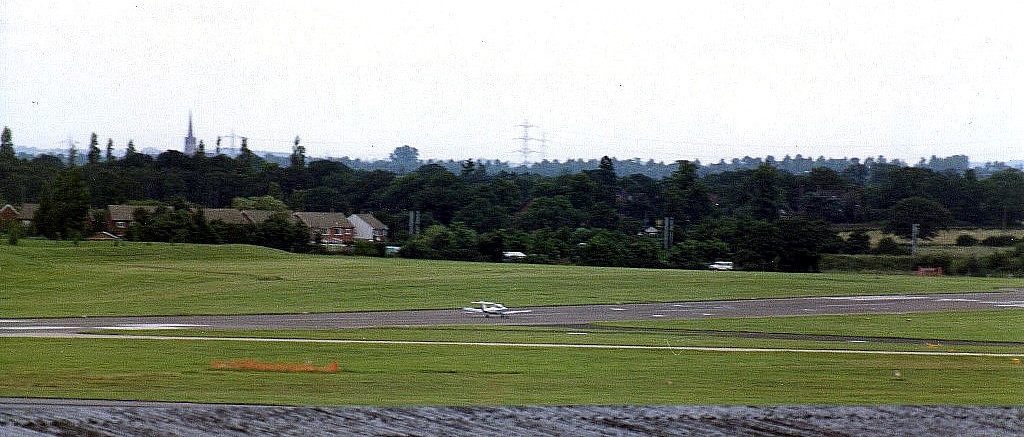
This picture, showing a Piper PA-38-112 Tomahawk, was taken on the 12th July 1992, and kindly sent by Mr Bryn Willetts on the 21st June 2022. So, very nearly thirty years later to the day! He was taking flying lessons here at that time, most probably with Warwickshire Aro Club.
Helicopter ops: In early 1956 BEA opened a Birmingham-Leicester-Nottingham service using Westland S-55s. The sevice ended in November but 1,829 passengers had been safely handled and the service achieved 84% regularity! A level of service some scheduled airlines using modern airliners are struggling to match in the 21st century. Such is progress
Pleasure flights: Post 1945: C&M Air Charter, Lees-Hill Aviation, Mid-Fly, Patrick-Duval Aviation, Solair Flying Services, Yellow Air Taxi
Maintenance: Post 1945: Patrick Aviation
Location: N of A45, NE of Elmdon, 6 nm ESE of Birmingham
Period of operation: 1939 to present day (Official opening 8th July 1939)


Note: These maps are reproduced with the kind permission of Pooleys Flight Equipment Ltd. Copyright Robery Pooley 2014.
Runways: 1939: Three grass 914 One grass (about) 1433 (Orientations unknown?)
Also, only 215 of the potential 800 acres was available initially
WW2: 06/24 1229x46 hard 15/33 1246x46 hard
(another report says these runways were 1271 and 1298 metres long?)
Another map of the airport, presumably produced for the Kings Cup Air Races in the early 1950s, because it shows car parks, grandstands etc, gives the runways as being: 06/24 1298 and 15/33 1271 long. Perhaps the additions of turning circles at each end would account for this? In 1958 runway 15/33 was extended by 244 metres, (presumably to 1515 metres?), to allow BEA to use their 800 Series Viscounts to take-off at maximum weight.
A plan published in 1959 states: 06/24 1315x46 hard 15/33 1526x46 hard
In 1961 plans to extend runway 15/33 to 2134m where in hand, to enable BIRMINGHAM to become a prime diversion airfield for HEATHROW and more suitable for direct flights by bigger aircraft to Europe - before VTOL aircraft made runways obsolete obviously! A concept that failed to be realised of course.
1965:07/25 1315x46 hard 16/34 1526x46 hard
The 15/33 2255 long runway came ‘on-line’ in 1967
1990: 06/24 1315x46 hard 15/33 2255x46 hard
2000: 06/24 1315x30 hard 15/33 2605x46 hard
NOTES: The first aircraft to arrive was Western Airways D.H.90 Dragonfly G-AEDH, (20th March 1939). From June Western Airways started a thrice daily service linking Weston-Super-Mare, Bristol, (WHITCHURCH probably?) and Manchester, (BARTON). It has been an endless source of fascination to me to discover how several towns featured prominently on ‘the map’ for airline planners, (in the 1930s especially), whereas today it would seem inconceivable these English towns would warrant popular and scheduled airline services. Brighton, Isle of Wight – Cowes/Ryde, Hull, Ramsgate, Stoke-on-Trent, Torquay and Weston-super-Mare just for examples. It is interesting to note that it is reported that the Western Airways routes from ELMDON listed above, (served by D.H. Rapides G-ACTU and G-AFSO plus Percival Q.6s G-AFIX and G-AFVU), “attracted few customers.” Obviously some senior management people thought it worthwhile to launch such a service. But - why?
OPENED FOR BUSINESS
ELMDON opened for business on the 1st May 1939, the first arrival being the Swallow G-ACXE from CASTLE BROMWICH. The first scheduled arrival was Dragon Rapide ‘Volunteer’ of Great Western & Southern Airlines landing at 09.55 having departed from Liverpool (SPEKE?) at 08.55 via Manchester, (BARTON). One hour, including a stop at BARTON? Can this really be correct? It is then said to have departed a few minutes later for Bristol (WHITCHURCH?), Southampton (EASTLEIGH?), RYDE and SHOREHAM. As it departed the Railway Air Services D.H.86 G-AEFH Neptune arrived from CROYDON en route for Liverpool, (SPEKE?), Belfast, (NUTTS CORNER?) and Glasgow, (RENFREW?).
THE OFFICIAL OPENING
The ‘official’ opening was on the 8th July 1939. (As so often appears to happen at UK airports the ‘official’ opening seems to occur some time after operations commenced. Is there a singular reason for this?) The day was thoroughly spoilt by torrential rain and low cloud, (as low as 300ft at times), but even so half a dozen managed to arrive. One being the Vega Gull flown by Alex Henshaw who was soon to stamp his name on Spitfire history in WW2 when test flying them out of nearby CASTLE BROMWICH. (I can thoroughly recommend reading all of the books Alex Henshaw wrote). Incredible though it might seem today, an air display of sorts was carried out. First was a C.40 Autogyro, then some Fleet Air Arm Skuas followed by a Piper J-4A Cub Coupe. The RAF contigent displayed eight Spitfires, then a Lysander, Whitley, Hampden, Blenheim, Hurricane and a Bombay. The Imperial Airways A.W27 Ensign G-ADSW was there but returned to CROYDON without carrying any passengers. Other visitors were the prototype DH.95 Flamingo G-AFUE on loan to Jersey Airways and the Royal Flight Airspeed Envoy G-AEXX which had previously flown the Duchess of Kent to WALSALL. Western Airways offered joy flights in their new DH.86 G-AETM plus three DH.89A Rapides and Olley Air Services also offered joy flights.
Aaaah, those really were the days!
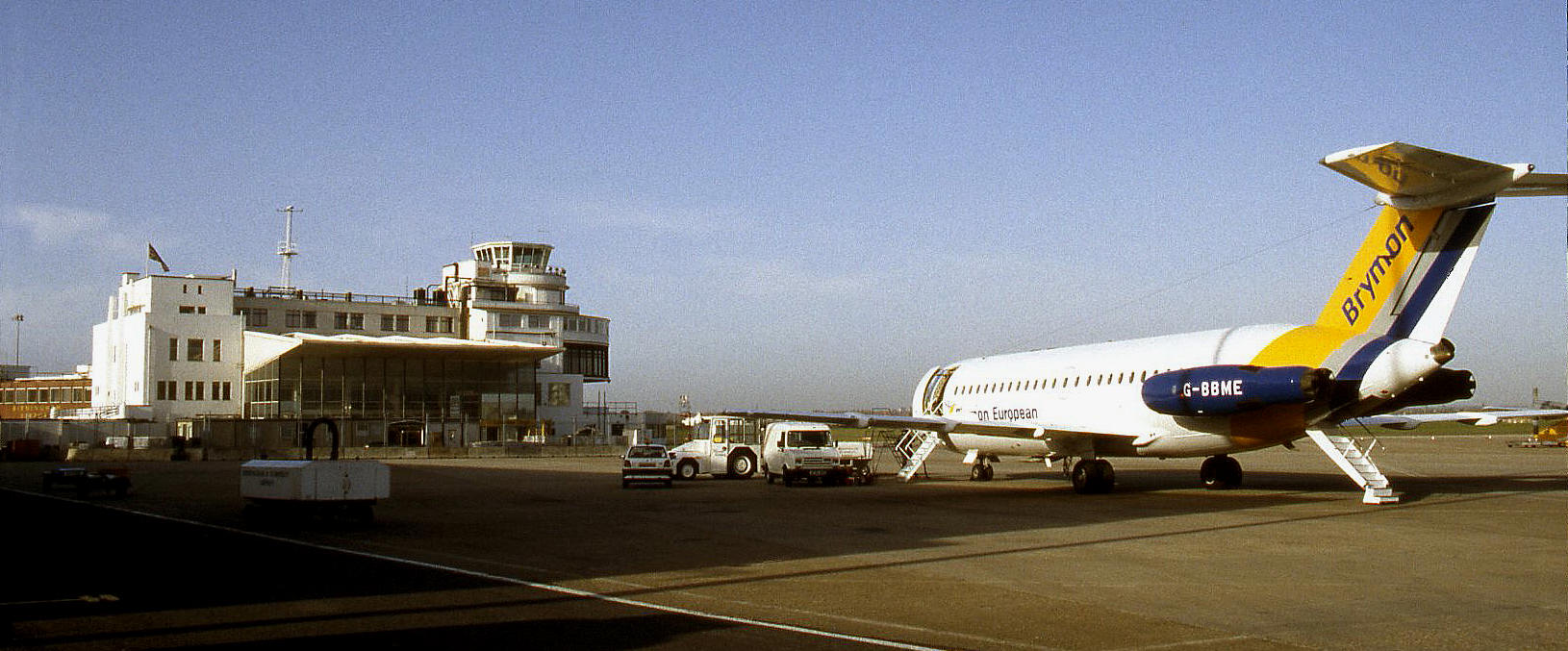
Probably not really surprising, considering the fairly short gap between this airport opening and WW2 starting, it appears that only one foreign airliner visited, and once only? This was the KLM Douglas DC-3 PH-ASR when en route to Manchester, (BARTON?) and Liverpool, (SPEKE?). The original terminal building was highly regarded in its day for architectural merit and still exists, (I think), although originally it had two ‘wing-like’ canopies extending fifty feet on either side to protect passengers and cargo from the weather. How practical or effective were these with a strong wind blowing?
It seems ironic that today we couldn’t possibly offer such “low carbon footprint” regional air services, so what happened to the idea of progress? Today the sort of people able to afford such a service to these destinations would invariably jump into a gas-guzzling car and do the journey individually. Time to start building glass cockpit Dragon Rapides perhaps? It’s a serious point in some respects, during weekdays most of the lower airspace above 3000ft in the UK is nigh on deserted so why aren’t customer demand based internet booked regional services on offer? Most people make plans, at least a few days in advance, so any journey could be logged and if enough demand is on hand, an e-mail sent to arrange the booking. Makes some sense in the greater scheme of things?

ELMDON IN WW2
The main reason ELMDON came to have it’s hard runways appears to have been the decision to use this airfield for the test flying of Austin built Stirlings and later Lancasters flown out from their Longbridge factory airfield/airstrip.
During the early days of WW2 the almost catastrophic incompetence of the RAF logistics staff is well demonstrated here when 99 Sqdn arrived from MILDENHALL with their Wellingtons on the 9th September 1939. Only to be posted to NEWMARKET six days later!
On the 16th September 1939 all civil flying was formally stopped.
A GREAT DEBT OWED
I really must thank Geoffrey Negus and Tommy Standon for their excellent book, ‘Aviation in Birmingham’ for so many insights and information regarding aviation history in the WEST MIDLANDS. I have just ‘cherry picked’ a few items. The full history as they portray it, really is fascinating. On reading their book once again my ignorance of the realities of aircraft production is graphically explained. Thank the Gods I decided only to list sites where some form of flying took place! To learn that about two million people were employed in ‘shadow’ aircraft component production in 1938 beggars the imagination. It was soon to rise to a great deal more of course!
Short Stirling and later Avro Lancaster bombers were built and assembled at nearby Marston Green. A bridge was built over the railway to tow them along a concrete track to ELMDON. Final checks were made, including weighing to establish the C of G, (Centre of Gravity), before being flight tested and released for service.
ANOTHER ASPECT OF WW2
In the West Midlands, and whichever way you look at it, the English ability to be very often thoroughly incompetent, from top to bottom, certainly made its presence felt, especially when tasked with producing aircraft when engaged in a war which allegedly threatened our nation like no other. As pointed out elsewhere, (see my notes on the Battle of Britain), the threat of a Nazi invasion was just that – a threat. It never stood any chance of succeeding. But that wasn’t the point – in the longer term the Nazi regime and their allies threatened not only all of Europe but much of the world. What is largely brushed under the carpet, increasingly so in more recent years, is that a great many English people were not in favour of the war. Strikes occurred and sabotage was also encountered. The now common idea that the vast majority of the British people were patriotic and in support of the war is a nonsense.
Apart from a great many English dissenters many of the Welsh weren’t patriotic either, especially in North Wales. How the Scots felt I have yet to discover but they would of course mostly have felt distanced from the whole affair anyway? I believe that is often overlooked today that WW1 had only ended some twenty years before and the senseless slaughter of vast numbers of men was still a very raw memory. And now they were being asked to do it all over again. It seems to me to come as no surprise that the vast majority of combatants in WW2 were youngsters, many still in their teens, for which the idea of war was a great adventure, just as it was in WW1, an opportunity to escape the drudgery of day to day life so many were faced with.
PEACE REIGNS AGAIN – EXCEPT FOR THE ‘COLD WAR’ MINOR DETAIL
ELMDON reverted to civil use in 1946 but was used only for mostly private, flying club and charter work. In 1946 Dunlop’s Test Flight moved in with the Wellington III BK563, Albemarle V2046, Buckingham KV479 and later the Lancaster I PB752. Also the ProctorG-AHBA. This enterprise ended in 1949. Civil flying resumed in 1946 and the Midland Aero Club resumed flying here in May 1946.
It seems almost unbelievable today, but in 1949 councils in the West Midlands were complaining that BEA, (British European Airways, our European national airline), were not serving this area! To cut a long story short, BEA started a thrice weekly service from ELMDON to LE BOURGET (Paris) in 1949. This route was shared with Air France. Despite promises the route lost money and passengers did not materialise. The service, started initially from Manchester, (RINGWAY). In 1949 Aer Lingus opened a weekday service using Dakotas to DUBLIN and in 1950, BEA added services to the Channel Islands and Northern Ireland.
A MIKE CHARLTON GALLERY

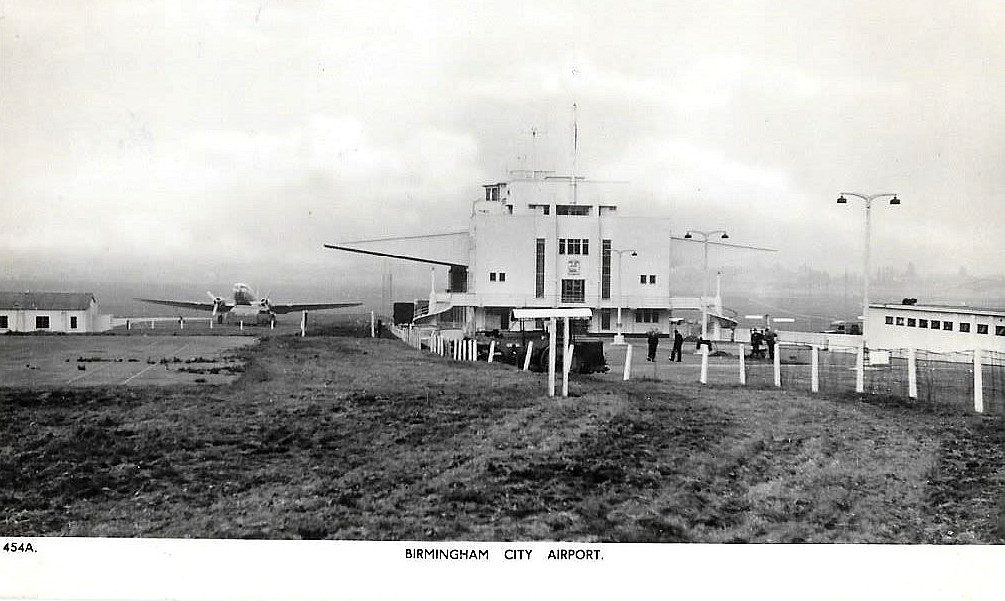

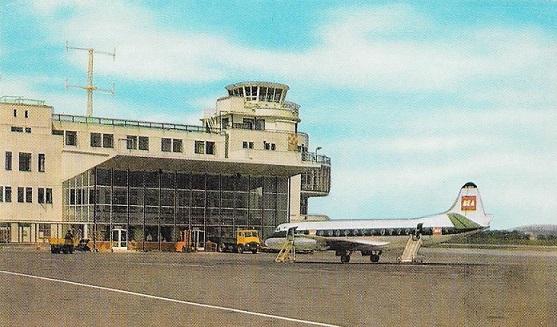

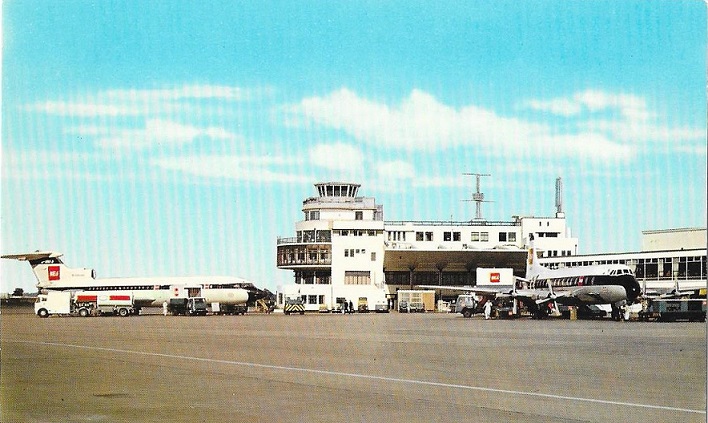

Note: These pictures from postcards were kindly sent by Mike Charlton who has an amazing collection: See, www.aviationpostcard.co.uk
First picture: This picture seems to reveal an aspect I have yet to find out about. Almost certainly post-WW2 it shows three Miles Magisters, presumably engaged in some quasi-military role.
Fourth & sixth pictures: This BEA colour scheme was applied, I think, from 1960 to 1971.
Fifth picture: The colour scheme applied here, on this Viscount 700 Series, was from the 1950 to 1959 era.
AND MORE PICTURES
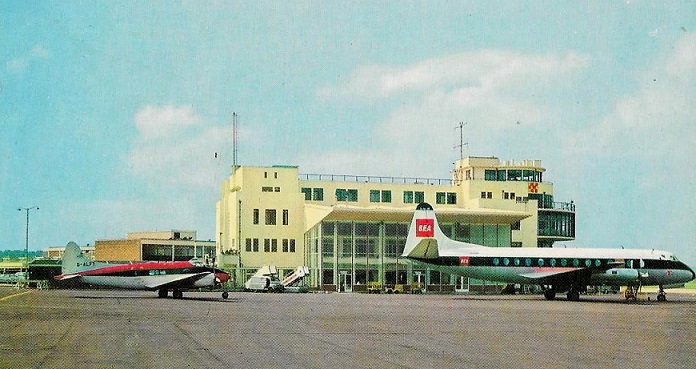
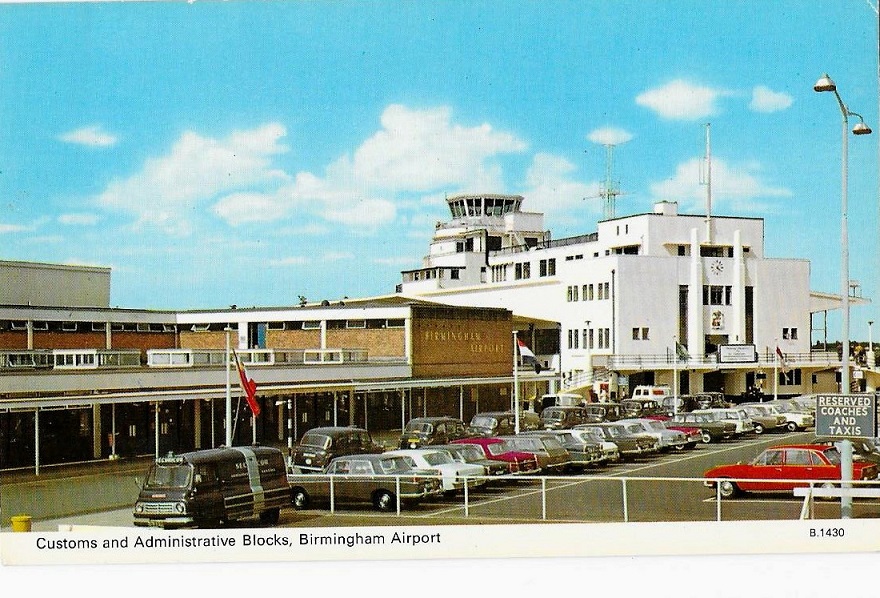

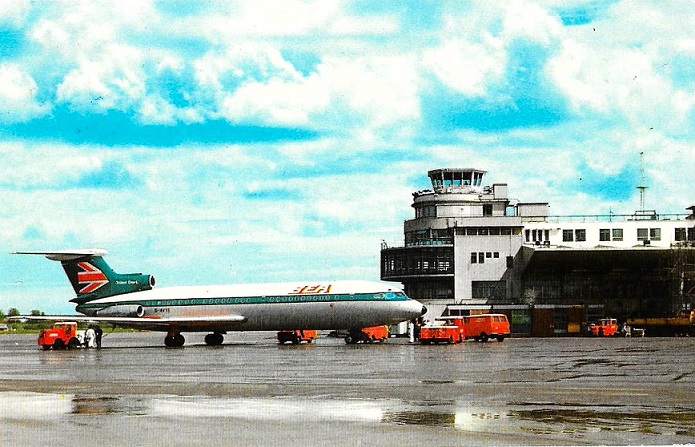
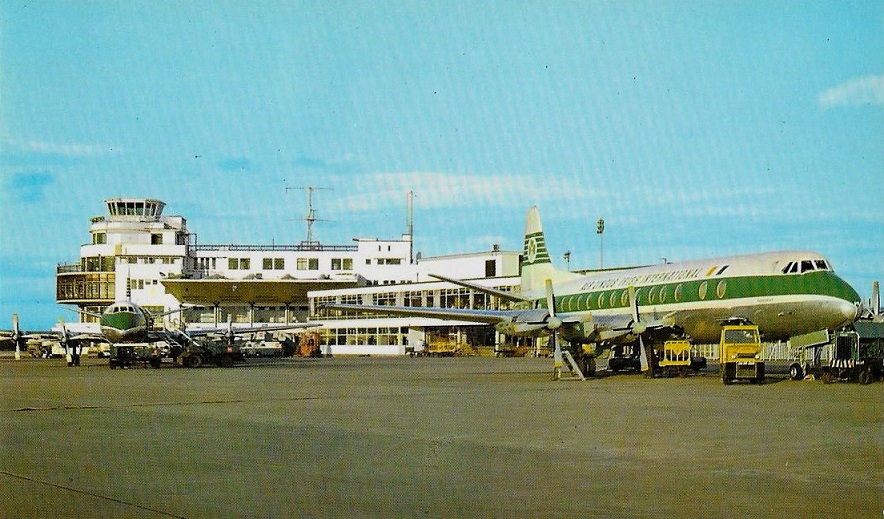
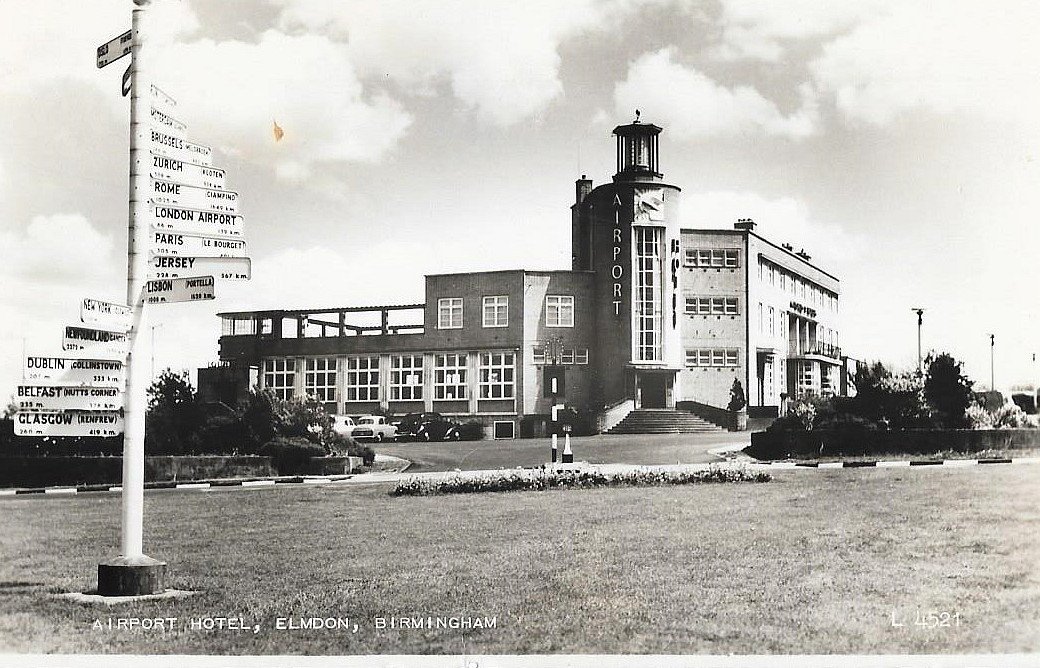
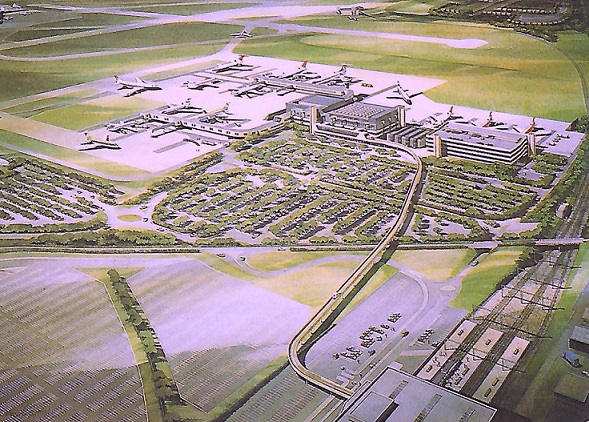

First picture : The BEA Viscount is almost certainly a 800 Series wearing the colour scheme applied, it seems, from 1960 to 1971 according to some experts. The history of the de Havilland DH104 Dove 6 G-ALFT, seen in this picture tells another story. In 1972 it was first registered to the Department of Trade and Industry. Then the Civil Aviation Authority from April 1972 to February 1977.
Mike Charlton tells me that the Dove 'Foxtrot Tango' was one of two Doves, the other being G-ALFU, that the CAA used for checking nav-aids, ATC proficiency, (SRAs, vectoring etc). Both were based at BOURNEMOUTH (HURN).
Third picture: This Viscount, G-AMOA, was one of the first to enter service with BEA and served from 28.03.53 to 23.12.63. I found that from 28.03.52 to 23.08.53 Oscar Alpha was registered to Vickers, and I suspect, was probably involved in trials and certification procedures before entering service.
Fourth picture: BEA aircraft wore this colour scheme from 1968 - 1979.
Fifth picture: This picture of a brace of Aer Lingus Viscounts can probably be dated from between 1954 to 1956. In 1956 Aer Lingus introduced a colour scheme which made global news it was so revolutionary; they painted the tops of their aircraft a fairly dark green. This move was, needless to say, highly controversial but the ever inventive Irish had probably worked out that the newer pressurised airliners had 'air-con' systems which could cope, especially on the routes Aer Lingus were serving.
Up till then all airliners, originally mostly painted silver or just plain unpainted aluminium, had adopted a white painted top fuselage - presumably to help keep the passenger cabin cooler in hot weather.
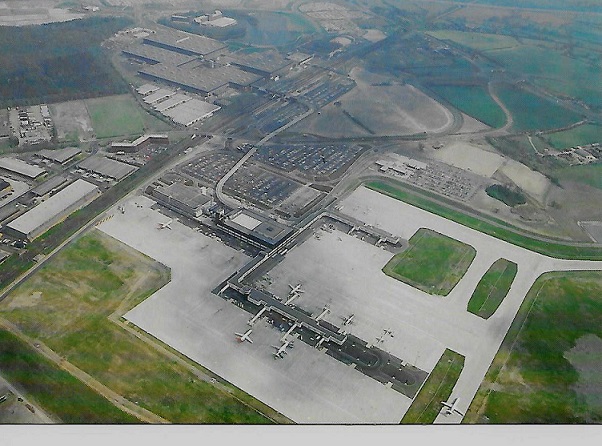
Eighth picture: This multi-view postcard shows scenes presumably taken not long after the new terminal, on the east side of the airport, opened in July 1991. The top left is, presumably a replica?, of a pre-WW1 Blériot monoplane. The top right is the Boeing 767-204 G-BOPB operated by Britannia from 01.11.88 to 10.05.2001.
In the bottom left is a British Midland BAe ATP, and in the bottom right is the British Airways BAC One-Eleven 523HJ G-AXLL which only served with BA from 14.04.88 until 16.02.95. The BAC One-Eleven was a most remarkable airliner, claimed by most of those that flew them as being the most efficient at converting pound notes into noise!
AIR RACING
In 1949 the Royal Aero Club announced that air-racing would be re-started in the UK. The first meeting being a ELMDON from Friday 29th July to the 1st August. (Apparently, in those days, being a Bank Holiday?). By all accounts it was a mad, mad affair attracting 120,000 spectators. On the one hand competitors were fielding Austers, Messengers and Geminis whilst on the other hand the Kemsley trophy was won by Sqdn Ldr Neville Duke flying the Hawker P.1040 VP401, the prototype Hunter. What I find really fascinating is that the Norton Griffith Challenge Trophy went to Jan Andrle flying the Aero 45 OK-DCL! Pretty obviously, the ‘Cold War’ had yet to kick in?
The King’s Cup Race was held on the Saturday, (30th July 1949), with thirty-six entrants and was won by J. Nat Somers flying the Miles M.65 Gemini 3 G-AKDC at an average speed of 164.25mph over a course of just sixty miles. Before WW2 the King’s Cup course often exceeded 1,000 miles, the longest recorded being 1,443 miles in 1937. I think I am correct in thinking this was the only occasion air racing took place at ELMDON? The next year the King’s Cup Race was held ‘up the road’ at PENDEFORD, the airport for Wolverhampton.
ANOTHER MYTH EXPLODED
I am still inclined to think that after WW2 air cargo operations came along well behind the massive increase in commercial passenger flights, (both scheduled and charter), but the truth is air cargo blossomed too. Often using converted WW2 bomber aircraft, these air-cargo operations were often ‘iffy’ stabs, and a lot failed. But, the people involved saw the potential. Making it work is another matter entirely of course. In 1951 Aer Lingus opened a freight service from BIRMINGHAM to Dublin, one of many which failed to succeed.
A WELCOME DIVERSION
ELMDON had often been a diversion airport, much to the delight of local coach operaters. One occasion was the infamous London smog in 1952. Fifteen flights with 400 passengers diverted here, from as far afield as Dublin, Aberdeen and Oslo.
Similar situations still occurred in the 1970s. For example on the 4th January 1971 5,457 passengers passed through after HEATHROW was closed, the aprons packed full with diverting BA aircraft. The 1972/73 winter often had similar spectacular results, ten BA Tridents diverting from HEATHROW on the 20th December for example. On New Years Eve a record forty-five flights diverted from HEATHROW due to fog!
DESTINATIONS
Getting back to passenger services I find this period utterly fascinating. The choice of destinations were such a broad choice, and we are still struggling to catch up today. I suspect a lot of this flexibility, and economy of operation, was due to the flexibility of ptston powere types such as the Douglas DC-3 and Vickers Viking? For example Air France, in 1951, operated a weekend service from Manchester, (RINGWAY?), via ELMDON to Dinard and La Baule. The Manchester bit was dropped from April 1952. BEA operated flights using ‘Dakotas’ to JERSEY from Manchester, (BARTON or RINGWAY?) via ELMDON from 1950 to ?
From 1953 to 1956 Derby Airways operated a DERBY-WOLVERHAMPTON-ELMDON-JERSEY route. Initially with a Dragon Rapide G-AEAL, then DC-3 Dakotas. In 1955 a DERBY-ELMDON-OSTENDE service was opened using Dakota G-ANTD. This DC-3 was replaced with a twenty seat Miles Marathon G-AMGW.
Also in 1953 BEA started replacing DC-3 Dakota services with Airspeed Ambassadors, (called by BEA Elizabethans). For example ‘Elizabethans’ took over the Manchester, (RINGWAY?) -Birmingham, (ELMDON), Paris (LE BOURGET or ORLY?) route. The short ‘main’ runway at ELMDON in those days prevented BEA from operating these beautiful airliners at full MTOW.
GOING TRANSATLANTIC
I can remember a lot of ‘hoo-hah’ being displayed here regarding the first ‘Trans Atlantic’ flight. However, it now seems this was mostly a PR exercise. Other trans-Atlantic had occurred at Birmingham long before. It appears the first trans-Atlantic flight at ELMDON was actually an arrival, a Sabena DC-4 cargo flight, (via New York, Gander and Shannon), in December 1954. To collect 4.5 tonnes of oil heaters destined for Bruxelles. This might seem a weird option today but Ro-Ro ferries had still to be invented, and, in the early days even crossing the Channel using trucks was a very risky business. The first trans-Atlantic flight going the other way was also a cargo flight on the 6th August 1955, with an Airwork DC-4 routeing via Manchester, (RINGWAY surely?), PRESTWICK and Montreal. It was intended to be a regular twice weekly service but ceased in December.
The first ever ‘Trans-Atlantic’ passenger flight to BIRMINGHAM appears to have been an arrival by diversion, a Caledonian Bristol Britannia en route to GATWICK from Montreal on the 3rd June 1967.
REGIONAL SERVICES
It has to be remembered that many scheduled services operating between regional airports often employed smaller aircraft types. Even in the 1970s Air Anglia operated a Piper PA-23 Aztec for example – a NORWICH to BIRMINGHAM service, soon to be replaced by a Piper Navajo Chieftain going on to SWANSEA and NEWQUAY. Also British Caledonian used a Piper Navajo Cheiftain G-SCOT on a BIRMINGHAM to GATWICK service.
In 1955 Don Everall opened a summer season operating flights to the Isle of Wight using Dragon Rapides. Thanks to David, (see 'Comments' below), I now know they flew into SANDOWN. One Rapide G-AGLR crash landed on this route near Berkswell, just 5nm SE from ELMDON. Nobody was hurt fortunately but the company was prosecuted for several breaches of regulations!
GOING ABROAD
In many ways the Don Everall company amply illustrates the ‘state of play’ in the precarious post war independent airline/charter sector. In 1957 they purchased the Dakota G-ANEG. I just love this record, “It operated the lion’s share of the scheduled services in 1958, not to mention Inclusive Tour flights to Palma, Perpignan and Basel.” Basel is a nice enough city, hardly remarkable though, so why Basel? Perpignan was not a destination in itself, more a convenient airport to then send by coach, over the Pyrenees, holiday-makers to their final resort on the Costa Packet. (Sorry, the Costa Brava), although, in my defense many a tale has been told of holiday makers getting carried away and blowing a small fortune, returning to the UK ‘brassic lint’.
Derby Airways also ‘cashed in’ with a Dakota via ELMDON, (for a short time via WOLVERHAMPTON on their Jersey flights), but also serving Palma. Also four flights a week to Ostend in 1958. I have landed at Ostend a couple or so times in more recent years and have wondered why it has such a grandiose but deserted terminal. It’s a sign of quickly changing times of course, but I still struggle to imagine Ostend as being a rather exotic foreign holiday destination. But - it was! This said, I have flown a light aircraft to stay in Ostend for a long weekend and it is a delightful town. Maybe the time has come to re-explore those early destinations rather than forge ever onward?
COLD WAR ASPECTS
There seems to be something quite significant which happened at ELMDON, an intriguing injection of reality into history? As the Cold War developed into one on the biggest and most expensive military confrontations ever, it now appears the Russian leaders Bulganin and Krushchev flew into ELMDON on a scheduled BEA Viscount flight to visit the British Industries Fair in April 1956. I expect they arrived at HEATHROW in an Aeroflot Tupolev TU-104? As a young spotter living very near HEATHROW the sight of an airliner with a glazed ‘bomb-aimers’ nose, (I think we thought it could be quickly converted to be a bomber?), was quite a novelty. I’m trying to remember if we had anything similar in the ‘West’ but can’t recall anything. The Comet much later became the Nimrod, and the Boeing 707 became the AWACS, but I can’t think of any civilian airliner intended from the outset to perform joint civil and military roles?
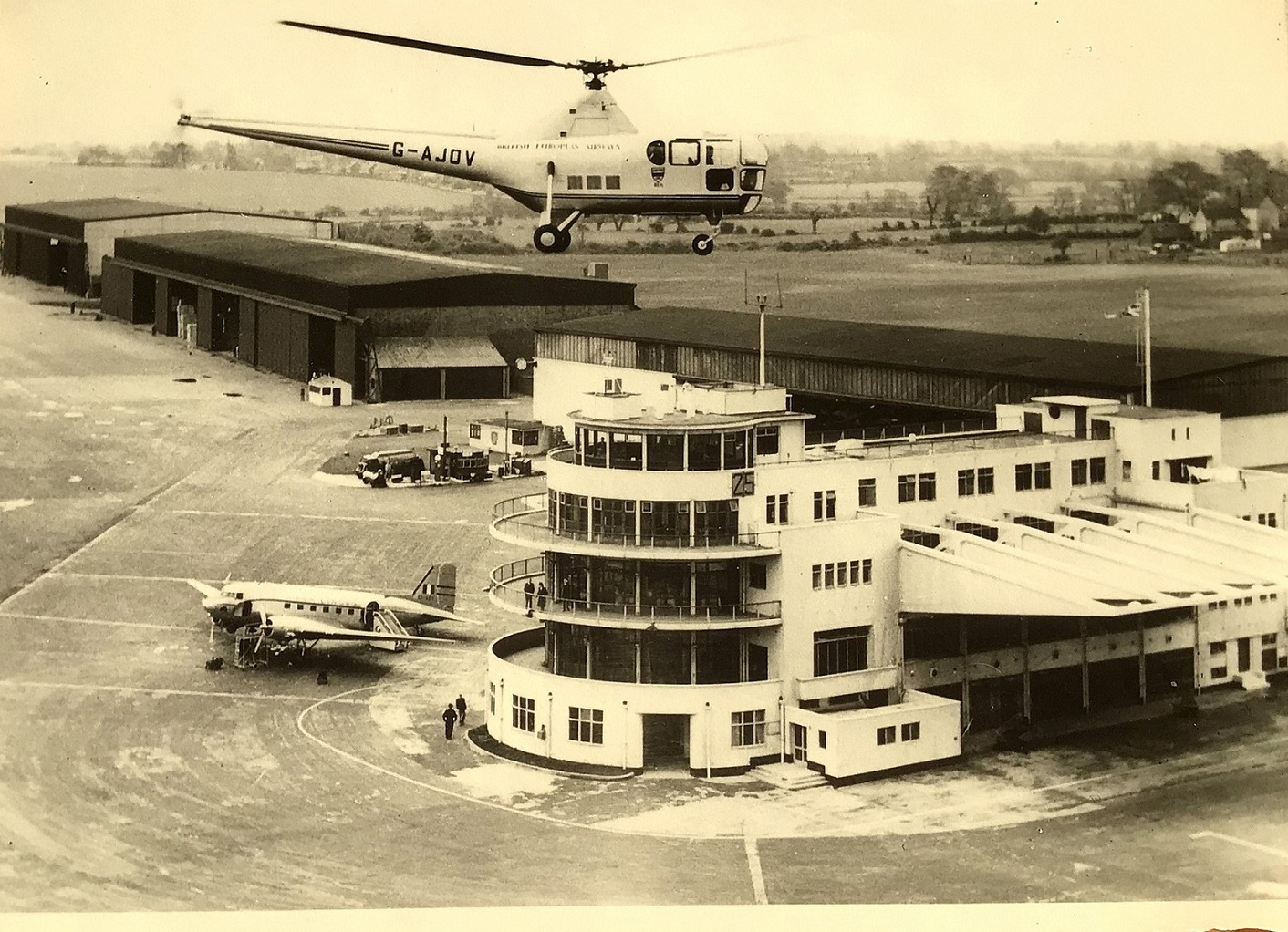
Note: This great air-to-air picture was kindly provided by Mike Charlton. (See above for his details in his galleries). Presumably this picture was taken during one of the early proving flights prior to helicopter operations eventually commencing here. On the other hand it might well have been pictured whilst en route to the HAY MILLS rotorstation not far to the west. This particular Sikorsky S.51, G-AJOV was operated by BEA, (British European Airways), from 10.10.47 until 04.08.54. It was sold to Canada as CF-JTQ in 1957.
THE START OF THE HELICOPTER ERA
BEA helicopters reappeared at ELMDON in 1956, operating a Birmingham, (ELMDON), Leicester – Nottingham service. Intially thrice daily, later twice daily using Westland-Sikorsky S-55s. The service started on the 2nd July and ceased on the 10th November. It seems 1829 passengers were carried and the service achieved 84% regularity. Pretty damned good for those days?
BRITISH EUROPEAN AIRWAYS versus DERBY AIRWAYS
It is I think always interesting to compare how a 'State Carrier' airline goes about its business, when compared to the private sector. By 1958 the BEA operations from ELMDON were almost entirely flown by Vickers Viscounts, but the ‘Pionair Class’ Douglas DC-3s still served Belfast, (ALDERGROVE?), and the Channel Islands. Against this scheduled BEA regime serving Dusseldorf, Paris and Zurich for example; in 1959 the itinerary for Derby Airways ‘Inclusive Tours’ operations, using DC-3 Dakotas seems positively exotic. Destinations being Biarritz, Nice and Perpignan in France, Madrid in Spain, Agadir, Marrakesh and Tangier in Morocco, Tenerife in the Canary Islands, plus, Oslo in Norway.
BIRMINGHAM GETS AN ILS
Another aspect of ELMDON history comes from them introducing an ILS, (Instrument Landing System). Many aircraft on test or training flights did trials here, if not actually landing. These included Bristol Britannias from FILTON destined for BOAC, Canadian Pacific, EL AL and Northeast Airlines. Armstrong Whitworth Argosies from BITTESWELL were often seen. Many aircraft from Fields Aircraft Services at WYMESWOLD appeared, mainly DC-3s, to use the ILS, land and clear Customs here. The ILS system was also extensively used by lighter aircraft especially from CSE at KIDLINGTON, (now OXFORD AIRPORT). Piper Apaches and later Beech Barons arrived from the College of Air Training at HAMBLE. Even the RAF took part, using Varsities from LITTLE RISSINGTON initially, later Dominies and Jetstreams from FINNINGLEY. Plus various transport aircraft from BRIZE NORTON and LYNEHAM.
THE AERO CLUBS
In 1959 the Midland Aero Club were operating the following: Auster Autocrat G-AIFZ and three DH Tiger Moths G-ANLB, G-AOEL and G-AOHY. On the other hand the Warwickshire Aero Club had a more interesting mix of types: Auster G-ALFA and Auster Autocrat G-AIZU, two DH Tiger Moths G-ANON and G-AOIM, two Fairchild Argus’ G-AJOX and G-AJPI, the Miles Gemini 3A G-ALMU and a Taylorcraft Plus D G-AHVS
OPEN DAY FOR THE HAND-OVER
To prove, (I hope?), just how air-minded the people of Birmingham, (at least), were in 1960, ten thousand or so spectators arrived for the handing over ceremony of the airport to Birmingham City Council. A display was held, (certainly a static display), with, another excuse for me to list some the British manufacturers names I grew up with; featuring an Armstrong Whitworth Argosy, Blackburn Beverely, De Havilland Dove, Heron and Vampire, English Electric Canberra, Fairey Gannet, Hunting Jet Provost, Vickers Varsity plus a Westland Wessex and Widgeon.
In their book Aviation in Birmingham Geoffrey Negus and Tommy Staddon have a great picture, (the book has many great pictures), of the 47 Squadron Beverely XH116 on the main apron in front of the ‘old’ terminal with crowds massing around it – many queueing to go inside the Beverly. The main reason I mention this is simply because this picture amply serves to illustrate the massive effects of the Health & Safety culture today. (Not ALL negative in my opinion, but virtually out of control today). There is not a cone, flag, or length of plastic tape in sight, let alone crowd barriers. Definitely no fluorescent jackets, indeed no obvious signs of any marshallers and indeed two young unaccompanied boys can be seen on the apron.
Much if not most of these crowd control ‘facilities’ could be in place behind the photographer of course, but, can you imagine such an event taking place at this or any other airport today? To celebrate just a change of ‘ownership’ for heavens sake! Is it just me seeing the irony, that the price we now pay, (when more people fly than ever before), and for having a succession of modern UK governments intent on waging war given any excuse, is that public access like this to airport operating areas is totally forbidden, and the channels we’re forced through, (despite the boutiques, cafés and shops), are more akin to the processing of inmates into prison? Aren’t we supposed to progress?
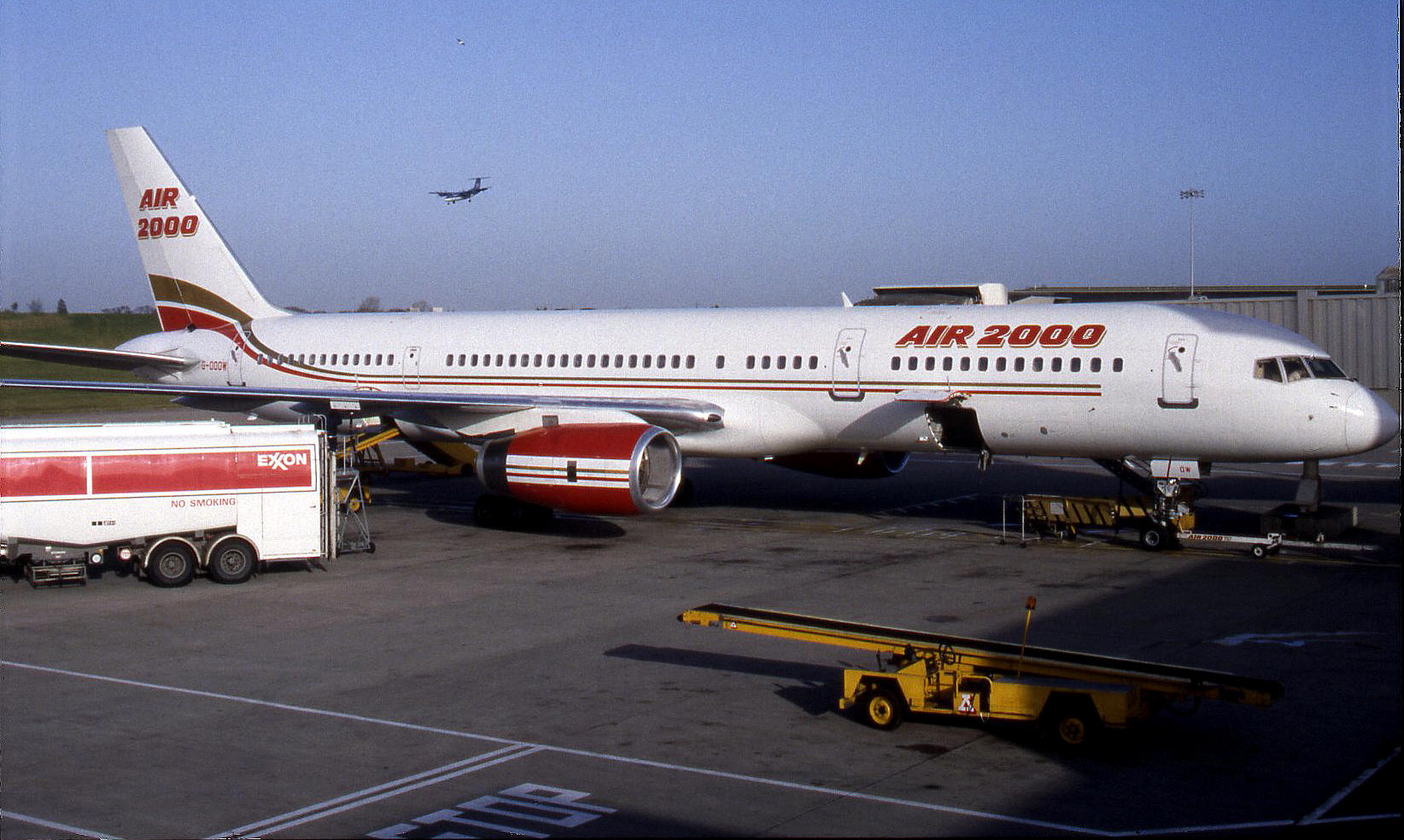
INCLUSIVE TOURS ETC
In the early 1960s Air Safaris based at GATWICK took over the Don Everall operation. The Everall operation had IT, (Inclusive Tour), routes to Basel in Switzerland, Malaga in Spain, Nice and Perpignan in France and Rimini in Italy. Obviously, popular destinations. Today, only Malaga remains as a very popular holiday destination airport which serves to illustrate how the choice of destination for British holiday-makers has changed so much over the years. I very much doubt that anywhere near enough ‘credit’ is being given today to the startling effect the arrival of those first British DC.3s and Vikings have had? (I get the impression the British pioneered the ‘Inclusive Tour’ holiday concept? What I don’t know is, did holiday-makers from other EU nations follow, or perhaps lead the way?) Who and what exactly kicked this whole idea off?
Looking at the colossal rate of change around much of the northern Mediteranean coastline especially, from Spain via France, (a bit in Italy), Greece to Cyprus, (Turkey too etc), where massive coastal areas are now covered in vast strips of dense, and nearly identical, white concrete apartments and hotels, it seems very hard to believe that a few Dakotas and Vikings, later DC-4s and Viscounts, (we musn’t forget the Handley Page Hermes, Canadair Argonaut and Lockheed Constellation contribution etc, etc), helped to bring this phenomenom about. But, without them, could it, or would it have happened? Go to the ‘new’ Palma airport in Majorca, or Malaga today and it’s hard to believe the volume of arrivals and departures of mostly medium size airliners seeming to equal the volume of movements at HEATHROW or GATWICK most of the time.
It took a while but eventually foreign operators picked up on the potential offered by IT, (Inclusive Tour) operations. During the early 1960s the British ‘independent’ operators like Overseas Aviation flew Canadair Argonauts to Palma, Rimini and Valencia. Euravia flew Lockheed Constellations to Palma, Perpignan, Rimini, Valencia and Venice. Lloyd International DC-4s served Naples, Palma and Venice. In 1964 this picture changed and the foreigners mostly had better aircraft, like the the Douglas DC-6. From France Airnautic served Nice, from Spain Aviaco served Palma and Societa Aerea Mediterranea flew holiday-makers to Rimini. Between 1961 and 1964 the number of seats booked on ‘IT’ flights from this airport trebled.
On the back of this you started to have the ‘wrinkly’ brigade, (my age), deciding to forsake retirement in the suburbs of Birmingham, Cardiff, Glasgow, London, Manchester and Teeside for a life exposed to sun , sea and a supposed existence free of stress. Hmmmm? Today, flights back to UK, via QueasyJet or Rynair ‘pirate or prisoner-of-war class’ etc, booked well in advance, can be obtained for the price of a decent paella. Hardly sensible, hardly sustainable? The early IT destinations did change, quite a lot. Was this because these operators were desperately seeking a winning combination? In 1961 the principal destinations for Air Safaris were, Copenhagen, Nice, Perpignan and, Stavanger.
Learning about the early history of the IT (Inclusive Tour) is a subject I find fascinating. Some of their destinations appear so improbable today? For example in 1963 Derby Airways operated Argonauts to Barcelona, Cork, Ostend, Palma, Perpignan, Rimini, Tarbes, Valencia and Venice. Cork, Ostend, Perpignan, Rimini and Tarbes have disappeared as popular holiday destinations on the IT agenda today, but why were they so popular at that time? What exactly attracted and convinced the early IT operators to service these destinations?
Derby Airways was renamed British Midland Airways in October 1964 before moving their main base from BURNASTON to the new EAST MIDLANDS AIRPORT. It must be remembered though, that their Argonauts were also maintained at ELMDON.
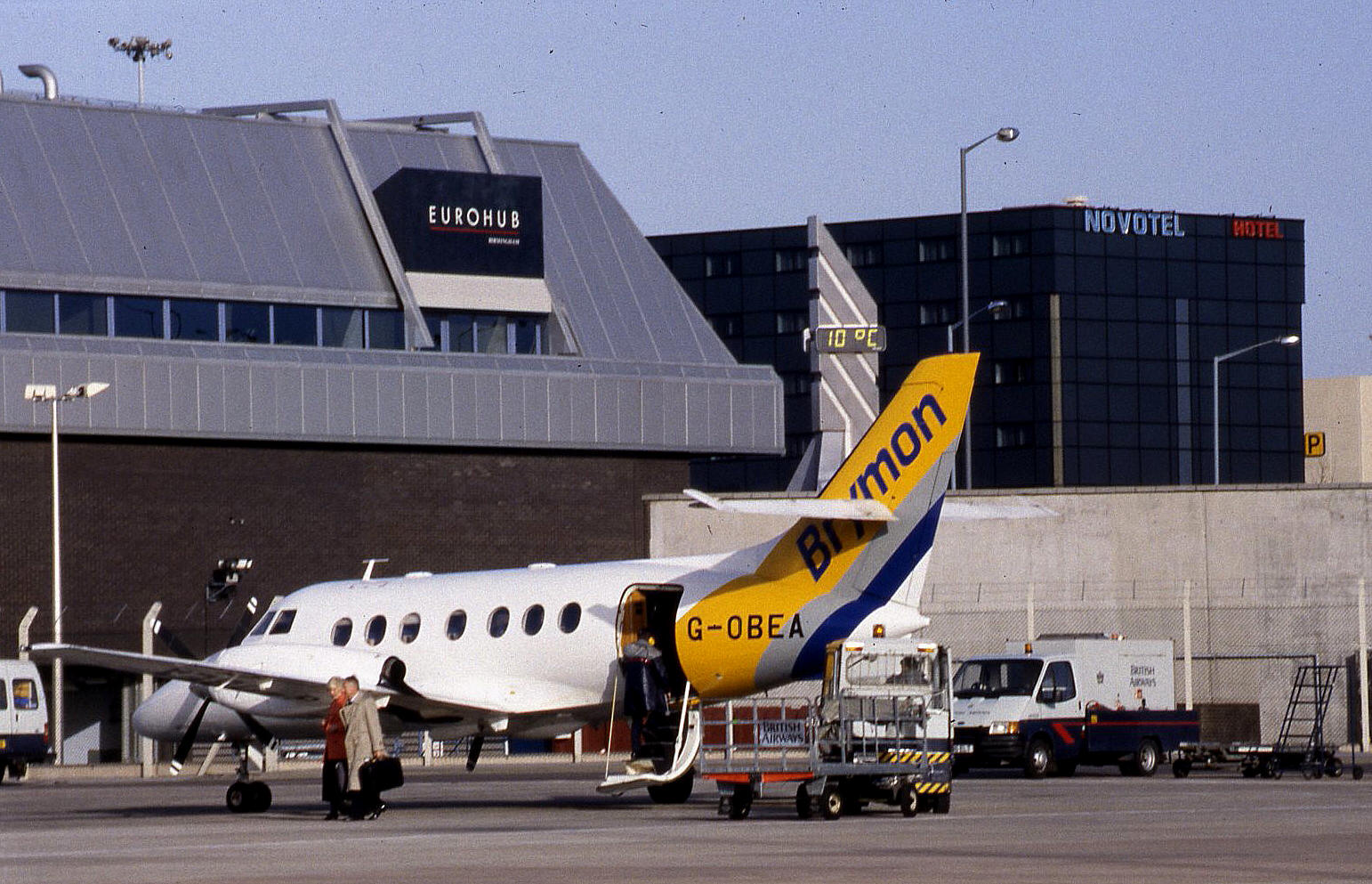
SCHEDULED SERVICES
The development of scheduled services appears to have been a “hit and miss” affair as often as not. In 1960 BEA opened a Manchester (RINGWAY), Birmingham (ELMDON) to Barcelona night service. (Why?) The first five services carried thirty passengers, one flight had NO passengers! But, BEA scheduled an additional frequency in 1962! The service was finally withdrawn in October 1967. Obviously the inmates taking charge of the asylum? A service to Amsterdam did better, but with a 30% load factor at best it seems it was more a political rather than commercial gesture? In those days, it must be remembered, both BEA and BOAC were charged with "flying the flag" duties. But, as Anthony Milward, BEA’s Chief Executive said about the ELMDON to Amsterdam route, “It is the easiest way of losing money that I have ever come across.” On the other hand, BEA routes to the Channel Islands in 1960, were fully booked.
This seems such a shame. The last regular BEA scheduled flight by a DC-3 Pionair, (from HEATHROW), was G-AGZB flown in by Capt Peter Griffin. He tried landing in fog, (I can imagine the pressure?), and ran off the end of the runway. The last southbound BEA‘DC-3 Dakota’ needing to be cancelled! BEA, (British European Aiways), remained a ‘disaster’ waiting to happen in nearly every operational respect until BA, (British Airways), was formed amalagamating BEA with BOAC. (This is NOT to say BOAC was a brilliant airline without any serious flaws).
THE FIRST PURE JET ARRIVES
The first ‘pure jet’ aircraft to visit ELMDON was the RAF Transport Command DH.106 Comet XK716 “Cepheus” arriving on the 18th April 1961.
THE COMPANY HACK TO EXECUTIVE JET
It has to be remembered that many of the companies operating their own aircraft mainly for ‘executive’ transport purposes have made a significant impact on the UK aviation scene. Indeed, for a few aerodromes these few activities kept them alive! ELMDOM/BIRMINGHAM had a share in this too. Tube Investments had a Rapide based here in 1954, then a Dove G-AKJG, Heron G-ANPV, a King Air G-AYLW and then a Super King Air G-BKTI. The company J. C. Bamford, (known everywhere as JCB), based their Dove G-ARJB “Exporter I” here from September 1960 followed by Dove G-APVX “Exporter II” from March 1969. Their HS.125 Srs 400B G-AYLI "Exporter III" was based here from late 1970 to 1971, before JCB moved their exec operations to EAST MIDLANDS AIRPORT that same year.
BSR Ltd had their Dove G-ASMG based here from 1963 to 1965. Their HS.125 Srs I – G-ASSM arrived in 1965 and together with a later HS.125 Srs.400B G-AXDM kept up their jet operations until 1970. It appears that BSR also operated for a short period a Jet Ranger helicopter G-AVTE to transport top execs and favoured visitors from ELMDON/BIRMINGHAM to their plant at OLD HILL about 15nm W, surely a most expensive and totally unnecessary indulgence? GKN had a complex history here too.
Private aviation has a place here too. The history is much too complex to state here but a list of types operated from about 1959 to 1975 can give some idea of the diversity. Aero 145 G-AROE, Auster 5s G-ALFA & G-AOTJ, Beech Baron G-AZUJ, PA-28-160 Cherokee G-ARVT, PA-28-235 Cherokee G-ASLV, PA-24-260 Commanche G-ATAO, PA-30/(39?) Twin Commanches G- AVVI & G-AYZE and the Percival Prentice G-AOKO.
MORE DEVELOPMENTS
For more recent developments at ELMDON/BIRMINGHAM it is best served by once again refering you to ‘Aviation in Birmingham’ by Geoffrey Negus & Tommy Staddon. They certainly seem to give many examples that prove the lesson that to be a truly successful senior manager of a major airline, it’s probably best you are either barking mad or entirely ignorant and preferably both? The basics of costing flying a VC.10 from BIRMINGHAM to MANCHESTER, (about 65 miles as the crow flies), to collect more passengers before departing to New York is surely an obvious nonsense from the outset. But somehow, the fools employed by BOAC in this sector of their route planning operations managed to find a way to justify their jobs by recommending this. And BOAC senior management, agreed to it! Am I missing something? Surely this tactic must have knocked the profit off the job?
BACK TO THE 'IT' SCENE, THE 1970s
The range of aircraft used by the IT (Inclusive Tour) operators in the early 1970s using ELMDON/BIRMINGHAM must bear mention? Without doubt a picture of the cross-over between three distinct generations of airliner development, including the last of the piston engined types. Before the era where only Airbus and Boeing dominated the global airliner production scene. Air Spain had Douglas DC-8s, Aviaco Sud-Aviation Caravelles, Aviogenex used Tupolev Tu-134s and Britannia Airways had a nonsensically registered Boeing 737 G-AVRO “City of Birmingham” flying from here, pretty quickly renamed “Sir Francis Drake”.
Bavarian Airways were then, (hard to believe today?), operating BAC One-Elevens, Balair had elderly Douglas DC-6Bs and newer DC-9s. Braathen-SAFE were flying in with Fokker F-28s and British Caledonian were also, like Bavarian Airways shunting BAC One-Elevens around the skies. Channel Airways, incredible though it may seem today, were still operating DH.106 Comets, plus a weekly Vickers Viscount service to Ostend. Court Line were also using the then popular BAC One-Eleven for their services. Donaldson International however, were still persevering with Bristol Britannias.
Inex-Adria were by then using Douglas DC-9s but JAT were still stuck with Sud Aviation Caravelles. Monarch were operating Boeing 720Bs to Toronto and Vancouver and Societa Aerea Mediterranea, like JAT, were still using Sud Aviation Caravelles. On the other hand Spantax SA were operating the fabulously performing Convair 990 Coronado. (Technically excellent and far better in most respects the 880 and 990 Series are said to have lost Convair over $450 million in the commercial battle to win ‘big jet airliner’ sales against Douglas and Boeing. Hints of the Vickers VC.10 failure scenario perhaps? To round off, Trans-Europa were using Douglas DC-7s and Sud Aviation Caravelles and World Airways were operating Douglas DC-8s.
AN OVERALL VIEW OF THE EARLY 1970s
I think this overall view published in 1974 in the UK & EIRE Commercial Airports book by Airline Publications & Sales is well worth quoting: "Since 1972, Birmingham has helped to lead the trend for regional airports to extend their range of direct international services. This both alleviates pressure on the congested London airports, and improves the quality of service to the regional traveller - or visitors to these regions who wish to by-pass London."
(My note: For as long as I can remember I have banged on about the importance of developing regional airports - and not just in the UK - not that anybody would listen to my opinions of course. But, as this is my 'Guide' I can at least make a mention).
"In that year, British Midland Airways introduced direct services to Brussels and Frankfurt, whilst in 1973 Alidair introduced a Viscount service bringing Copenhagen just two-and-a-half hours from Birmingham. Other such developments are in the offing, both with British Airways (whose Channel Islands Airways division is based here) and through independent such as these."
"Inclusive tour flights to most of the popular Continental centres help to bring the number of airline movements on a typical summer day to some 80 or so. During 1973 the annual number of passengers passing through Elmdon exceeded one million for the first time. United States supplemental carriers, such as World Airways, occasionally call here with transatlantic charter flights."
"Light aircraft, for both business and pleasure use, are particularly active here, whilst among training aircraft to be seen regularly on ILS runs are those of the College of Air Training and C.S.E. Aviation. Non-commercial flying now accounts for more than 40,000 aircraft movements annually at Birmingham." How things have changed!
LIGHT AIRCRAFT BASED HERE IN 1974
According to U & EIRE Commercial Airports published in 1974 (which gives extra details) the following types were based here:
Beagle B.121 Pup 2
Beechcraft singles: Beechcraft M.35 Bonanza
Beechcraft twins: Beechcraft 95-B55 Baron (x 2), Beechcraft 90 King Air (x 2), Beechcraft 100 King Air
Britten-Norman BN-2A Islander
Cessna singles: Reims Cessna 150 Aerobat, Reims Cessna 150 (x 2)
Cessna twins: Cessna 337F Super Skymaster
Hawker Siddeley HS.125 Srs.1 (x 2), Hawker Siddeley HS.125 Srs.400B
Piper singles: Piper PA-22 Colt 108, Piper PA-24 Comanche 250G, Piper PA-28 Cherokee 140B, Piper PA-28R Cherokee Arrow 180 (x 2)
Piper twins: Piper PA-23 Apache 160, Piper PA-E23 Aztec 250C, Piper PA34 Seneca 200-2, Piper PA-39 Twin Commanche 160 C/R (x 2)
Robin HR.100-200 Royal
Socata MS.88B Rallye Club
Sokol Aero 145
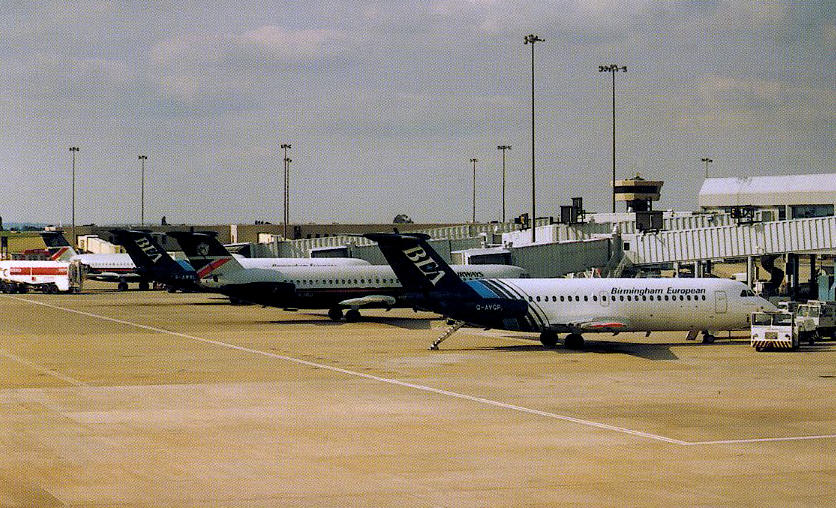
THE NEW TERMINAL
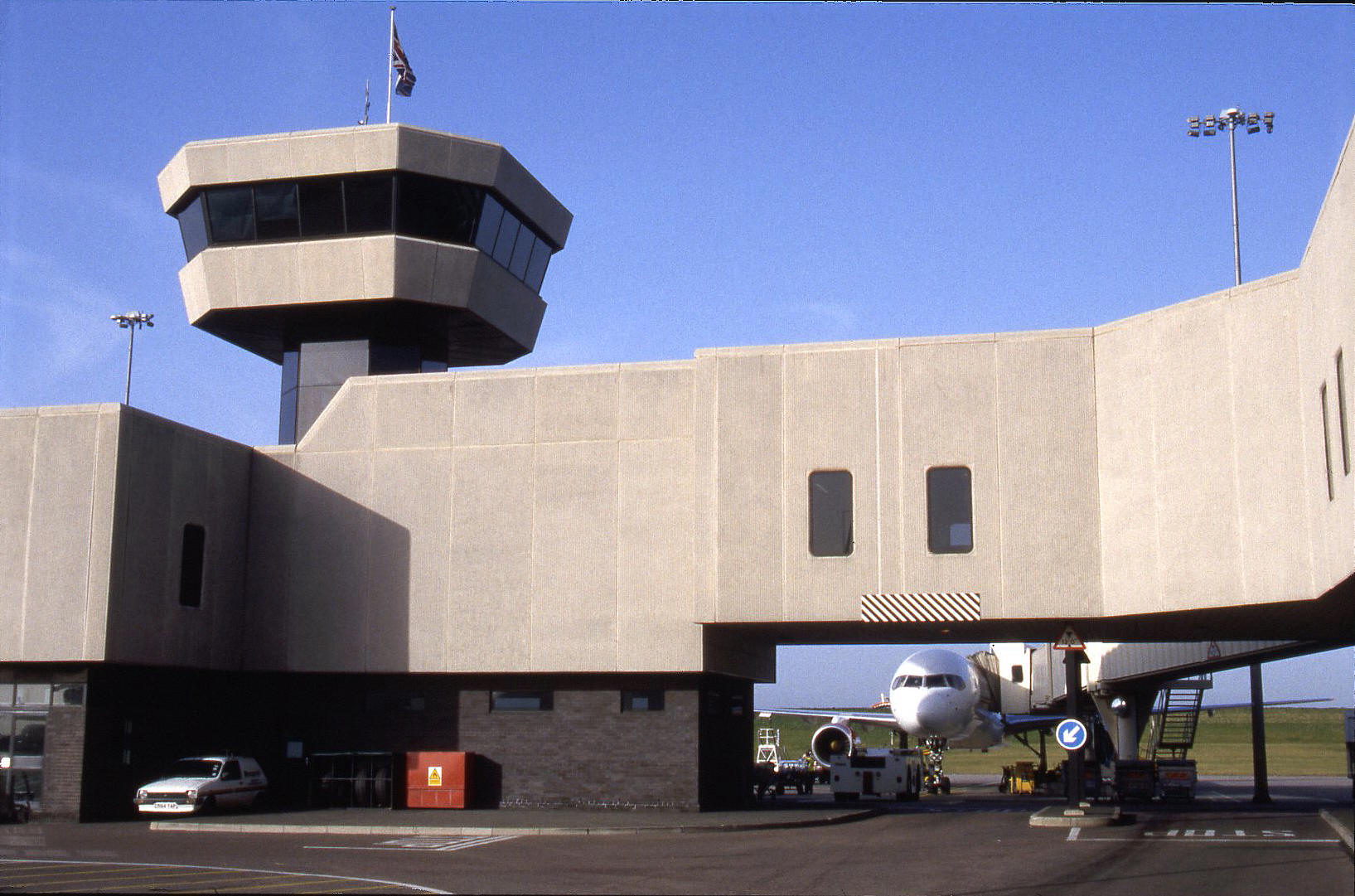
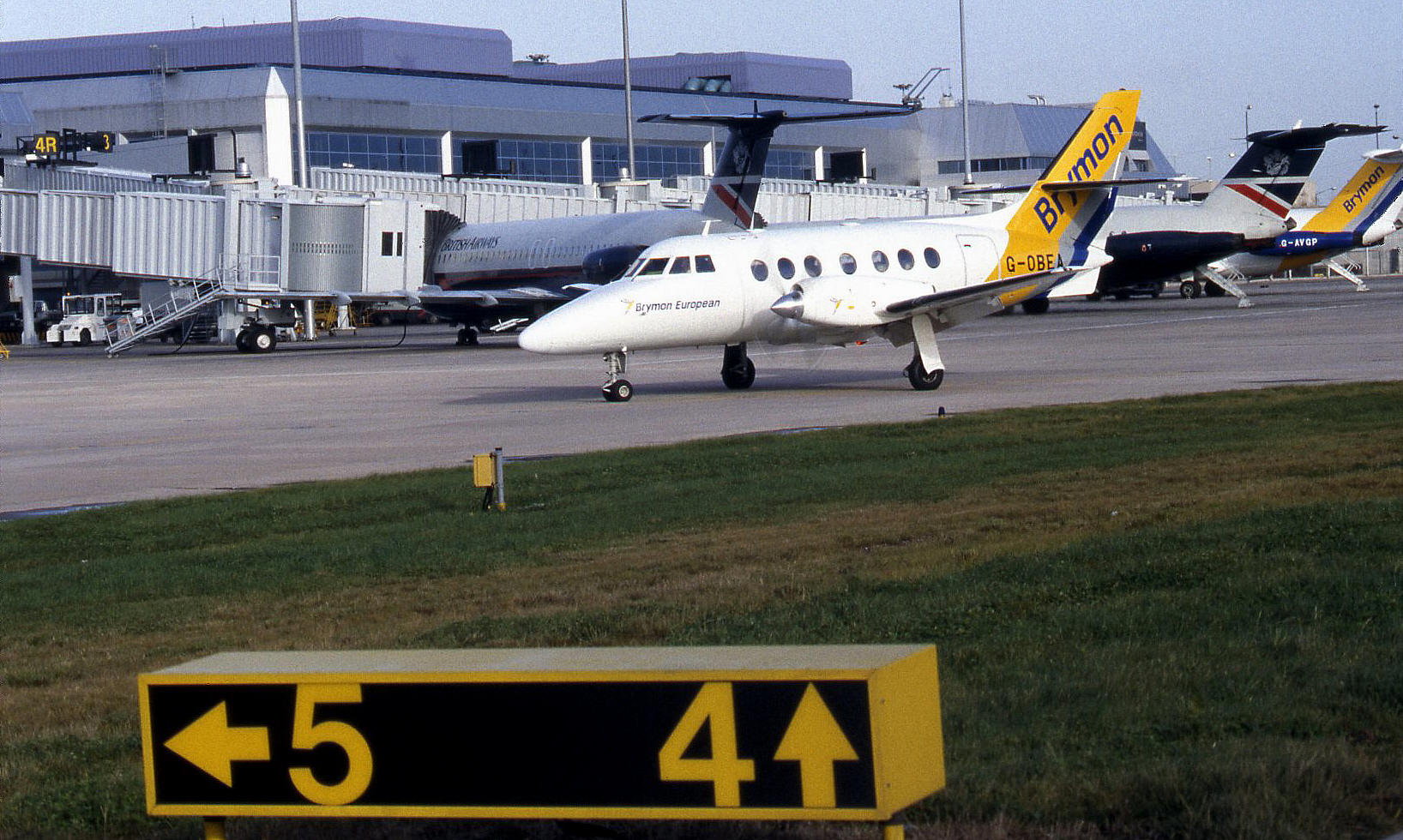
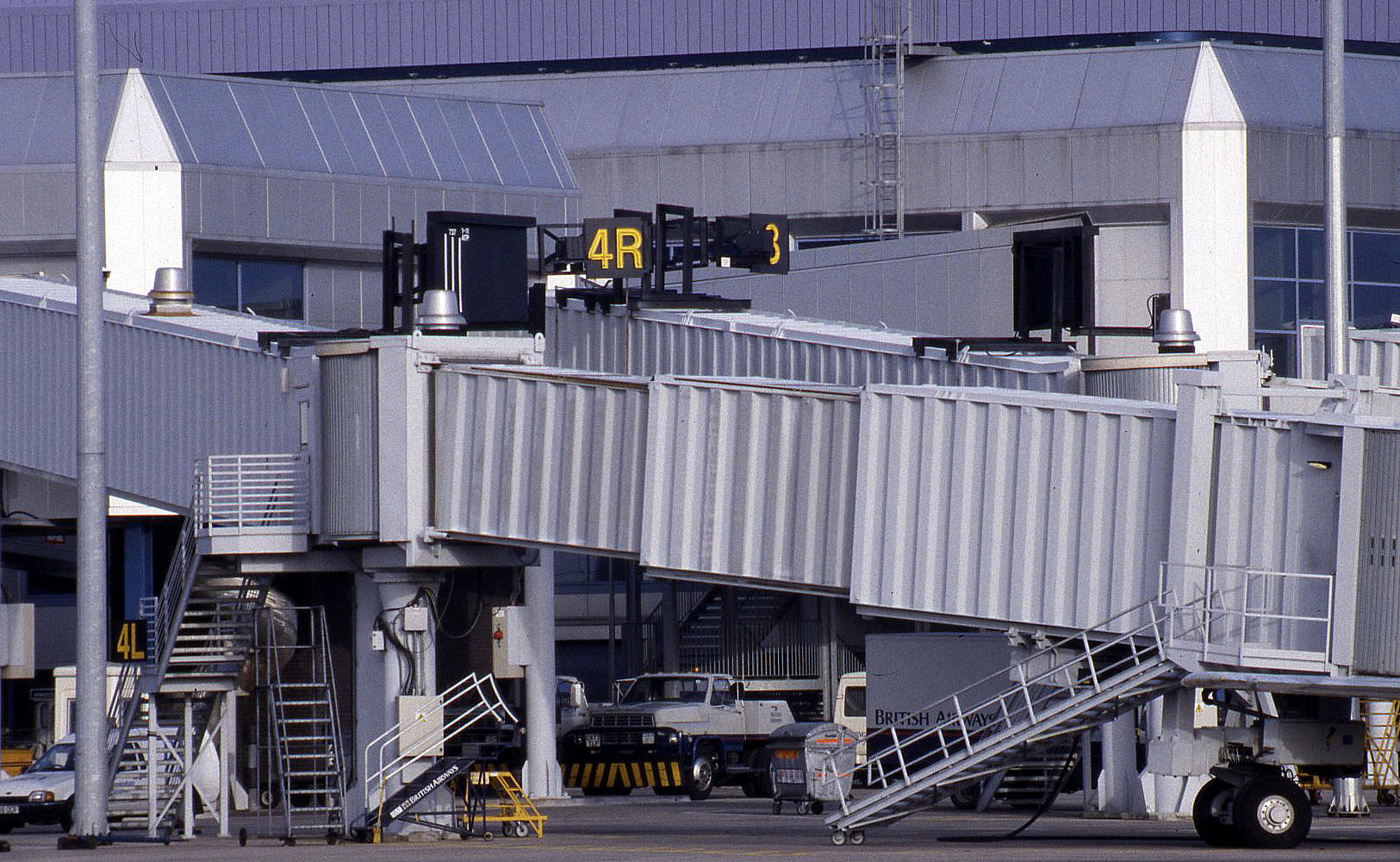
This picture is a scan of a limited edition postcard, (just 1000 printed it appears), of a picture taken by Carl McQuaide captioned: BAC-111 aircraft parked at the Eurohub Terminal shortly after opening on the 22nd July 1991.
Clearly seen, apart from two British Airways BAC-111s, are two more BAC-111s of Birmingham European Airways. In 1992 Birmingham European Airways merged with Brymon Airways to form Brymon European Airways. I now suspect that this is quite a rare picture, given the timescale?
A NICE STORY
I suppose it is fitting to quote in full a paragraph from ‘Aviation in Birmingham’ just to show how little most of us really know about what has been going on over the years. These sorts of tales keep appearing the more the subject is researched. I quote: “Birmingham bricklayer Fred Taylor designed and built, with Ken Bracey, a series of ultra-light aircraft in the 1930s and 1940s. Their serials had no official significance. They all had the letter ‘T’ for Taylor?), on the tail. First was the A.101, a single seat open-frame aircraft. Then the B.102, a single-seat high-wing monoplane powered by a pusher engine. This survived the war and flew in the late 1940s . C.103 was called the Wagtail. Built at a cost of £15 in Taylor’s council house bedroom, it flew from a farm, possibly at Marston Green. It was a single-seat parasol monoplane powered by a JAP J-99. Because it was built with unapproved materials, it could not be registered. It was stored during the war and later fitted with a Bristol Cherub sold to them by Don Burgoyne of Knowle. And, here comes the main reason for including this account!) It flew to CASTLE BROMWICH on 2 October 1948, then ELMDON, where it was charged 12s 6d, although an illegal aircraft! Yet another story, presumed truthful, (?), which has inspired me to research flying sites. Setoff along this line of enquiry the people and their machines come flooding in, along with so many often amazing stories.
ASTONISHING?
In November 2011 the following story received a lot of publicity. A number of Asians had booked tickets to fly with Comtel Air based in Vienna. It appears this airline was a typical ‘virtual’ airline leasing in aircraft from Spain to fulfil its commitments. On landing in Vienna the passengers were informed by the Captain that they could not depart to Birmingham unless £22,000 was paid in cash, to him. It appears the travel agency hadn’t paid Comtel Air and they had gone bust. A ‘whip round’ was organised, some passengers being allowed off to access cash points. On arrival at Birmingham the Captain was promptly arrested! I mention this just to illustrate that the emergence of ‘cut price’ airlines in the late 20th century mirrors in so many ways the many ‘cowboy’ operators who emerged after WW2. Isn't it astonishing sixty years on, even with the mass of regulations, something like this can still happen in the 21st century. Heh ho, what happened to progress?
A QUERY
In 2016 Daniel Phipps added an interesting question in 'Comments' - see below. Could anybody be kind enough to add to this? I certainly do not know the answer.
Daniel Phipps
This comment was written on: 2016-03-24 07:36:37Which was the first commercial jet to leave Elmdon? I thought l was on it. It would have been late 60's, after 67. I went to Heathrow for the day. £9 17s 6d return. It was the 08 00 out and 20 00 return. I flew out on a BEA Bac111 that had been diverted due to fog to Elmdon. My only claim to fame! I am now 62. Daniel
Neville PHILPOTT
This comment was written on: 2017-07-11 07:34:39Wonderful site Carl, brings back so many memories, many thanks...
Reply from Dick Flute:
Hi Neville, Many thanks. Just one question - who is Carl? Best regards, Dick
Garry Cole
This comment was written on: 2019-02-21 18:49:23What a great read, its was a fantastic time through the 60s & 70s for aircraft enthusiasts. My spotting days at Manchester lead to a job offer at East Mids with Britannia but was scuppered by the oil crisis in 73. Not to be defeated a late entry into the RAF as an engineer. Great posting to Finningley on 125 (Dominie) & Jetstreams. A quick brush with the Jaguar fleet and then i found it or they found me! The Queen's Flight RAF Benson, I made Crew Chief on Andover CC Mk2 ( HS 748) then fleet Manager of the BAe 146-100 aircraft. This whole period 1982-1995 was never going to be beaten. On leaving the RAF a short sharp stint with Flightline & their rapidly expanding 146 fleet. Then I was back on the spanners as a contractor at RAF Cranwell on my old friends the Dominie & Jetstreams. As these old girls faded from the RAF a short spell on Kingair to finish my 40 years loving and working on/with aircraft. Now in retirement the Family tree is well back into the 16th century and i have produced an Airline board game. The prototype plays very well just not sure it's viable product though in this electronic age but my family & friends love playing it and if you are lucky to get Concorde into your fleet watch the money roll in,Great Fun!
David Ian Brown
This comment was written on: 2020-01-01 15:07:44Never seen such a detailed history of Elmdon before. Thanks for such great research on your part. Thoroughly enjoyed it! You ask at one point if the Don Everall Aviation service to the Isle of Wight in the mid 50s flew to Bembridge or Sandown. I had an Aunt who went on that service for her holiday. We went to see her off and I can still see her waving to us as she walked out of the terminal on the east apron to board the DH 89 Dragon Rapide and can tell you that it was definitely going to Sandown, where she was staying. The first photo in the Mike Charlton Gallery is described as Elmdon post 1945, though I can see no hard surface taxiways or runways visible, so I would say it's actually taken then in 1939. Also wondered why you denote Manchester airport in 1939 as Barton, albeit with a question mark, when air services had transferred to Ringway in 1938? Would you by any chance know what was the pre-WW2 grass runway layout at Elmdon when it opened? In those days, there could be up to 4 at airfields, one for each compass direction to accomadate whichever way the wind might be blowing. Finally, is it possible to obtain a copy of 'Aviation in Birmingham' by Geoffrey Negus and Tommy Staddon? I have googled it but to no avail. Thanks.
Dick Flute
This comment was written on: 2020-01-01 19:38:46Hi David, Many thanks for the kind comments and information. Much appreciated. You should be able to obtain a copy of Aviation in Birmingham from AbeBooks. They had a copy for £2.70 when I Googled them. Best regards, Dick
Nick Grice
This comment was written on: 2021-02-03 14:19:27Great site and bringing back many happy memories. i worked there as a baggage handler for 2 seasons and also continued with my PPL at Warwickshire Areo clu. My late father was a regular visitor there as he worked for Lufthansa.The late great Sir Bob Taylor was the boss there and what a true gentleman he was. Apart from business Dad attended a club which was based there called the RAMS club (Retired Airline Managers ) club. Great memories for me. Thanks again. Nick.
We'd love to hear from you, so please scroll down to leave a comment!
Leave a comment ...
Copyright (c) UK Airfield Guide