





Brough flying sites
BROUGH: Private Seaplane Station
NOTES: Listed in the 1934 edition of the Air Pilot
BROUGH: Military Landing Ground, seaplane operating area and civil aerodrome


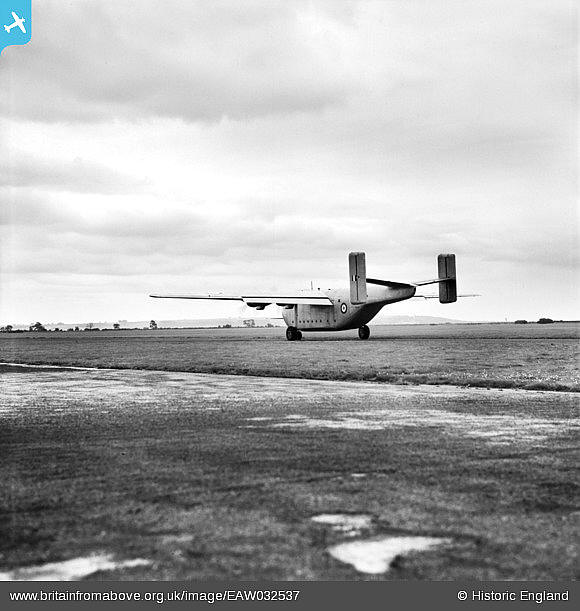
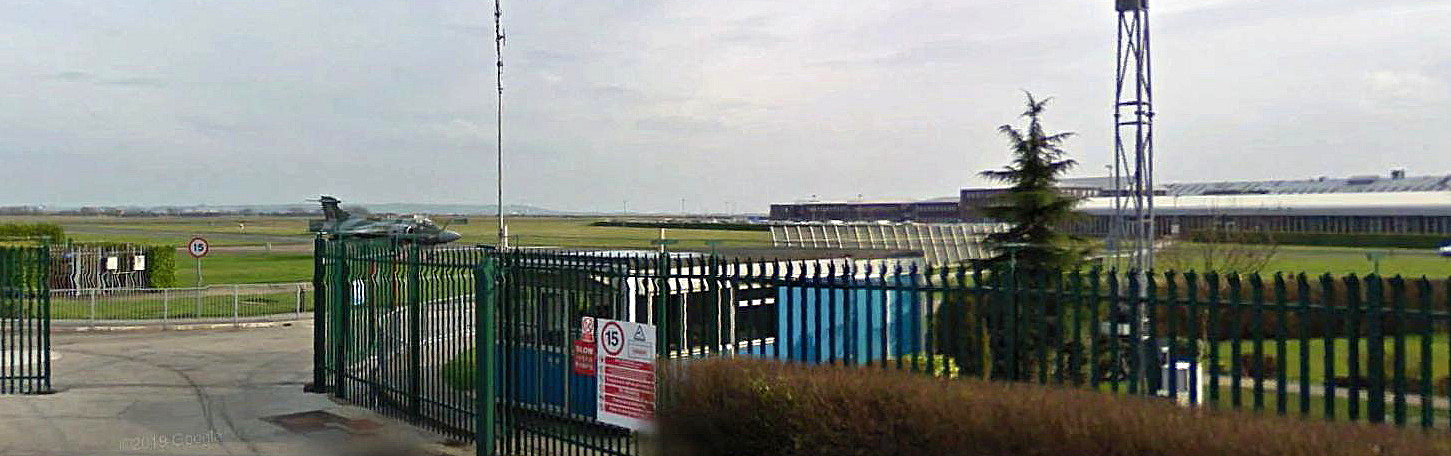
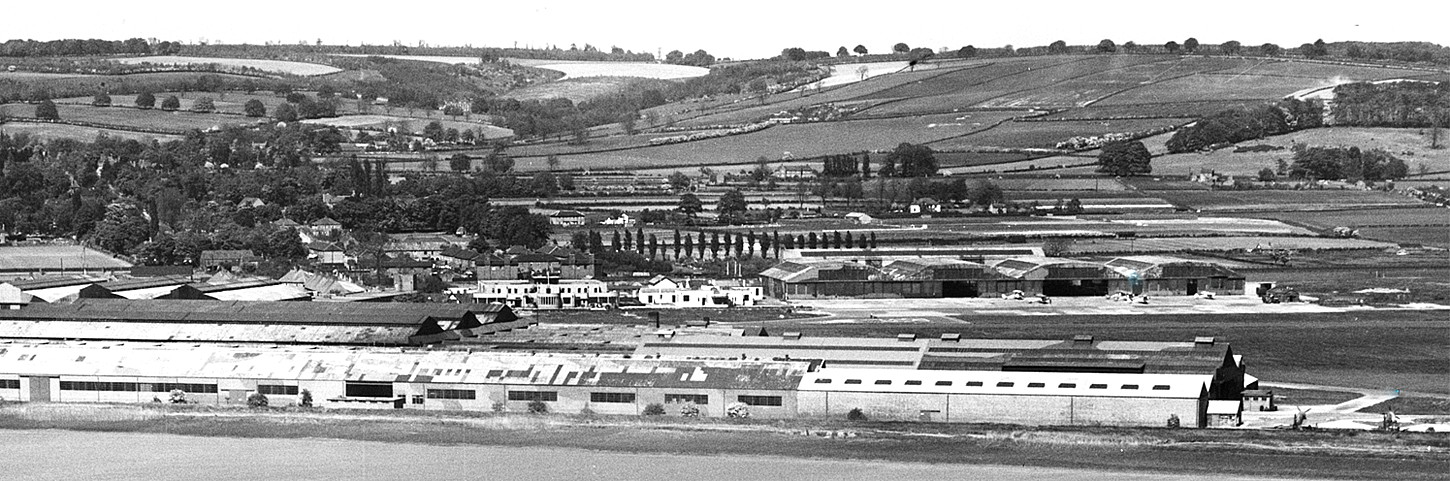
Note: In the first picture we can see quite a substantial factory. Can anybody put a date on this photograph?
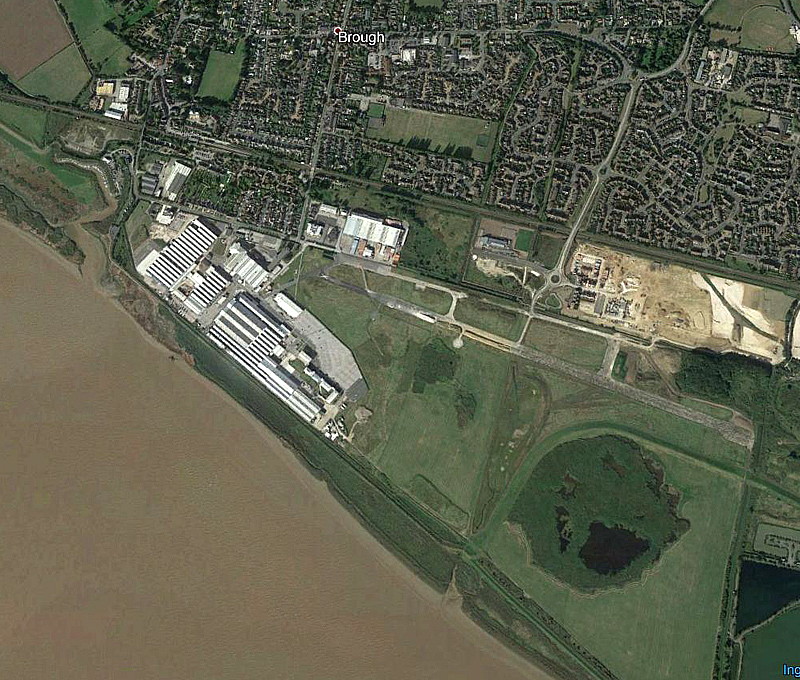
The second picture is by the author.
The third picture was kindly provided by Mr Michael T Holder. Apparently taken in 1950 the type was then known as the General Aircaft GAL.60 Universal Freighter. This example probably being the prototype WF320? The aircraft was designed and built by General Aircraft at HANWORTH AIR PARK in Middlesex, south-west of central London. The company had meanwhile been taken over by Blackburn and the prototype was transported by Road to BROUGH for assembly, the first flight taking place on the 20th June 1950.
Once in production the type was known as the Blackburn B-101 Beverley C.1.
Military user: WW1: 1916 RFC 33 (Home Defence) Sqdn
1918 to 1919 RAF No.2 Marine Acceptance Park and/or Depot
PICTURES FROM MIKE CHARLTON

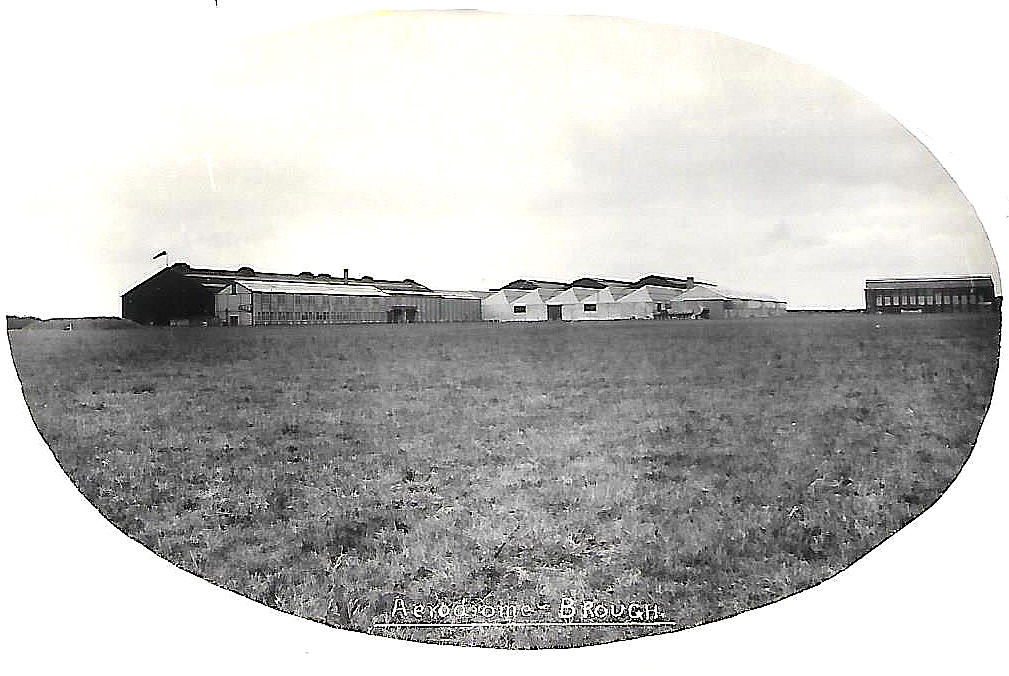


Note: These four pictures from postcards were kindly sent by Mike Charlton who has an amazing collection. See, www.aviationpostcard.co.uk
The first two pictures were it seems, taken in 1934, whereas the third was taken in 1939. The fourth picture is undated, but presumably taken in the 1930s?
WW2: RAF Training Command 51 Group
4 EFTS [Elementary Flying Training School] (de Havilland DH82a Tiger Moths)
Operated by: 1933: Blackburn Aeroplane & Motor Co Ltd
1965: Hawker Siddeley Aviation, Hawker-Blackburn Division
1975: Hawker Siddeley Aviation, Hawker-Blackburn Division
1990: British Aerospace plc (Aircraft Group)
2004: British Aerospace Military Aircraft & Aerostructures
British airline users: Pre 1939: North Sea Aerial & General Transport, Humber Air Ferry
Post 1945: Humber Airways
Charter?: North Sea Air Transport
Notes: In the 1957 edition of 'The Aeroplane' directory, it appears that North Sea Air Transport were operating just one DH89A Dragon Rapide.
However, in 2024 I was advised that in 1948 the company acquired three Avro 652A Anson Mk.1s, G-AJCO (ex NK370), G-AJCP (ex MG829) and G-AJCR (ex NK878). G-AJCO and G-AJCR were registered from 17.09.48 until 04.03.52. The G-AJCP registration was not taken up, so presumably used for spares? I have also found a record that neither G-AJCO and G-AJCR were converted for civil use. But, presumably having civilian radios fitted?
It was also during this period when North Sea Air Transport acquired the Miles M57 Aerovan 4, G-AJOG, having it registered from 01.11.49 until 27.11.51 when it went to Belgium as OO-ERY.
If anybody can kindly offer information about any other aircraft operated by this company (?), this will be most welcome.
Flying schools: Pre 1940: North Sea Aerial Navigation Co, Blackburn Aeroplane Co
Flying club: Post 1945: Humberside Police Flying Club
Pleasure flights: Pre 1940: North Sea Aerial Navigation Co
Manufacturing: WW1: Blackburn Aeroplane & Motor Co, Brush Electrical Engineering Co Ltd, Dick Kerr, Phoenix Dynamo Manufacturing Co Ltd, Robey & Co Ltd
1919 to late 1960s?: Blackburn Aeroplane & Motor Co
Post 1970: British Aerospace (in their various transformations)
Location: 7nm W of Hull
Period of operation: 1916 to 2006?
Site area: WW1: 44 acres 503x357 grass Slipways to the River Humber provided

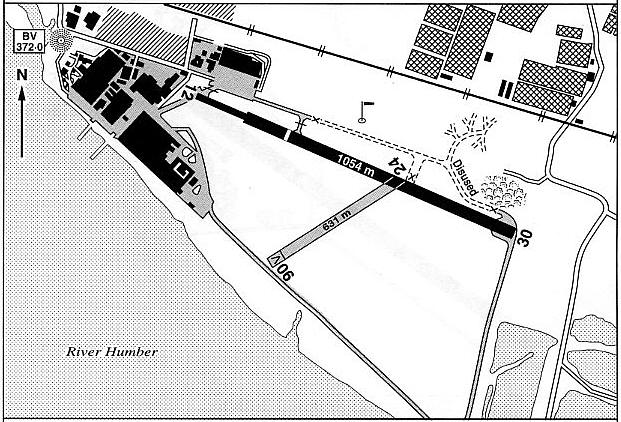
Note: These maps are reproduced with the kind permission of Pooleys Flight Equipment Ltd. Copyright Robert Pooley 2014.
Runways: 1933: Max. run available: 686 grass
WW2: 12/30 1307x91 hard
1965: 12/30 1062x30 (with extension of 342x9 at NW end) hard
NE/SW 594 grass NNW/SSE 1006 grass
1990/2001: 06/24 631x18 (626x18 in 1990) grass 12/30 1054x30 hard
NOTES:
The North Sea Aerial Navigation Co operated here from 1919 to 1925 apparently using Blackburn Kangaroos for freight carrying and later joy-riding, the latter operation also using two Avro 504Ks G-EAIT and G-EAIU. The freighter Kangaroos still bore their military serials B9972, B9973 and B9978 and this operation started at ROUNDHAY PARK near Leeds and closed in 1920. The joy-riding versions were G-EAIT, G-EAIU and G-EAKQ. The use of the letter ‘Q’ was later dropped of course for civil registrations.
In 1920 the William Beardmore Co based at RENFREW started an experimental airline service from RENFREW, via BROUGH to CROYDON.
ROUND THE WORLD VISIT
It is said that on their epic Round-the-World trip in 1924, the three surviving U.S. Army Douglas World Cruisers, after being equipped with undercarriages at PLYMOUTH (DEVON) to land at CROYDON (LONDON), then flew to BROUGH to be re-equipped with floats. Then they flew to the BAY-of-HOUTON in the Orkney Islands, (see my listing with a picture), before undertaking the hazardous North Atlantic crossing. Some say they flew directly from BROUGH but this is incorrect.
RAF RESERVE SCHOOL
In 1925 North Sea Aerial Navigation started a RAF Reserve School here using yet more Kangaroos; G-EBOM, G-EBPK and G-EBMD named ‘Pip’, ‘Squeak’ and ‘Wilfred’. Using the type till 1928 it seems. So it appears this WW1 type wasn’t as silly as its name!
SIR ALAN COBHAM MAKES A VISIT
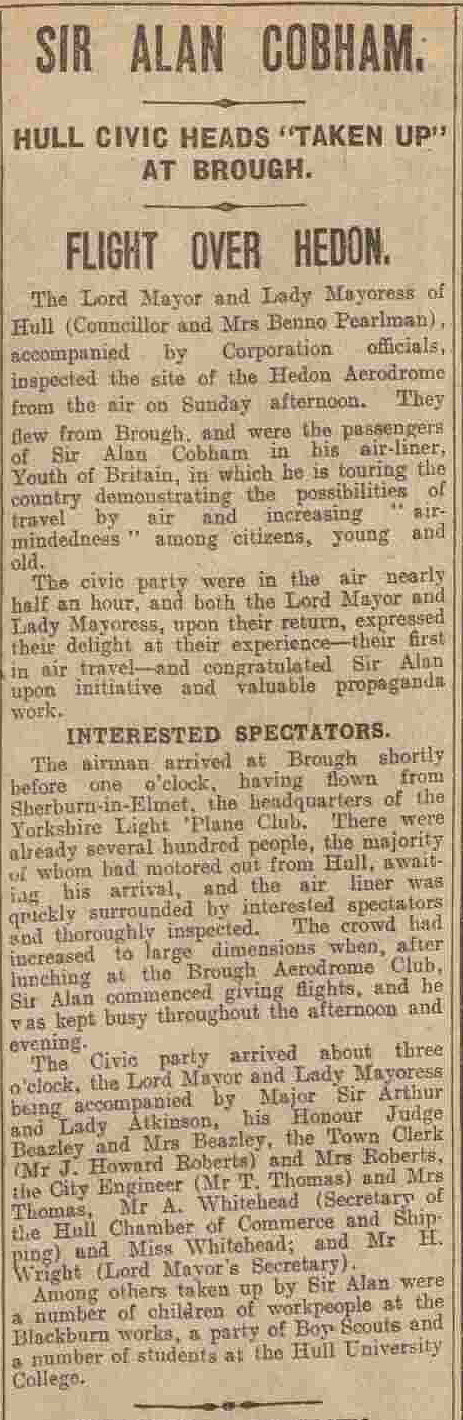
We have Mike Holder for finding this article published on the 8th July 1929 in the Daily Mail. This was his 28th venue of a tour of much of the U.K. during his 1929 Municipal Aerodrome Campaign. Using the de Havilland DH61 'Giant Moth' G-AAEV named 'Youth of Britain' this tour started in May and ended in October. The original plan was to visit 107 venues, but a couple of mishaps occurred along the way.
A MICHAEL T HOLDER GALLERY


Note: I have added the area view from my Google Earth © database.
BECOMING A REGIONAL AIRPORT
It appears that on the 10th October 1929 BROUGH had its official opening as a regional airport. An air display was held including, (without much doubt formation aerobatics), with the Armstrong Whitworth Siskin III type flown by 29 Squadron of the RAF.
A FLYING CIRCUS VENUE
Venue for CD Barnards Air Tours 1st June 1931?
On the 25th June 1933 Alan Cobham’s No.2 Tour performed here after operating from HEDON the day before. Today of course this probably wouldn’t be seen as commercially viable as so many people have cars, but in the early 1930s many of the people attending would have walked or travelled by bicycle.
THE HUMBER AIR FERRY
On the 1st July 1933 the Humber Air Ferry commenced to Grimsby (WALTHAM) using the Blackburn Seagrave G-ABFR and DH Fox Moth G-ABWB. As a point of interest the twin engine Seagrave could carry three passengers whereas the single engine DH Fox Moth could carry four – albeit of modest size and weight.
THE BLACKBURN R.B.3A 'PERTH' FLYING BOAT BEING LAUNCHED

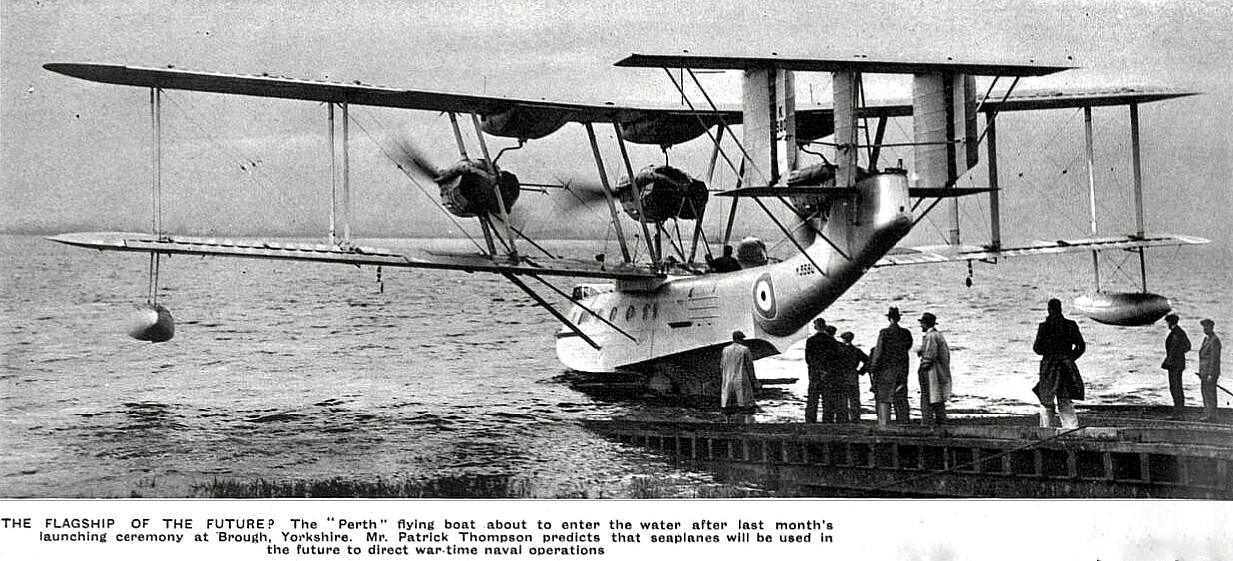
Note: This great picture of the Blackburn 'Perth' flying boat being launched was published in The Sphere on the 4th November 1933. Both pictures kindly provided by Mike Holder. The first flight is given as being on the 11th October 1933. It appears that only four were built, although being at that time the largest flying boat operated by the RAF. They only remained in service until 1937.
FAST FORWARD: THE BUCCANEER
In 1975 it seems Buccaneer assembly was the main activity. I remember these apparently remarkably strong and capable aircraft from my youth and unlike so many other ‘early’ military jet types I haven’t heard any dark rumours regarding how bad they really were. In fact quite the opposite, but perhaps you know better? It was I suppose the unique “Coke” bottle area-rule shaped fuselage that fixes this aeroplane in my memory. Whatever happened to that idea?
SPOTTERS NOTES
I suppose there is no point in denying it, once a spotter, always a spotter. When landing at new aerodromes/airports/strips etc I’m always drawn to looking around, seeing what’s there. So I make no apologies for listing, on occasion, various types that featured in these airfield histories. My love is GA types, so, seeing as this is my Guide, why not indulge from time to time? I suspect many others interested in aviation history will also share the interest. To discover just how many GA types were based at BROUGH in 1977 came as a bit of a surprise, although not all of them were strictly speaking GA types.
Take the first; Blackburn B.2 G-AEBJ operated by Hawker Siddeley Aviation Ltd, an unique flying example.* The DH.104 Dove 8 G-ARBE also operated by Hawker Siddeley Aviation doesn’t fit the GA mould exactly either of course. Getting back onto more familiar ground I discovered the PA-32 Cherokee Six 260 G-AWCX operated by G.T.E Aviation was based here, as was the Beech 95-B55 Baron G-BAMI operated by Ace Belmont International. The AA-5 Traveller G-BAVS was also based here was, (I love this), operated by Crystal Heart Salad Co. On the other hand the PA-E23 Aztec 250 G-BBEW belonged to Armstrong Aviation Ltd as did the Aero Commander 500S G-BBLI. A PA-28R Cherokee Arrow 200 G-BBZH belonged to TFC Foods Ltd and AA-5B Tiger G-BCRR was operated by Harlands of Hull Ltd. Hmmmm, not one privately and individually owned aircraft in this list - very unusual.
*On the 21st February 2007 I loaded the Blackburn B.2 G-AEBJ into my truck for restoration of the fabric surfaces at Skysport Engineering at Sandy in Bedfordshire before it went to the Shuttleworth Collection. I was told I had a certain claim to fame, moving the last airworthy aeroplane from BROUGH, the airfield having then been closed.
A HISTORY OF BROUGH
Note: The history of BROUGH is well explained and explored by Ron Smith in his series of books, British Built Aircraft. In this case see Vol.5.
John Cooper
This comment was written on: 2018-03-06 22:15:19It concerns me that none of the web sites which d/w Brough refer to the intensive use of the field for RAFVR basic flying training for some 20 years. As with many others I flew for 3 years from the field
Reply from Dick Flute:
Dear John, I am of course 'just the messenger' in producing this 'Guide' and can only work on information which I can find available. Do please tell us more as this will be of value in the history of this site. My best regards, Dick
Andy
This comment was written on: 2020-06-19 14:37:15Hi Dick, interesting history. I do recall seeing the jetstream(s?) departing and arriving until the early 90’s (and subsequently only at the few open days thereafter), but cannot recall when the airfield was mothballed by BAe? I know the jet streams were withdrawn from brough as a base due to economic reasons. Seems staff were offered a car rental company on site instead. Great shame and this all happened around the time I started getting interested in aviation. Could you acquire the exact date the airfield was mothballed? I do know that Brough radar was handed over to humberside airport in 1994 according to Hansard records, I believe this may have been when the North Sea ACMI range was closed as it was controlled by brough. I also recall PC9’s at brough, when did they move to Warton? Also perhaps of interest, Autair operated a number of civilian scheduled flights (using heralds I believe) to serve hull, but the airfield lost its civilian licence in 1969/70 when the chimney at Cappa pass was built on the eastern approach. Perhaps more history you could dig out? I certainly would find it very interesting to get some definitive answers.
John
This comment was written on: 2021-04-07 11:25:55And for a while, a gorgeous Pilatus PC-9 was based at and frequently flown from Brough, though eventually the Tucano was selected for the RAF. Sad: it seemed to me that the PC-9 was superior :)
We'd love to hear from you, so please scroll down to leave a comment!
Leave a comment ...
Copyright (c) UK Airfield Guide